 Guide On Map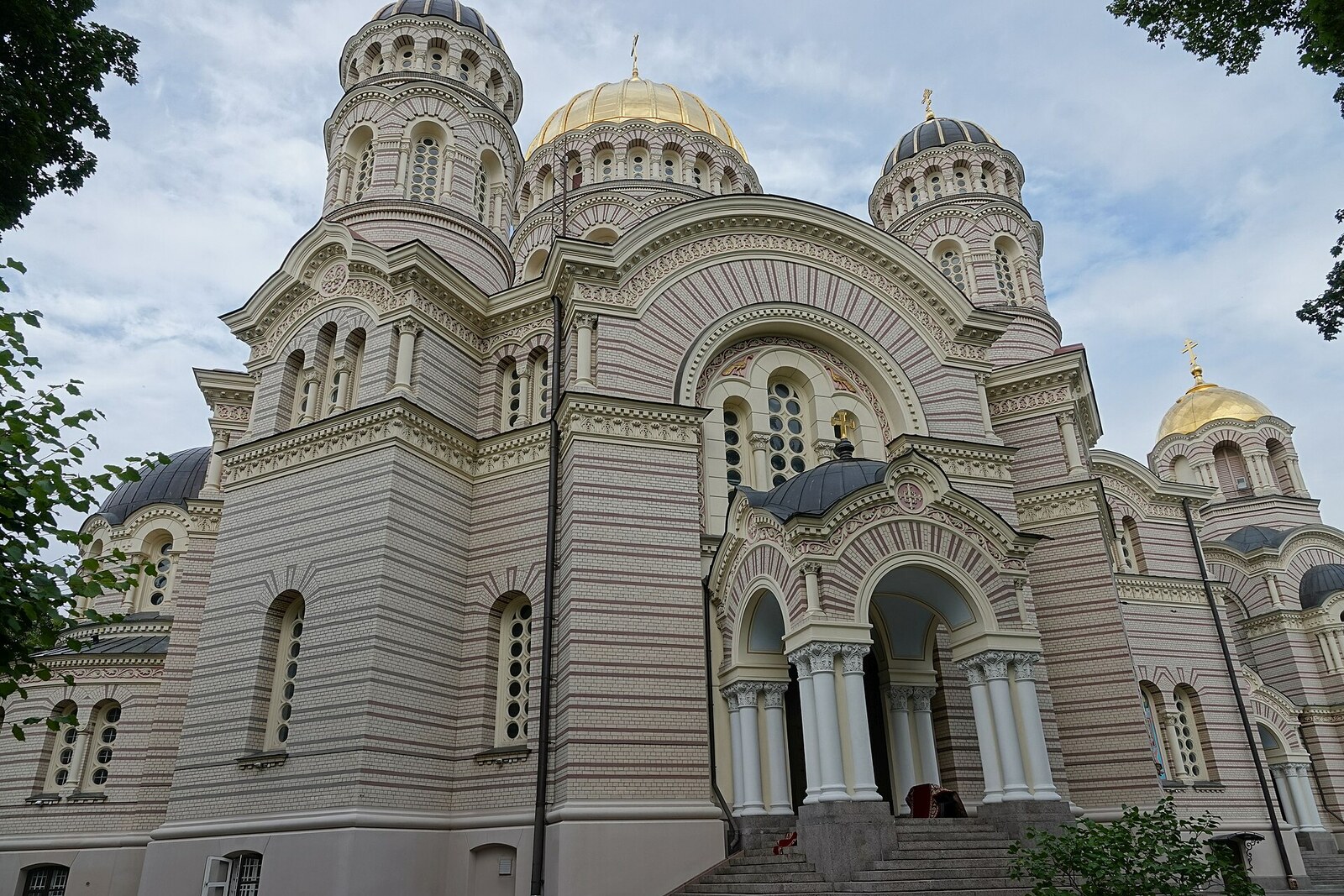
Look around first
What to notice
- Gilded domes
- Bell tower
- Main entrance
- Reliquary containing the relics of John of Riga
The story of the place
The cathedral was built for Riga’s growing Orthodox community. The head of the local church serves here; that is what makes the cathedral a cathedral church. It was consecrated in eighteen eighty-four and dedicated to the Nativity of Christ. The gilded domes and bell tower remained in place even after the war, when the cathedral was being considered for conversion into a Lutheran church, a pantheon, or demolition.
On July twenty-fourth, nineteen twenty-one, Archbishop Jānis Pommers (John of Riga) finished a service in this cathedral, went down beneath the bell tower, and announced: “I will live here.” Local Orthodox parishes had invited him to lead a church whose rights and property remained uncertain in the young Republic of Latvia. Pommers himself was a Latvian, the son of a peasant, and was an Orthodox bishop; people expected him to secure recognition for a community many regarded as a remnant of the Russian Empire.
The cathedral was built for Riga’s growing Orthodox population and consecrated in eighteen eighty-four. It was dedicated to the Nativity of Christ—the Gospel event of Jesus’ birth. A church is called a cathedral because the head of the local church serves there. By the time Pommers arrived, the building had been damaged by war, had lost some of its icons and bells, and had not been used by Orthodox Christians for several years. Different futures for it were discussed: a Lutheran church, a pantheon, demolition. On the eve of Pommers’s arrival, the episcopal residence was transferred to the Catholic Church, and the Orthodox had no money for other housing.
A room beneath the bell tower, where dilapidated church utensils had been stored, was cleared out. Its small stove was repaired, and a second window frame was fitted into the narrow barred window beneath the ceiling. The cathedral treasury could not find funds for a full repair. In this damp semi-basement room, the archbishop received visitors, drafted petitions, and administered the parishes. By settling inside, he simultaneously occupied the vacant church and gained the opportunity to gather the surviving objects and oversee the repairs.
By Christmas of nineteen twenty-two, services were again held here every day. Pommers took part in drafting the church charter, but petitions alone proved insufficient. In nineteen twenty-five, he ran for the Saeima—the Latvian parliament—and won a deputy’s mandate. The following year, the Cabinet of Ministers approved rules that recognized the Orthodox Church’s self-government, legal-person status, and right to own property. After that, the parishes were able to receive state grants for repairs, and the Orthodox seminary in Riga resumed its work. Pommers was reelected twice more.
In nineteen thirty-four, the archbishop was murdered at his country residence by Lake Ķīšezers. The killers set the house on fire and destroyed his personal archive; the crime remains unsolved, so it cannot be attributed to particular opponents of Pommers. The archbishop was first buried at Pokrov Cemetery. In nineteen oh one, the church canonized him under the name Jānis Pommers (John of Riga), a hieromartyr, and two years later his remains were moved here.
Today, a reliquary containing his relics stands inside the cathedral. The man for whom there was no room here above a basement window returned to this very church as its local saint.
Useful on site
An active church; check services, interior access, and photography rules on site or before your visit.
Checked: June 26, 2026. Check the official source before visiting.You may enter only in accordance with the active church schedule. Keep quiet during a service; do not regard viewing the interior as a guaranteed part of the route.