 Guide On Map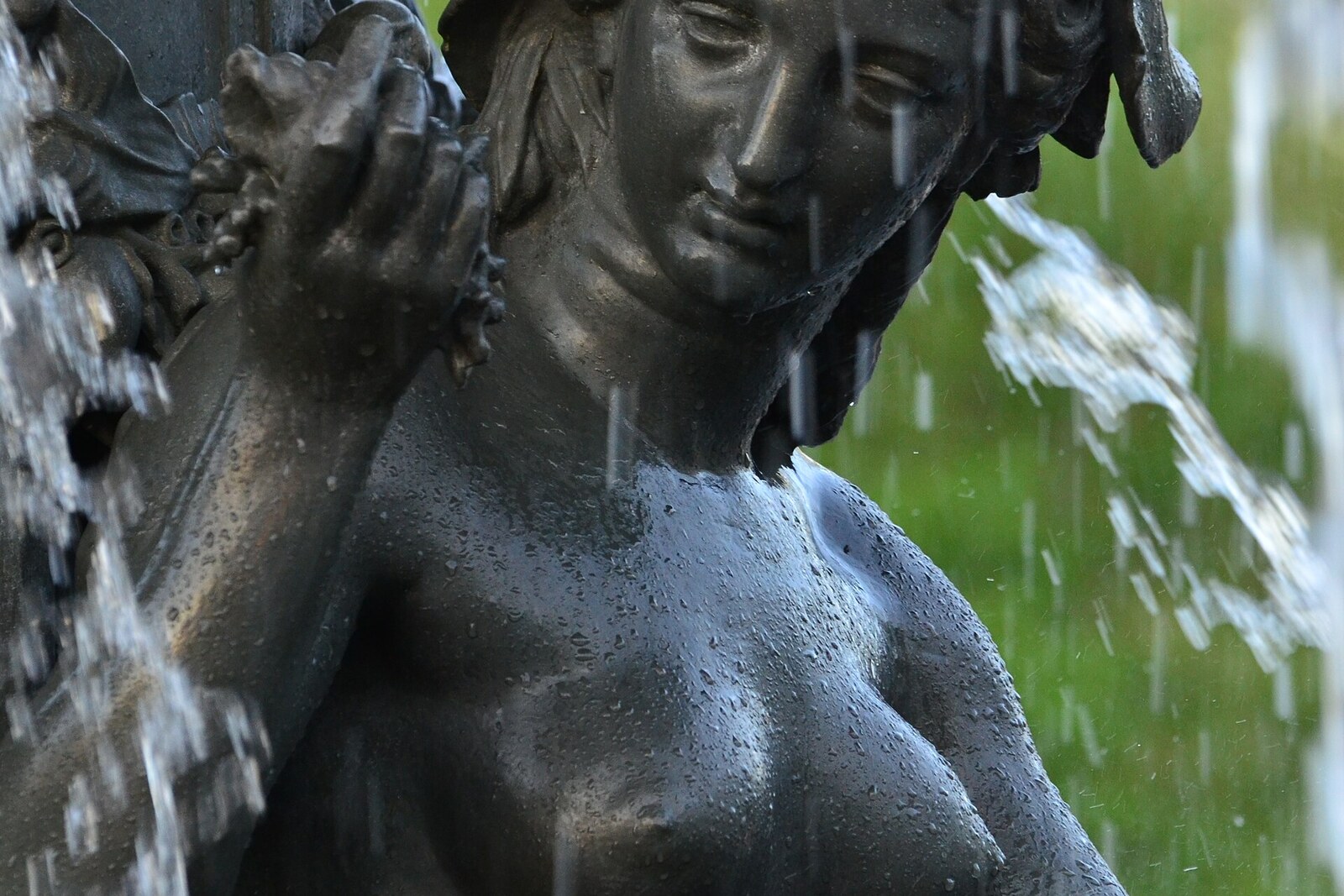
Look around first
What to notice
- Four seated figures
- Cast-iron rocks
- Tiers of basins
- Ring of jets
The story of the place
Four mythological figures sit on the lower tier, cast-iron rocks rise between them, and jets spray around the basins. This is how a French urban fountain of the nineteenth century is arranged, one of a pair once installed at the ends of a Bordeaux promenade avenue. There, it marked the completion of a new spring-water supply system, although no one used it for water; its name preserved that of the Marquis de Tourny, under whom Bordeaux dismantled its walls and laid out broad streets.
In the early two thousands, Peter Simons, a fifth-generation representative of the owners of a Québec department-store chain, came to the Saint-Ouen flea market in Paris looking for old wooden beams for a store. At an antique dealer's, he found something else: parts of a seven-meter cast-iron fountain. Some figures stood separately, the details had rusted, and four large elements were missing. Simons imagined this heap reassembled—right in front of the Parliament Building.
The fountain was made in France after a model by the sculptor Mathurin Moreau. In eighteen fifty-seven, municipal councilors in Bordeaux installed two such fountains at the ends of a long promenade esplanade. The city had just completed a new spring-water supply system; the fountains were meant to mark the event, although they themselves served as decoration.
They took the name de Tourny from the esplanade. Louis-Urbain-Aubert de Tourny, the Marquis de Tourny, was intendant of Guyenne—a king-appointed head of the provincial administration. From seventeen forty-three to seventeen fifty-seven, he worked to rebuild cramped Bordeaux: under him, the city walls were dismantled, six new gates were built, squares were laid out, and broad streets were created. One of the promenade avenues he created was named in his honor. The marquis himself died almost a century before the fountains appeared there and never saw them.
By the middle of the twentieth century, the internal fittings of both fountains had rusted. A residents' association proposed removing them, repairing them, and returning them to the promenades. The city council chose another project: to widen the roadway and add space for cars. In the minutes of a meeting in nineteen sixty-one, the councilors made provisions for moving the neighboring statue of Gambetta, but did not even discuss the fountains. They were dismantled and sold separately.
The future Québec City fountain ended up on a private estate. The owner placed the four mythological figures from the lower tier around the garden as independent statues; the remaining parts were stored separately. Later, the set reached an antique dealer in Saint-Ouen and waited several decades for a buyer.
Simons was looking for a gift for Québec City on the city's four hundredth anniversary. His family store had operated here since eighteen forty, and he considered the fountain's purchase a gesture of gratitude to the townspeople who had supported the business of five generations. The family paid about four million Canadian dollars for the acquisition, transport, restoration, and assembly.
Antoine Amarger, a Parisian restorer of metal sculpture, was tasked with reconnecting the scattered parts. The missing elements had to be remade. The fountain was then transported across the Atlantic and kept for two years in a hangar on Île d'Orléans while pumps and filters were installed beneath the roundabout on Avenue Honoré-Mercier. City services and the Simons family chose this exact site: French sculpture from the nineteenth century was to stand opposite the Parliament Building from the same era.
On July third, two thousand seven, Peter Simons turned on forty-three jets here. Cast-iron rocks can now be seen between the four seated figures of the lower tier. The Bordeaux pieces had been lost; the ones standing in front of the Parliament Building were remade by Amarger during the fountain's assembly.
Useful on site
The square is accessible around the clock. The fountain's water feature is usually turned off from about November to April; in the cold season, it is an exterior viewing of the cast-iron sculpture without jets.
Checked: June 30, 2026. Check the official source before visiting.Stand where the composition can be seen in full: up close, the water makes it difficult to judge its size. An exterior viewing is enough for the story.