 Guide On Map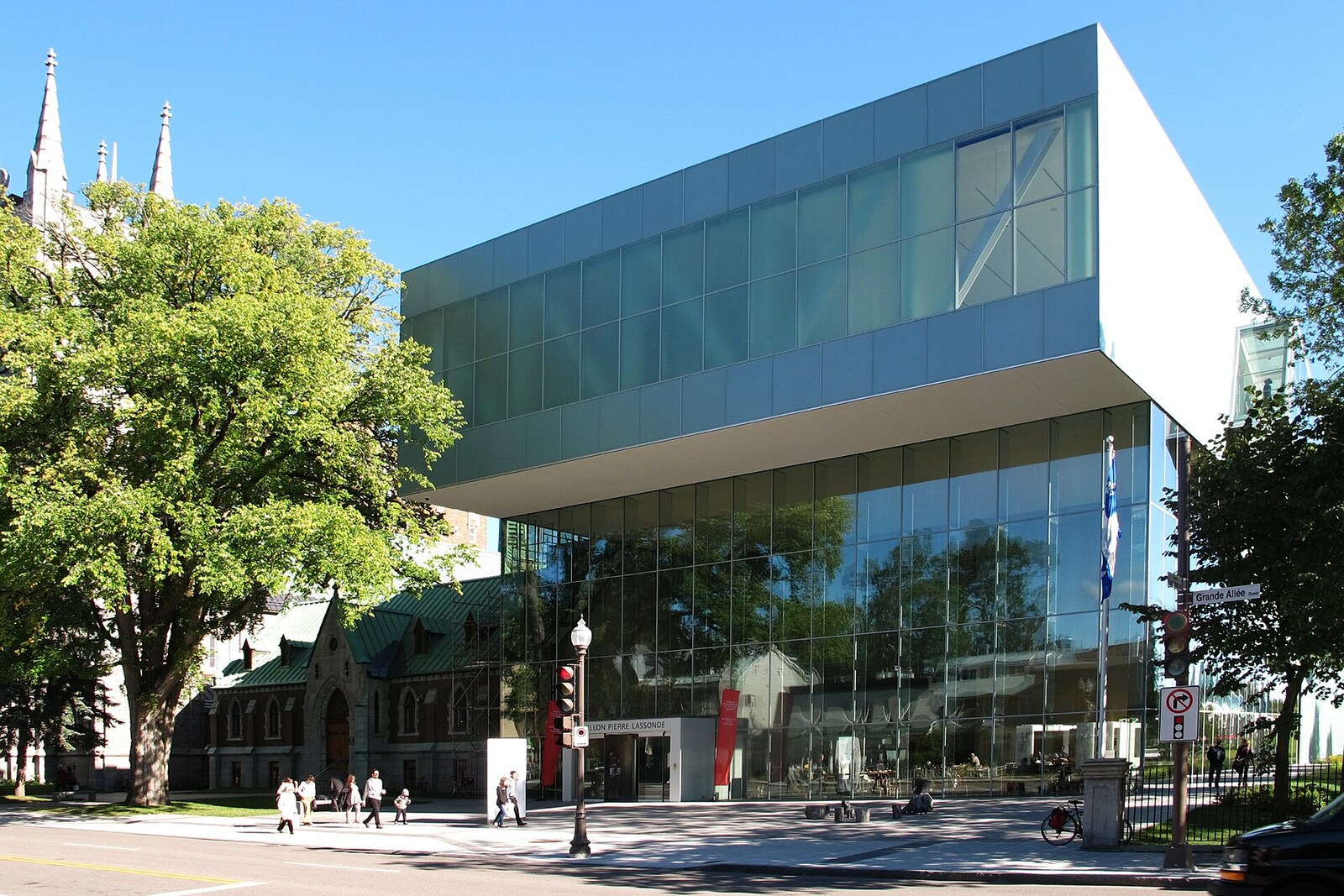
Look around first
What to notice
- Glass entrance building
- Stone pavilion
- Neoclassical facade
The story of the place
When today's National Museum of Fine Arts of Québec opened under the name Musée de la Province de Québec, its rooms were assigned at once to archives, natural history, and art. At first, the art rooms stood alongside two entirely different collections; now the museum's holdings include more than forty-two thousand works of Québec art from the seventeenth century to the present day. Behind the glass entrance extension, the stone building with its Neoclassical facade remains—the old core of the museum.
Behind the glass entrance building stands a stone Neoclassical pavilion from nineteen thirty-three. It was there, on June twelfth, nineteen forty, that Alfred Pellan, a Québec modernist artist, first showed one hundred sixty-one of his works in his homeland.
The province had once paid for the first Québec visual-arts scholarship. Pellan left to study in France and lived there for fourteen years. In nineteen thirty-six, he returned briefly and tried to obtain a teaching position at the School of Fine Arts in Montréal. He needed a steady income, and the school needed a new teacher. A member of the selection committee, the acclaimed landscape painter Clarence Gagnon, considered Pellan's style too radical and said, “You are modern—you are doomed.” Pellan was not accepted.
He continued his career in Paris. Then the German invasion of France forced him to leave urgently. His paintings were shipped across the Atlantic on a vessel, but at home the artist found himself in an environment where his Cubist and Surrealist experiments were still unfamiliar to many, and they sold poorly.
At the time, this institution was called the Musée de la Province de Québec. It had opened only seven years earlier and divided its rooms among provincial archives, natural history, and art. With the support of member of parliament Henri Groulx, Pellan obtained exhibition space here and selected the works himself, covering almost his entire Paris period: paintings, drawings, gouaches, and watercolors.
The exhibition gave the Québec public a chance to see local modernism on a scale that had not existed here before. Critics spoke of a turning point in familiar ideas about painting; artists who were already trying to move beyond academic rules received a publicly recognized example. Three years later, that same school in Montréal did hire Pellan after all. He gained a steady income and began teaching students to seek their own style. By the end of his teaching career, the school's environment had become noticeably freer.
Today, the museum preserves more than forty-two thousand works of Québec art, from the seventeenth century to the present day. Its collection also retains Flowers and Dominoes—a painting Pellan brought from his disrupted life in Paris and exhibited in this stone pavilion in the summer of nineteen forty.
Useful on site
Summer schedule through September 7, 2026: Mon–Tue 10:00–17:00, Wed 10:00–21:00, Thu–Sun 10:00–17:00. As of the verification date, the Pierre Lassonde Pavilion is open; the Gérard-Morisset and Charles Baillairgé pavilions are closed for preparation and construction of the Riopelle space.
Checked: June 30, 2026. Check the official source before visiting.Compare the architectural periods of the complex from outside. The preserved cells and artworks are inside, and the availability of the pavilions, including the Riopelle space under construction, should be checked before visiting.