 Guide On Map
A Royal Perspective: from the Louvre to Place de la Concorde
From Cour Carrée through Place du Carrousel and Tuileries Garden to Place de la Concorde
Guide On Map on your phone
Open the walk like a regular app
It takes about 10 seconds to install. No app store needed.
The whole path
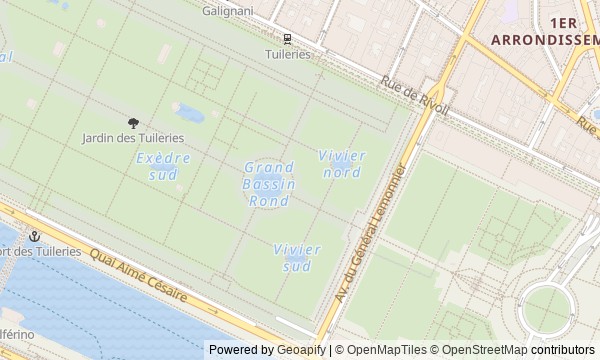
Route map
About the walk
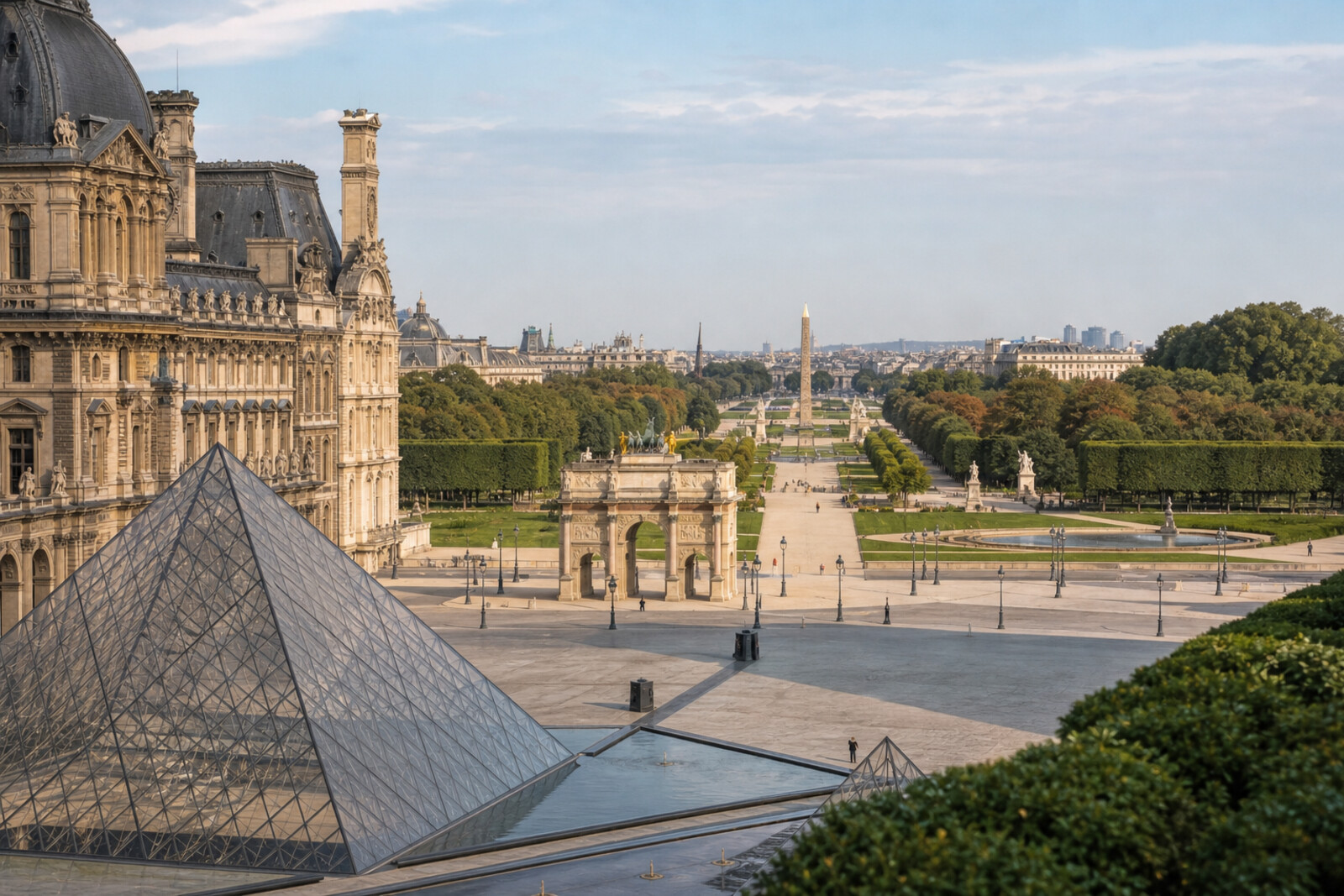
You will begin inside the Louvre, in the enclosed Cour Carrée. Then you will walk toward the glass pyramid, cross Place du Carrousel, and enter Tuileries Garden. The way will keep opening out: from stone façades to flower beds, a broad avenue, water, and Place de la Concorde.
This will be a walk through ceremonial Paris, with its vanished center. Between the Louvre and the garden, an empty space will remain where a palace once stood. Through it, the whole straight line becomes easier to see.
The stories will not be royal biographies, but decisions and awkward moments. Why will the glass entrance first have to be shown at full scale? Why will gardeners be asked whether Parisians spoil the paths? How will four horses become a diplomatic problem?
The account will be calm and precise. It will separate the plan from what came of it. By the end, you will be able to read the way from the Louvre to the obelisk as a sequence of losses, alterations, and other people's corrections to a royal plan.
Why this order
Cour Carrée begins the route inside the old royal residence: the western passage leads straight to the Louvre Pyramid, where the Louvre gained its new shared entrance. Beyond it, the Arc de Triomphe du Carrousel continues the palace line and shows how Napoleon I folded his victories into the approach to Tuileries Garden. Just beyond the arch, Jardin du Carrousel occupies the site of the former ceremonial courtyard and vanished palace; this is where the open break between the Louvre and Tuileries Garden becomes clear. From the parterres, the route runs into the Grande Allée: palace grounds become a public walk. The avenue leads to the Octagonal Basin, which completed the perspective calculated from the palace while also carrying it beyond the garden. Only then does Place de la Concorde become the finale: along the continuation of the same straight line, the royal plan meets the revolutionary changing of names and monuments.
Those who want to understand familiar ceremonial Paris through its transformations Those who care about the human decisions behind architecture Those who enjoy direct routes with a dense historical narrative
Those looking for a detailed tour of the Louvre's galleries Those who want a walk only through contemporary Paris Those who prefer a light overview without courtly and revolutionary stories
Before you go
The route stays outdoors, but access to the courtyards and garden is sometimes restricted because of security, events, or weather—check official Louvre and Tuileries Garden notices before setting out. Visits to the Louvre and Musée de l'Orangerie are not part of the walk: if you want to go inside, plan that separately. Choose shoes suited to stone and gravel, and bring water plus protection from sun or rain. Charge your phone beforehand: in the open sections, it is not always convenient to stop for long.
When to go
In the morning, it is easier to take in the façades and sculptures without dense crowds; closer to evening, softer light brings out the garden's perspective and reflections in the water. At a hot midday, the courtyards, Grande Allée, and Place de la Concorde feel especially exposed, so take breaks in available shade and do not put off drinking water until the end of the route.
Backup plan
If a particular courtyard or part of the garden is closed, do not try to pass through barriers: skip the inaccessible stop and continue along the permitted pedestrian paths beside the complex. You can listen to the story from the nearest point where the relevant façade, monument, or line of perspective is visible. In heavy rain, wind, or heat, it makes sense to split the walk after Jardin du Carrousel and return to the avenue later. Do not treat museum interiors as automatic shelter: separate entry rules and visitor arrangements apply.
Route conditions
Surface. Unpaved — 1.1 km; paved — 584 m
Stairs. Flights: 1, 67 m in total
Access. Wheelchair — no; stroller — limited (stairs)
Facilities. Toilets — 18; drinking water — 7
Elevation. Ascent — 7 m; descent — 23 m
OpenStreetMap extract of June 25, 2026: database data, not a check on the ground. Data © OpenStreetMap contributors, ODbL licence
Walk plan
Open in maps ↗- 1
Cour Carrée
This is where the story begins of how one successful farce restored a provincial troupe's place in Paris. - 2
the Louvre Pyramid
The full-scale mock-up helps explain why the debate over glass was a debate over the museum’s entire new arrangement. - 3
Arc de Triomphe du Carrousel
The return of the bronze horses will show how a victory monument outlived the defeat of the man who commissioned it. - 4
Jardin du Carrousel
Two days of courtly contests will link the Fronde, a royal celebration, and the centuries-long disappearance of the flower beds. - 5
Grande Allée
A dispute between a superior and a subordinate will explain why the royal garden remained a place for Parisian walks. - 6
Octagonal Basin
The difference in size between the two basins will reveal the perspective calculation made for a vanished palace window. - 7
Place de la Concorde
The fate of two relatives shows why the square’s conciliatory name became the Revolution’s family denouement.
Route features
Everything you need stays in the browser
Progress, saves and your trip plan are stored on this device.
Add Guide On Map to your home screen so the walk opens outside the browser.
How we handle sources, maps and corrections: our editorial standards