 Guide On Map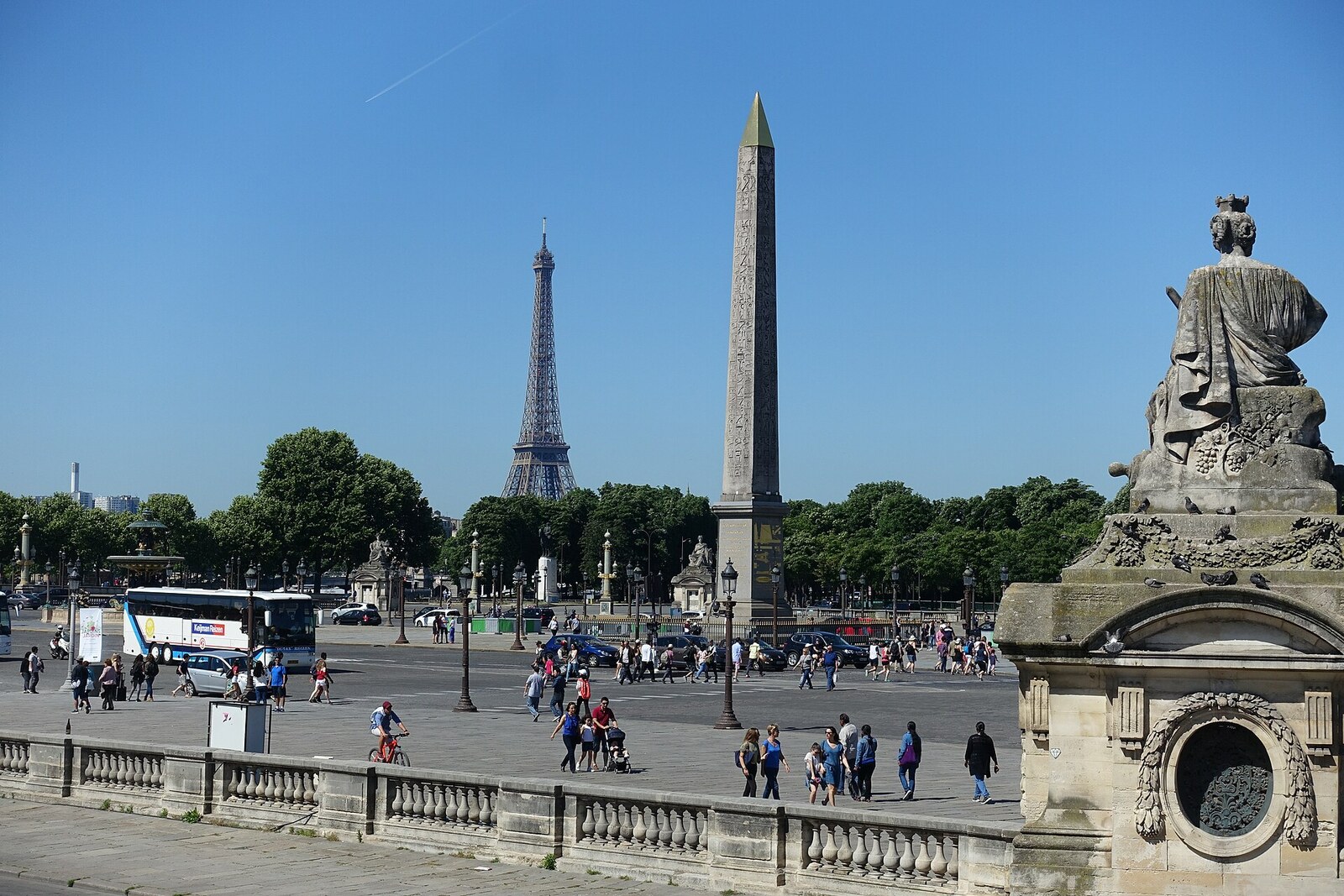
Look around first
What to notice
- The Luxor Obelisk
- The figure of Rouen
- Stone figures of French cities
The story of the place
The city authorities created a vast open space here around an equestrian statue of the monarch to mark his recovery from a serious illness. The bronze figure was later pulled down and sent to be melted down, while the square’s name changed along with changes of power in France. The Luxor Obelisk now occupies its center, while stone allegories of French cities, including Rouen, stand around its edges. The name Concorde was restored to the square as a sign of reconciliation after the revolutionary years.
At the western edge of the square, roughly in front of the stone figure personifying Rouen, a scaffold for Louis XVI stood on the morning of January twenty-first, seventeen ninety-three. The execution did not take place beneath the present obelisk: for the former king, the guillotine was moved to the other side of the square.
The choice was deliberate. In the middle of the eighteenth century, the Paris municipal authorities commissioned an equestrian statue of Louis XV to mark the king’s recovery from a serious illness. A huge open square was laid out around the monument and named after the monarch. After the storming of the nearby Tuileries Palace in August seventeen ninety-two, the monarchy was abolished. Revolutionaries pulled down the statue of Louis XV and sent the bronze to be melted down, and the square was renamed Place de la Révolution. A crowd of many thousands could fit here, and executing the king at a site created to glorify his grandfather made it possible to turn the sentence into a public event.
By then, Louis XVI was a prisoner in the Temple Tower and was seeking acquittal. He was tried by the National Convention—an elected assembly that abolished the monarchy and proclaimed the republic. The deputies charged the former king with conspiring against public liberty and the security of the state. The evidence included an attempted escape from the country and secret dealings with foreign courts.
The verdict was delivered by roll call: each deputy stepped up to the tribune, and the public learned how he had voted. Of the seven hundred twenty-one present, three hundred sixty-one voted for immediate death—exactly one vote more than half.
Among them was Philippe, Duke of Orléans, Louis’s cousin and a deputy to the Convention. Before the Revolution, he had been one of France’s wealthiest noblemen; his income came from family estates and the commercial galleries of the Palais-Royal, which he rented to shopkeepers. After the fall of the monarchy, Philippe sought to be regarded as a republican deputy rather than a possible claimant to the throne. At his request, the Paris Commune gave him and his descendants the surname Égalité—Equality. During the vote, he declared that he was guided by his duty as a deputy and demanded death for his relative.
The next day, Louis was brought here from the Temple Tower. At ten twenty-two, the blade of the guillotine fell. In the following months, the executioners moved the machine closer to the Tuileries Garden and left it there for almost a year: more than a thousand people were executed on Place de la Révolution.
Voting for the king’s death did not spare Philippe Égalité from suspicion. In the spring, his eldest son Louis-Philippe, a general in the republican army, crossed the front line with the mutinous commander Dumouriez to the Austrians. The deputies ordered the arrest of members of the Bourbon family as hostages. Philippe reminded the Convention of his loyalty to the republic and demanded respect for his status as a deputy, but he was sent to prison. On November sixth, seventeen ninety-three, the Revolutionary Tribunal accused him of seeking to take the throne. The sentence was passed and carried out on the same day—on this very square.
After the Terror, the Directory, the new republican regime, gave the square the name Concorde in seventeen ninety-five, intending to mark the reconciliation of the French. Later, the restored Bourbons again dedicated it to kings and planned to erect a monument to Louis XVI at its center. After the Revolution of eighteen thirty, Louis-Philippe—the son of the executed Philippe Égalité—became King of the French. Under him, the square was definitively given back the name Concorde, the monument project was abandoned, the Luxor Obelisk was raised at its center, and allegories of French cities were installed around its edges.
No exact trace of Louis XVI’s scaffold has survived. Its location is indicated only approximately—in front of the figure of Rouen, which appeared here only under Louis-Philippe, the son of the deputy who voted for the king’s death.
Useful on site
An open city square; routes may change because of traffic, work, and events.
Checked: date not specified. Check the official source before visiting.Because of the heavy traffic, stay in pedestrian areas and use only crossings. It is best to view the square’s full composition from a distance, without trying to approach every detail.