 Guide On Map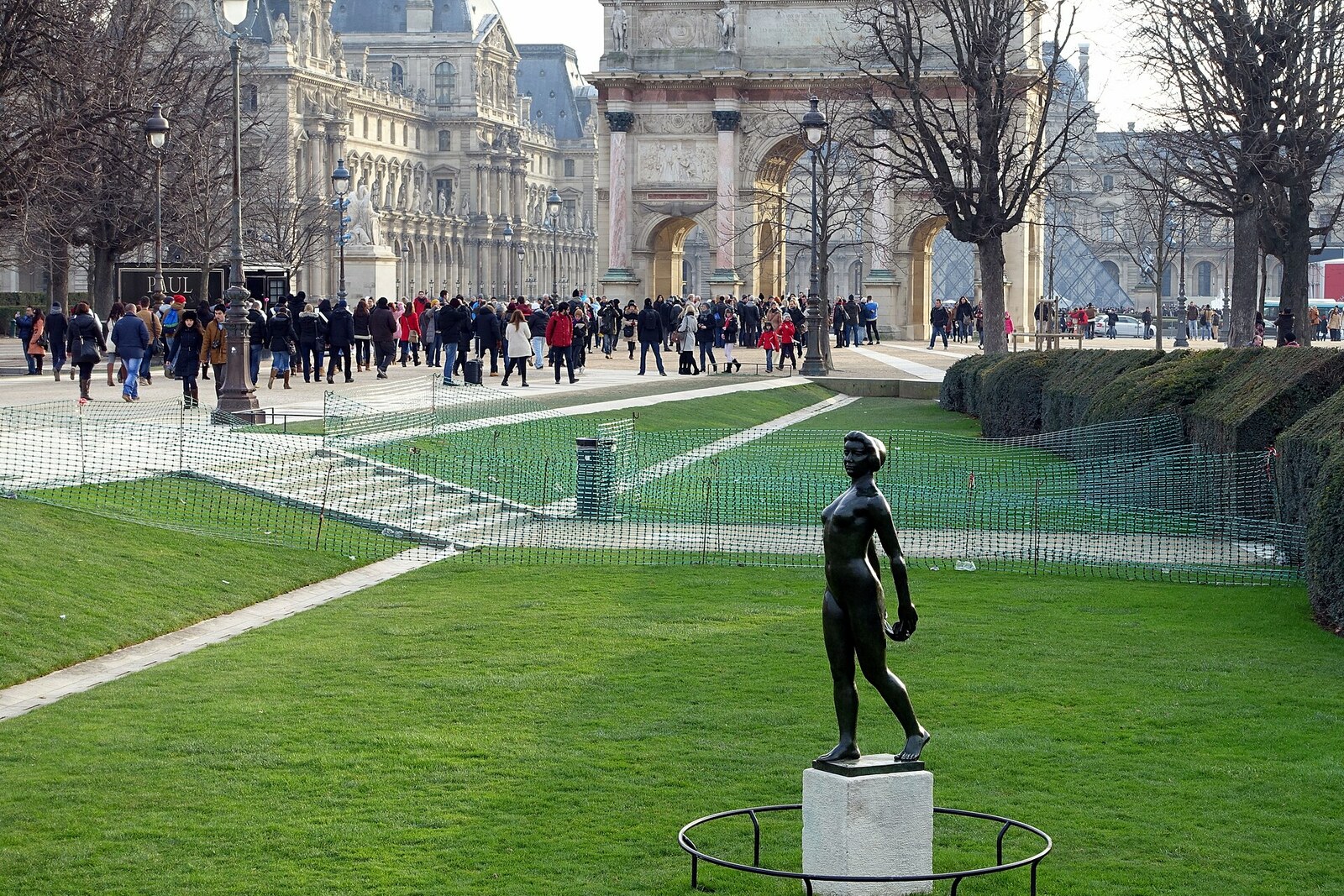
Look around first
What to notice
- Lawns and hedges
- Sculpture platforms
- Open passage between the pavilions
The story of the place
The present garden occupies the former courtyard of Tuileries Palace: the palace once stood across this space, between Pavillon de Flore and Pavillon de Marsan. After its demolition, parterres were laid out again on the strip that had been cleared, and at the end of the twentieth century the garden was redesigned once more. That redesign left behind the even lawns, clipped hedges, and sculpture platforms. The open passage to Grande Allée runs where the palace walls divided this space in two.
The green lawns appeared on the site of a garden that had once already been torn up for two days of equestrian contests. In sixteen thirty-eight, flower parterres were laid out here for Anne Marie Louise d'Orléans—a cousin of Louis XIV, heiress to a vast fortune, and resident of Tuileries Palace. At court, she was called La Grande Mademoiselle.
She intervened in the Fronde—an armed struggle of the nobility and Paris against the royal government during Louis's childhood. On July second, sixteen fifty-two, La Grande Mademoiselle ordered the Bastille's cannons to fire on the royal troops and saved the army of the Prince of Condé, whom she hoped to marry. Louis sent his cousin into exile at her Saint-Fargeau estate. Five years later, she was allowed to return to court.
The Prince of Condé paid a higher price. This military commander led part of the rebel nobility, then went over to the Spaniards and fought against France. He was able to return home only after receiving the king's pardon. All this is necessary to understand the composition of the participants in the celebration for which La Grande Mademoiselle's garden was destroyed.
After the death of his chief minister, Cardinal Mazarin, twenty-three-year-old Louis began to rule independently. His first son was born, and the king decided to celebrate the heir's arrival with the Grand Carrousel. In the seventeenth century, this was the name for a courtly equestrian contest: riders struck wooden and papier-mâché heads with lances and, at full gallop, tried to hit a suspended ring with the point.
The flower beds before the palace were torn up, grandstands were built, and the jousting ground was enclosed. On June fifth and sixth, sixteen sixty-two, a procession of about thirteen hundred riders entered here. Between ten and fifteen thousand spectators took their places in the stands, at the windows, and on the palace roofs.
The participants were divided into five quadrilles representing peoples as court artists imagined them. Louis led the Romans and rode out in a costume embroidered with gold and silver and set with rubies. The Prince of Condé was assigned the quadrille of Turks. Only recently, he had commanded troops against the king; now, after months of rehearsals, he followed the route set by the king and took part in contests organized by him. Condé would regain command of the French army only six years later.
Louis himself prepared for several months, yet did not win a single race. The prizes went to other riders. After the celebration, royal craftsmen produced dozens of engravings and a detailed official description, and the site came to be called the Carrousel courtyard. The flower beds were not restored: for several centuries, the ceremonial courtyard of Tuileries Palace remained here.
The garden returned after the palace itself disappeared. In May eighteen seventy-one, Jules Bergeret, the military leader of the Paris Commune, organized the burning of Tuileries Palace. The palace burned out, Bergeret fled France, and he was sentenced to death in absentia. The ruins stood for another twelve years, until the National Assembly voted to demolish them.
For the eighteen eighty-nine World's Fair, architect Edmond Guillaume laid out parterres here again. The present lawns, hedges, and sculpture platforms appeared after another redesign by Jacques Wirtz and his son Peter in the early nineteen nineties. Between Pavillon de Flore and Pavillon de Marsan, where the passage to Grande Allée is now open, Tuileries Palace stood across this space until eighteen eighty-three.
Useful on site
A free garden operating on Tuileries Garden hours; check the Louvre's current hours before your walk.
Checked: date not specified. Check the official source before visiting.Listen from the path and do not go beyond the plant barriers. The sculptures are outdoors, so no reservation is required to view them.