 Guide On Map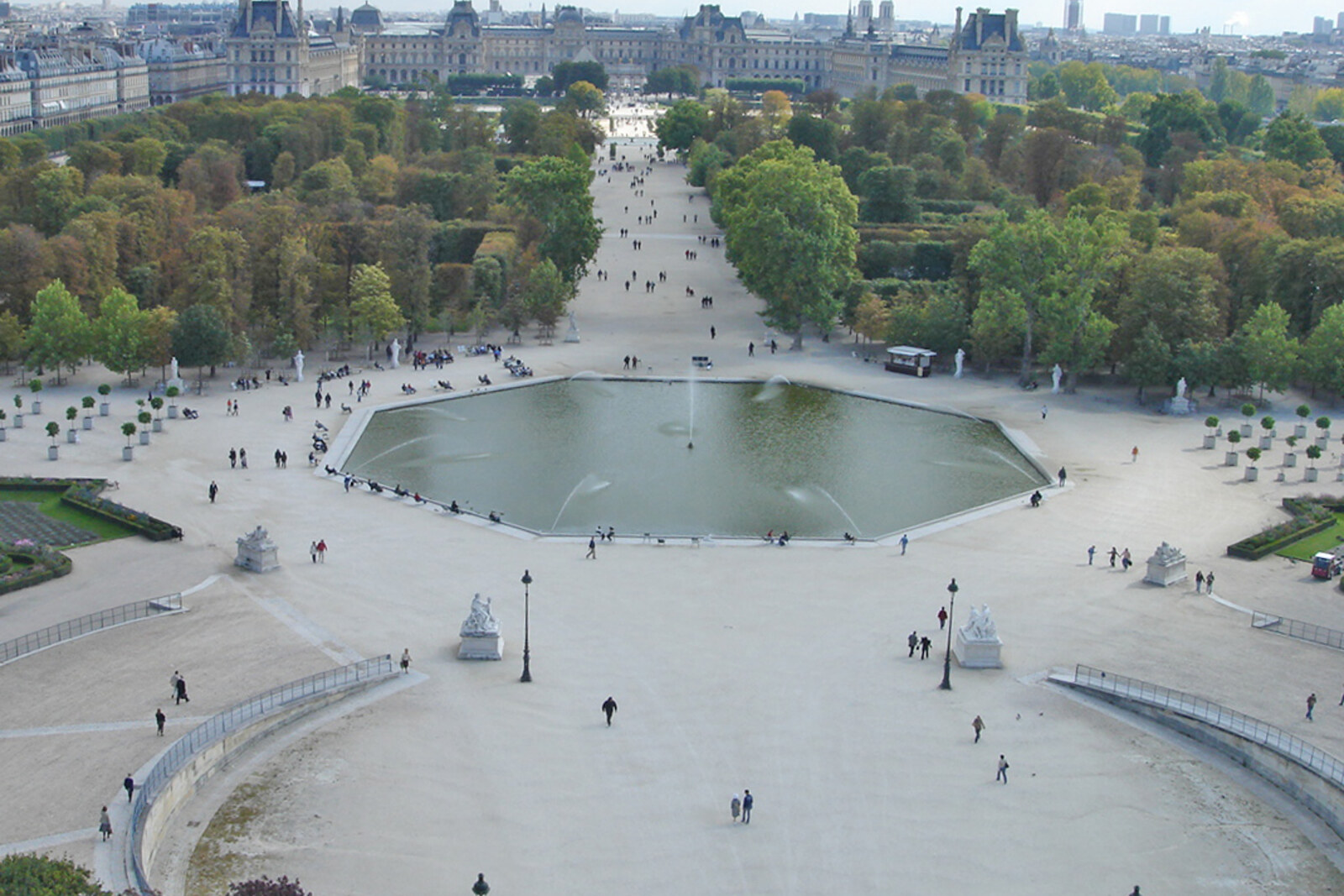
Look around first
What to notice
- The octagonal stone edge
- The water surface
- The horseshoe-shaped ramps
The story of the place
Eight straight sides of the stone basin enclose the western Tuileries basin. Two horseshoe-shaped rises curve out at the sides: the formal garden ends here, while beyond it a tree-lined avenue continues toward Chaillot, giving rise to the Champs-Élysées. In sixteen sixty-four, Louis XIV and Jean-Baptiste Colbert began a major redesign of the garden, extending its far edge with a road beyond the palace grounds.
In sixteen thirty-seven, twenty-four-year-old André Le Nôtre received the right to inherit from his father the post of resident gardener of the Tuileries. His father and grandfather had also worked here; Le Nôtre himself was born in a house on the garden grounds. The Tuileries had provided his family with employment, housing, and an income long before he became famous for the gardens of Versailles.
From sixteen sixty-four, Louis XIV and his minister Jean-Baptiste Colbert commissioned Le Nôtre to redesign the garden. The principal viewer was considered to be the person at a window of Tuileries Palace. From there, the near and distant parts had to form a clear pattern, even though perspective inevitably made everything at the far end of the Grande Allée look smaller.
Le Nôtre corrected this with geometry. He made the far basin about twice as large as the circular basin by the palace. From the window, the two appeared comparable in size. Eight straight sides gave the western basin its present name, while two horseshoe-shaped ramps marked the boundary of the garden.
Le Nôtre did not stop the line at the water. Beyond the basin, his plan laid out a tree-lined road toward the hill of Chaillot—the future Champs-Élysées. The king gained a vista that extended beyond his garden; later, the obelisk, the Arc de Triomphe, and the Grande Arche de la Défense appeared along its continuation.
Le Nôtre died in seventeen hundred in his home at the Tuileries. The house disappeared. The palace from whose windows the illusion of distance was calculated burned in eighteen seventy-one, and its remains were dismantled. It is now impossible to check the original effect from the intended vantage point.
Right at its edge, the optical correction looks like an immense expanse of water. Since the end of the nineteenth century, small sailboats have been launched on it. And near the entrance from Place de la Concorde, in a blind arch beneath the terrace, stands a bronze bust of Le Nôtre: the windows of his principal viewer have disappeared, while the basin calculated for them remains.
Useful on site
Part of the Tuileries Garden; open during garden hours, with possible event-related restrictions.
Checked: date not specified. Check the official source before visiting.The water is a convenient place to pause, but wind makes it harder to hear. The story does not require entering any buildings; a visit to Musée de l'Orangerie and its Claude Monet rooms is arranged separately.