 Guide On Map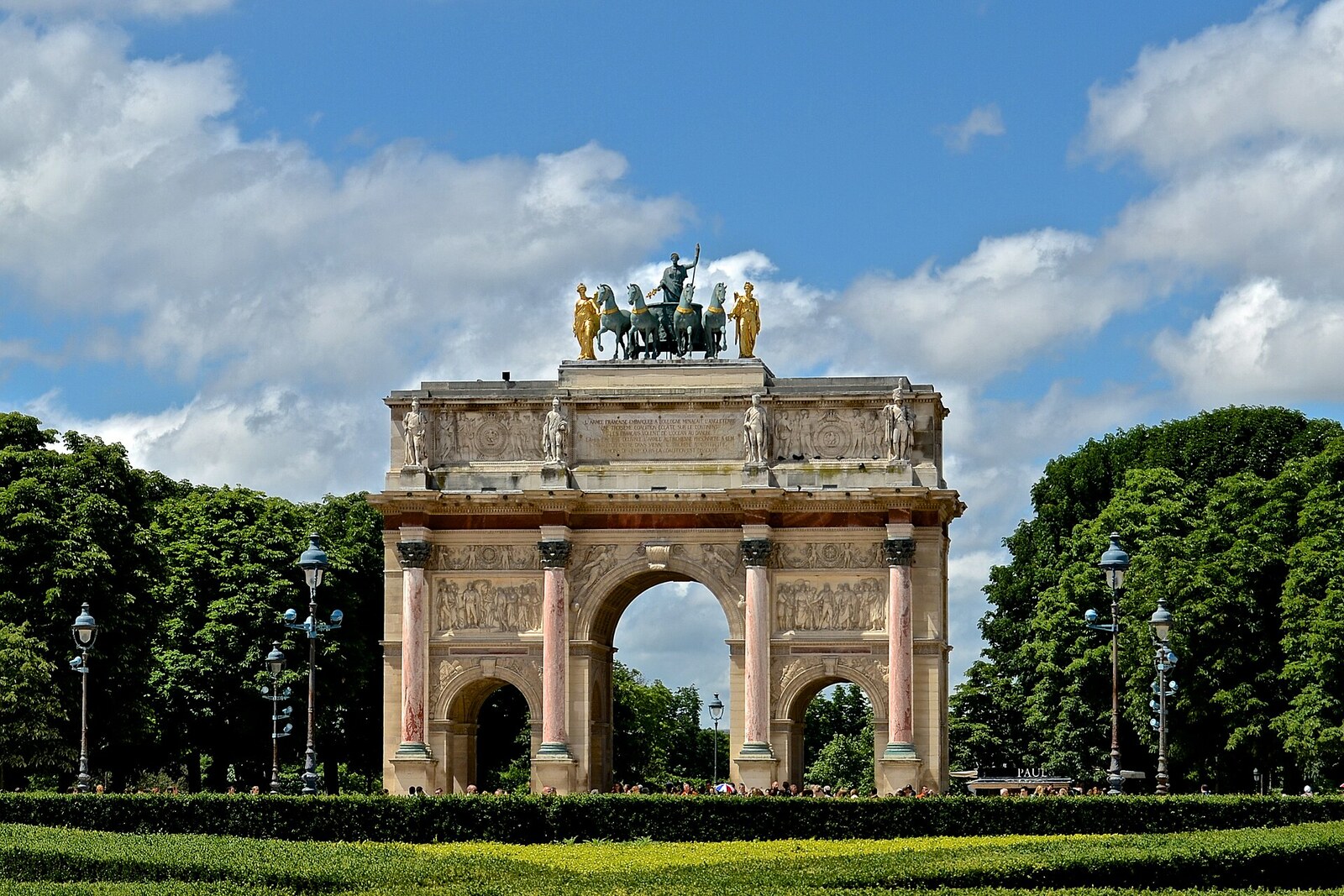
Look around first
What to notice
- Bronze quadriga
- Two winged figures
- Bas-reliefs on the façades
The story of the place
The Arc de Triomphe du Carrousel served as a ceremonial entrance to Tuileries Palace and at the same time as a monument to France's military victories. Reliefs on its façades show the capitulation of Ulm, the entry of French troops into Munich and Vienna, and Austerlitz; above them are two winged Victories. The structure is crowned by a bronze chariot with four horses and a female figure later called Peace.
The arch took its name from the square. On June fifth and sixth, sixteen sixty-two, twenty-three-year-old Louis XIV held the Grand Carrousel here—equestrian contests in honor of the birth of his son Louis, heir to the throne. For the tournament, the flower parterres in front of Tuileries Palace were destroyed and stands were erected.
The celebration was also meant to show the king's reconciliation with the French nobility. Shortly before, the Fronde had ended—a series of civil wars during which noble grandees had opposed the royal government. Now nearly thirteen hundred horsemen divided into costumed groups. Louis led the “Romans,” while the Prince of Condé, who had formerly commanded the rebel army, rode before Louis as the leader of the “Turks.” After the two-day spectacle, the former garden became the ceremonial courtyard of the Tuileries and kept the name Carrousel.
The four horses at the top of the arch came from another human story. Napoleon I ordered it built in eighteen oh six as a ceremonial gateway to Tuileries Palace and a monument to the victories of the Grande Armée. The bas-reliefs showed the capitulation of Ulm, the entry of the French into Munich and Vienna, and Austerlitz. Antique bronze horses from the façade of Venice's St Mark's Basilica were placed on top. French troops had taken them away after the conquest of Venice in seventeen ninety-seven. The spoils of war crowned the account of new conquests.
After Napoleon's defeat at Waterloo, the Allies demanded the return of the seized works. On September twenty-fifth, eighteen fifteen, two Austrian officers came to Dominique-Vivant Denon, director of the Musée Napoléon and one of the creators of the arch's decoration. Denon tried to prevent the dismantling of the imperial collection. He declared that the arch was a city monument and was not under his authority. When the officers asked for the architect's address, Denon replied that he had not known it for a year, then immediately recorded the conversation in a report.
This ruse brought only a delay. Austrian soldiers occupied the courtyard of the Tuileries and Place du Carrousel, while the British military engineer William Dumaresq directed the lowering of the horses. They were sent to Venice and raised again above the entrance to St Mark's Basilica. Napoleon was already sailing into exile on Saint Helena, and Denon soon left the museum.
The arch was stripped of some of its decorations, and there were plans to demolish it. Louis XVIII, the king of the House of Bourbon who had returned to the French throne, decided to preserve the imperial buildings and adapt them to glorify his dynasty. The sculptor François Joseph Bosio created a new quadriga—a chariot with four bronze horses. In the chariot stands a female figure embodying the return of the Bourbons to the throne; later, she came to be called Peace. Bosio placed a medallion with a portrait of Louis XVIII in her scepter.
After the revolution of eighteen thirty, the Napoleonic bas-reliefs were returned to the arch. Above them remained Bosio's horses, two winged Victories, and the scepter with the face of the Bourbon king. The original Venetian horses are in the museum of St Mark's Basilica. At the Carrousel, their place is taken by the quadriga commissioned to replace the trophy that Denon failed to keep.
Useful on site
Free outdoor stop; passage may change during events at the Louvre and the Tuileries.
Checked: date not specified. Check the official source before visiting.Walk around the arch on both sides: the details are distributed across the façades and the upper tier. Do not linger directly in the passageway, which pedestrians use constantly.