 Guide On Map
Île de la Cité: from Notre-Dame de Paris to the western tip
From Parvis Notre-Dame through the palace quarter to Square du Vert-Galant

Guide On Map on your phone
Open the walk like a regular app
It takes about 10 seconds to install. No app store needed.
The whole path
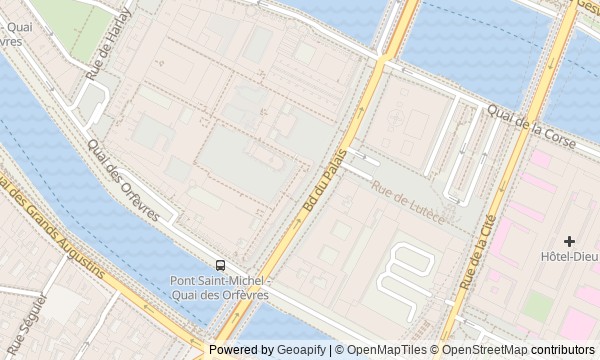
Route map
About the walk
You will cross Île de la Cité from east to west: from the square before Notre-Dame de Paris along the narrow streets of the canons, through the flower market and the palace quarter, to Pont Neuf and the low tip by the water.
The route will stay close to the Seine throughout, yet Paris will appear here not as a city of embankments, but as a tight piece of land that was enlarged, rebuilt, and joined to neighboring islets.
The stories will bring in a church threshold, hidden walls, keys to a casket, carnations with a note, and fabric that vanished from an entire bridge. You will see which versions are supported by documents and where only a legend or a disputed date remains. The tone will be calm and exact, without museum grandeur or ready-made heroic conclusions.
By the end, you will be able to point out where the cathedral quarter gives way to the royal palace, and where the old island becomes land added during the construction of Pont Neuf.
Why this order
You will begin by unpacking the church threshold of Notre-Dame de Paris. Behind the cathedral, Rue Chanoinesse will show who sustained the daily services and why church walls are now hidden inside residential buildings. From the canons’ quarter, you will reach the flower market: here the medieval church setting gives way to an urban space that was given a new name. Across Place Louis-Lépine, you will move on to the former royal palace. Sainte-Chapelle comes first, where you will learn what treasures the king gathered inside his residence. Then, at the Conciergerie, you will see what the same palace became after the monarchs left. Next, the palace’s northern façade will lead to Place Dauphine, where the island’s expansion made room for trade and an outdoor exhibition. Beyond two surviving pavilions, Pont Neuf opens up: the story will move from paintings in the square to an artwork the size of a bridge. The staircase by the equestrian statue descends to Square du Vert-Galant. Only there will it become clear that the western tip was assembled from earlier islets, and why the final story is older than both the bridge and the garden.
Those who want to see the history of Paris within a single island Those who care about human choices, documents, and the fates of objects Those who enjoy dense storytelling without ceremonial rhetoric
Those looking for an overview of all of Paris’s major symbols Those who need a walk without difficult episodes Those who prefer architectural analysis to historical stories
Before you go
Decide in advance whether you want to enter Notre-Dame de Paris, Sainte-Chapelle, and the Conciergerie: the stories work outside as well, but the interiors require separate time. For Sainte-Chapelle and the Conciergerie, check official entry conditions and available time slots; security screening is possible at the Palais de Justice. Bring headphones and shoes suited to stone paving. On Rue Chanoinesse and Place Dauphine, keep quiet and do not block entrances to residential buildings. Before descending to Square du Vert-Galant, assess the water level and the condition of the stairs.
When to go
Start in the morning if you want the cathedral square and old streets at their quietest. For a more striking finish, choose the second half of the day, when light falls on the Seine and the arches of Pont Neuf. Allow extra time for interiors beyond the walk itself.
Backup plan
If a line or security screening delays your entry, do not break the sequence: listen to the stop outside and continue the route, then save the interior for a separate visit. In rain, linger longer beneath the pavilions of the flower market and in sheltered parts of the square, but take care on wet stone. If the water is high or the descent is closed, do not go around the barriers at Square du Vert-Galant—finish the walk by the statue of Henry IV of France on Pont Neuf, where you can see the end of the island and both channels of the Seine.
Route conditions
Surface. Paved — 1.5 km (data covers 76% of the route)
Stairs. Flights: 1, 17 m in total
Access. Wheelchair — no; stroller — limited (stairs)
Facilities. Toilets — 7; drinking water — 9
Elevation. Ascent — 23 m; descent — 23 m
OpenStreetMap extract of June 25, 2026: database data, not a check on the ground. Data © OpenStreetMap contributors, ODbL licence
Walk plan
Open in maps ↗- 1
Parvis Notre-Dame
A church threshold connects a dangerous marital compromise with the return of the same groom, now King of France. - 2
Rue Chanoinesse
Walls hidden inside residential buildings will connect the street’s name with centuries of paid prayer. - 3
Queen Elizabeth II Flower Market
The market sign shows how a visitor's personal attachment became a rare municipal naming. - 4
Sainte-Chapelle
The fate of the relics reveals the chapel as a carefully guarded royal repository. - 5
Conciergerie
The failed escape leads from a prison cell to the rushed trial of the former queen. - 6
Place Dauphine
A street exhibition will explain how still life opened the way to the Royal Academy for a young master. - 7
Pont Neuf
Two weeks in fabric will show how many years of approvals were needed for a temporary work on an active crossing. - 8
Square du Vert-Galant
The finale will connect a vanished islet, the disputed date of an execution, and the ground of today’s garden.
Route features
Everything you need stays in the browser
Progress, saves and your trip plan are stored on this device.
Add Guide On Map to your home screen so the walk opens outside the browser.
How we handle sources, maps and corrections: our editorial standards