 Guide On Map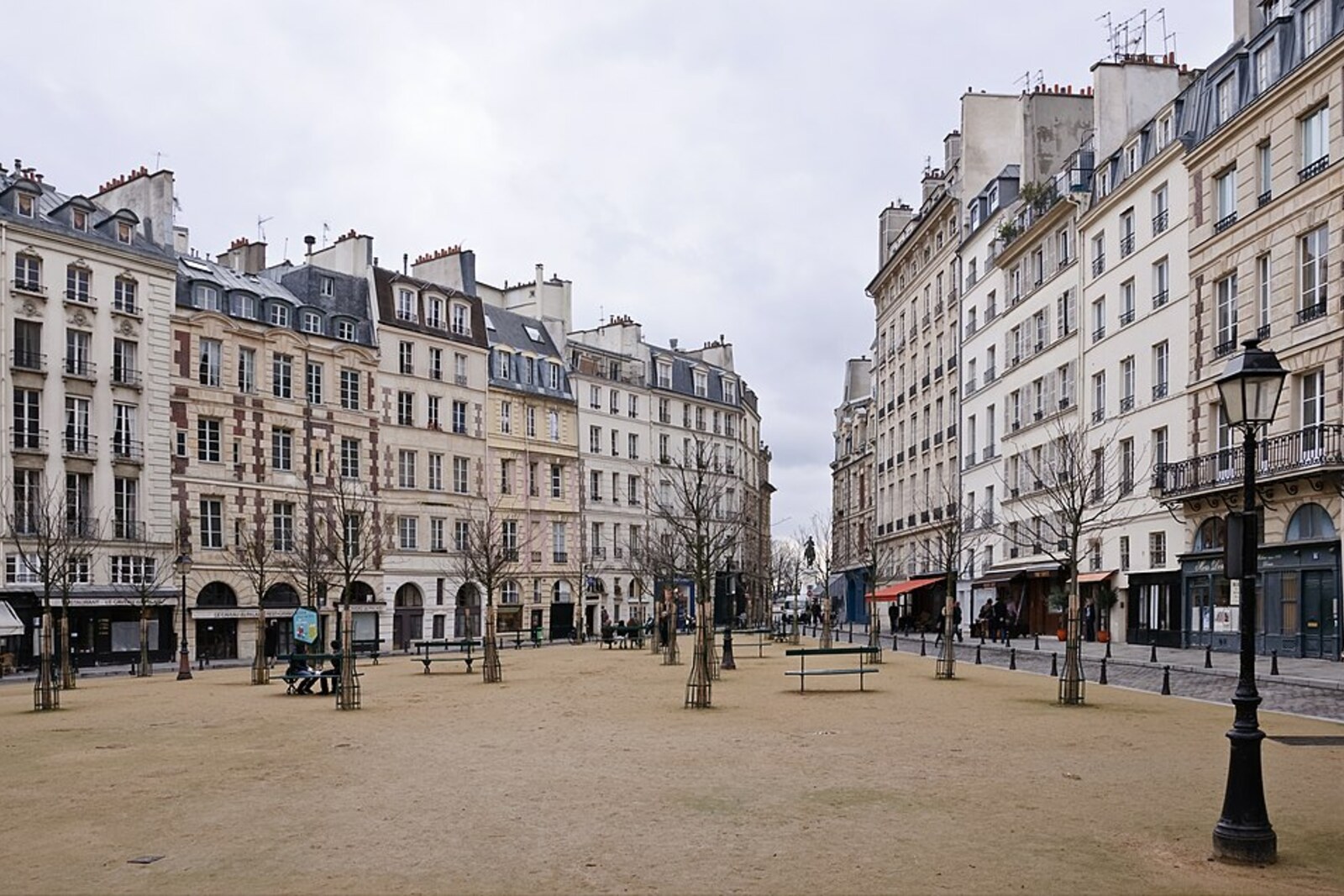
Look around first
What to notice
- The square's triangular outline
- Brick-and-stone pavilions
- The open passage on the side of the courthouse
The story of the place
In June seventeen twenty-eight, twenty-nine-year-old Jean-Baptiste-Siméon Chardin brought several paintings to Place Dauphine. The largest showed a split-open ray hanging up; fish, oysters, and leeks lay beside it, a copper pot stood there, and a cat was creeping toward the catch. The second still life was called The Buffet.
Chardin was the son of a craftsman and was already a master in the city's Guild of Saint Luke: this allowed him to earn a living as a painter. But he had not yet been admitted to the Royal Academy of Painting and Sculpture, which gave access to prestigious exhibitions and patrons. That was why the artist came to Place Dauphine.
Once a year, for the Catholic Feast of the Body of Christ, picture dealers stretched ropes at the exit toward Pont Neuf and hung works beside the carpets prepared for the religious procession. The exhibition of young artists lasted only a few hours; rain could postpone it for a week and then cancel it until the following year. For an artist without a place in the Academy, it was a rare chance to show paintings to the public and to the academicians who came out into the street to see the works.
Here, Chardin's still lifes caught the attention of members of the Royal Academy. A few months later, the artist presented them with the same The Ray and The Buffet. On September twenty-fifth, seventeen twenty-eight, he was unanimously admitted—immediately after the first review—as a master of “animals and fruits.” Still life was considered the lowest genre in the academic hierarchy, but Chardin gained the right to exhibit at the official Salon. He left both paintings to the Academy as payment for admission and proof of his skill.
The street exhibition could appear here thanks to the layout of the square itself. In sixteen oh seven, King Henry IV granted a plot at the newly formed tip of the island to Achille de Harlay, head of the Parlement of Paris—the capital's highest court. De Harlay was to divide the land into lots and surround the open triangle with houses whose uniform facades had been prescribed by the king. Commercial premises occupied the ground floors, while the proximity of the law-court palace and Pont Neuf ensured customers.
Place Dauphine was named after the son of Henry IV and Marie de' Medici. In France, the Dauphin was the heir to the throne; the Dauphin here was little Louis, the future Louis XIII. In the nineteenth century, a row of houses on the side facing the law-court palace was demolished, so the triangle is now open. The two brick-and-stone pavilions by Pont Neuf remain closest to the original design. The ropes with paintings between them are long gone, while The Ray and The Buffet, brought here by Chardin as a guild master, are now kept in the Louvre.
Useful on site
The square remains residential: listen from a bench or away from building entrances. The site of the bonfire is associated with the area around No. 26, but do not look here for an exact surviving boundary of the medieval sandbank.