 Guide On Map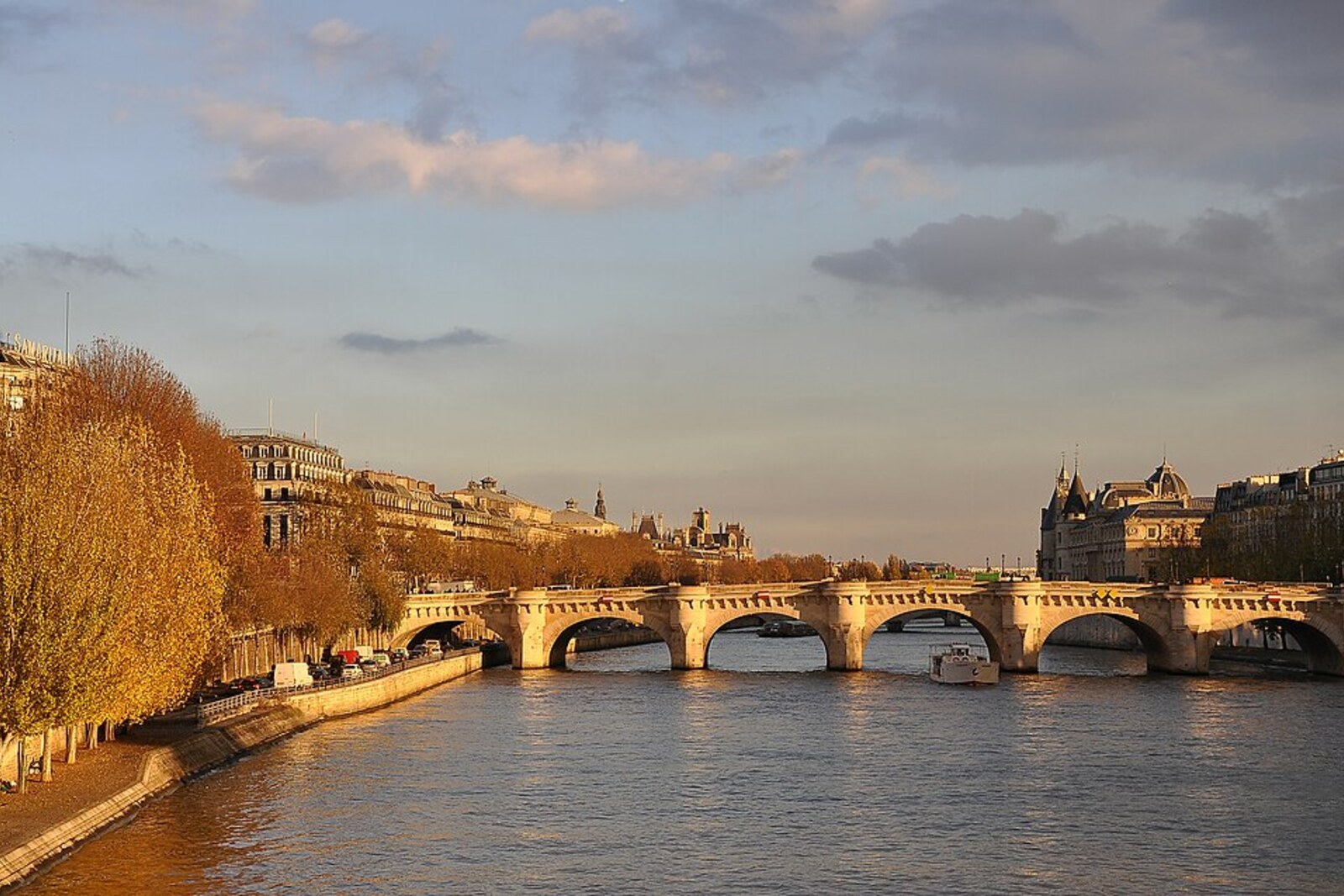
Look around first
What to notice
- Stone arches
- Open parapets
- Lanterns along the bridge
- Equestrian statue
The story of the place
In nineteen seventy-five, the artist couple Christo and Jeanne-Claude decided to cover Pont Neuf entirely with fabric, while keeping the bridge open to pedestrians and traffic. At first Christo considered Pont Alexandre III, but rejected it: its single arch spans from bank to bank, and its supports do not stand in the water. Pont Neuf has twelve arches over two branches of the Seine. The fabric could descend from the sidewalks to the very water and link both sections of the crossing over Île de la Cité.
Pont Neuf means “New Bridge.” It was built from fifteen seventy-eight to sixteen oh seven, and its very design was new. Houses stood on earlier Paris bridges: crossing the river resembled walking along a narrow street. Here, open parapets were left in place and sidewalks were laid out, separating pedestrians from carriages. This makes the stone arches, lanterns, and the edges of the island into one visible structure. It is now the oldest surviving bridge in Paris.
Draping an active crossing required the agreement of several authorities. Jacques Chirac, the Mayor of Paris, on whom work on the city sidewalks depended, initially refused. Christo and Jeanne-Claude continued negotiations, commissioned calculations, and tested fastenings; obtaining permission took ten years. They paid the expenses by selling Christo’s preparatory drawings and collages. If the project had ultimately been banned, the lost years and the preparation they had paid for would have remained at their expense.
On September twenty-second, nineteen eighty-five, workers covered the vaults of all twelve arches, the parapets, sidewalks, curbs, and forty-four lanterns with fabric. This required forty-one thousand eight hundred square meters of golden-sandstone-colored polyamide fabric. People were allowed to walk on it; cars crossed the bridge, and vessels passed beneath the arches. Two hundred thousand people came here on the first day, and about three million before the work ended.
On October sixth, the fabric and fastenings were removed. Nothing from Christo and Jeanne-Claude’s work remained on Pont Neuf itself: the stonework, lanterns, sidewalks, and all twelve arches, concealed for two weeks from the water up to the roadway, were open again.
Useful on site
Stay on the sidewalk and watch for traffic. The mascarons are easier to examine from the side platforms; some of the visible heads are later copies, while the originals are kept in a museum.