 Guide On Map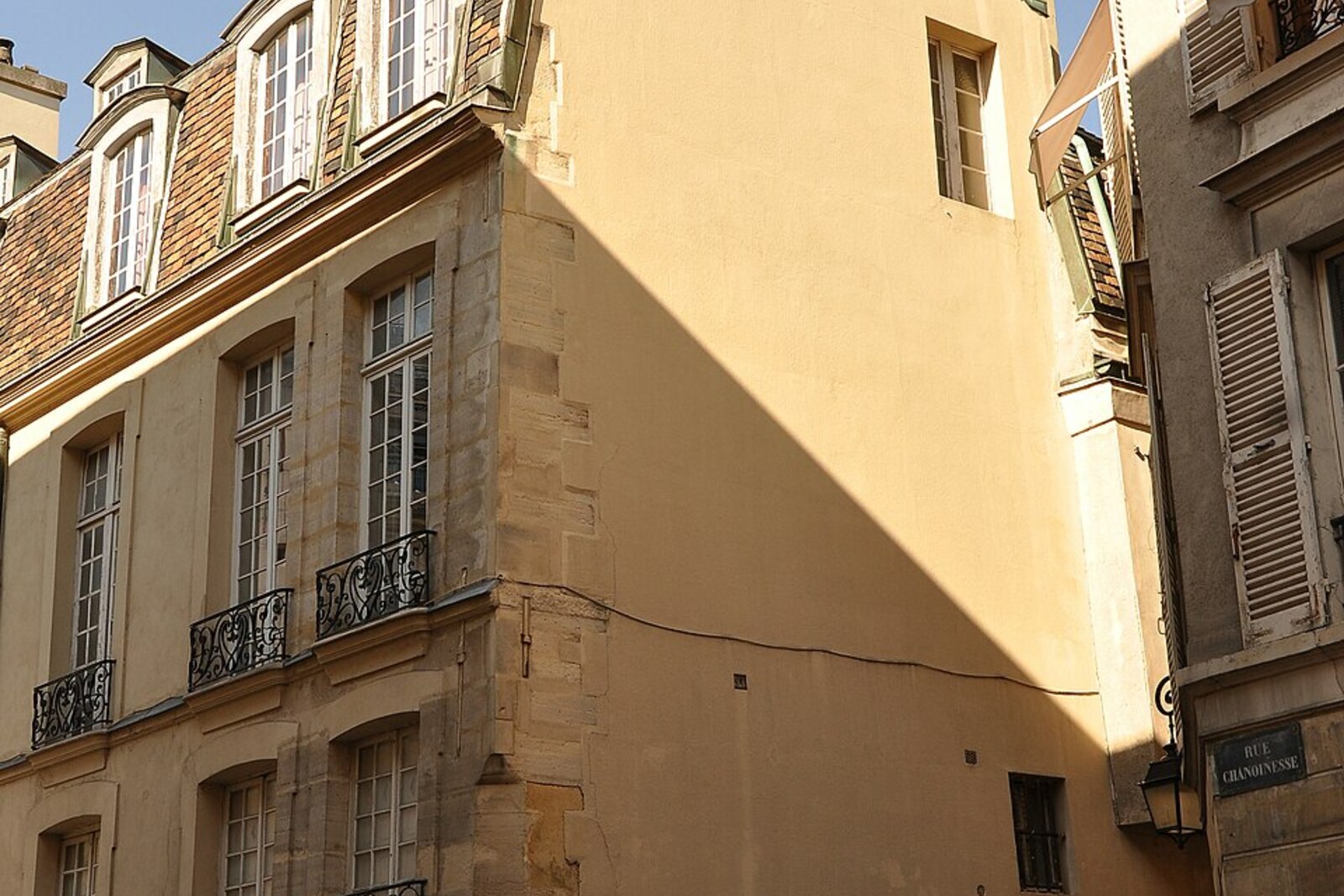
Look around first
What to notice
- Facade of house No. 24
- No. 24 on the facade
- The narrow line of Rue Chanoinesse
The story of the place
Narrow Rue Chanoinesse runs through the former residential quarter of the cathedral chapter: canons who served in the choir and managed the cathedral’s day-to-day affairs lived here. They had no communal monastic life—each was entitled to a house of his own and income attached to his place in the Chapter. This short street was therefore part of the cathedral’s working world, not just an incidental alley nearby.
Behind the facade of house number twenty-four lies Saint-Aignan Chapel. From the street, it is almost impossible to recognize: its walls form part of the ground floor of a private building, while the former nave continues through the block to Rue des Ursins. This hidden church best explains the name Rue Chanoinesse—the street of the canons of Notre-Dame.
Around eleven twenty, Étienne de Garlande, archdeacon of the cathedral and royal chancellor, wanted to ensure permanent prayers for himself and his relatives. Beside his own house, he built a chapel and dedicated it to Saint Aignan of Orléans, bishop of Orléans. The choice was personal: Étienne also headed the Church of Saint-Aignan in Orléans.
One building was not enough for his plan. After the founder’s death, the services could cease, so Étienne divided his prebend into two parts. A prebend was income from land and rents attached to a seat in the Chapter of Notre-Dame—the college of Notre-Dame clergy. This money supported two priest-canons, who were required to serve in the new chapel. Étienne entrusted the Chapter with appointing them. Thus prayer for him became a paid post, passed on to the next canon after each canon died.
The canons lived beside the cathedral, gathered in its choir for services, and managed the day-to-day affairs of Notre-Dame. They were not a monastic community: they had separate houses and income assigned to them. Several such houses stood here, which is why the street was named after its residents. Étienne gave both the chapel and the house to the Chapter; the Saint-Aignan canonries he established lasted for many centuries.
In seventeen ninety, the chapel was suppressed, and a year later it was sold as national property. Its new owners divided it with partitions; part of the former church was turned into a stable. Later, one of the rooms was again made into a place for prayer, but the church never reappeared from the street.
Of the twenty-three small churches on Île de la Cité that existed alongside Notre-Dame de Paris and Sainte-Chapelle, Saint-Aignan was the only survivor. The choir remains behind house number twenty-four, and around the corner, in house number nineteen on Rue des Ursins, two bays of the nave remain. The chapel walls still occupy the site where two canons received income and prayed for Étienne de Garlande.
Useful on site
This is a residential street: do not linger in doorways and speak quietly. The house of Abelard and Héloïse has not been identified with certainty, so treat No. 10 as a place of legend, not a proven address.