 Guide On Map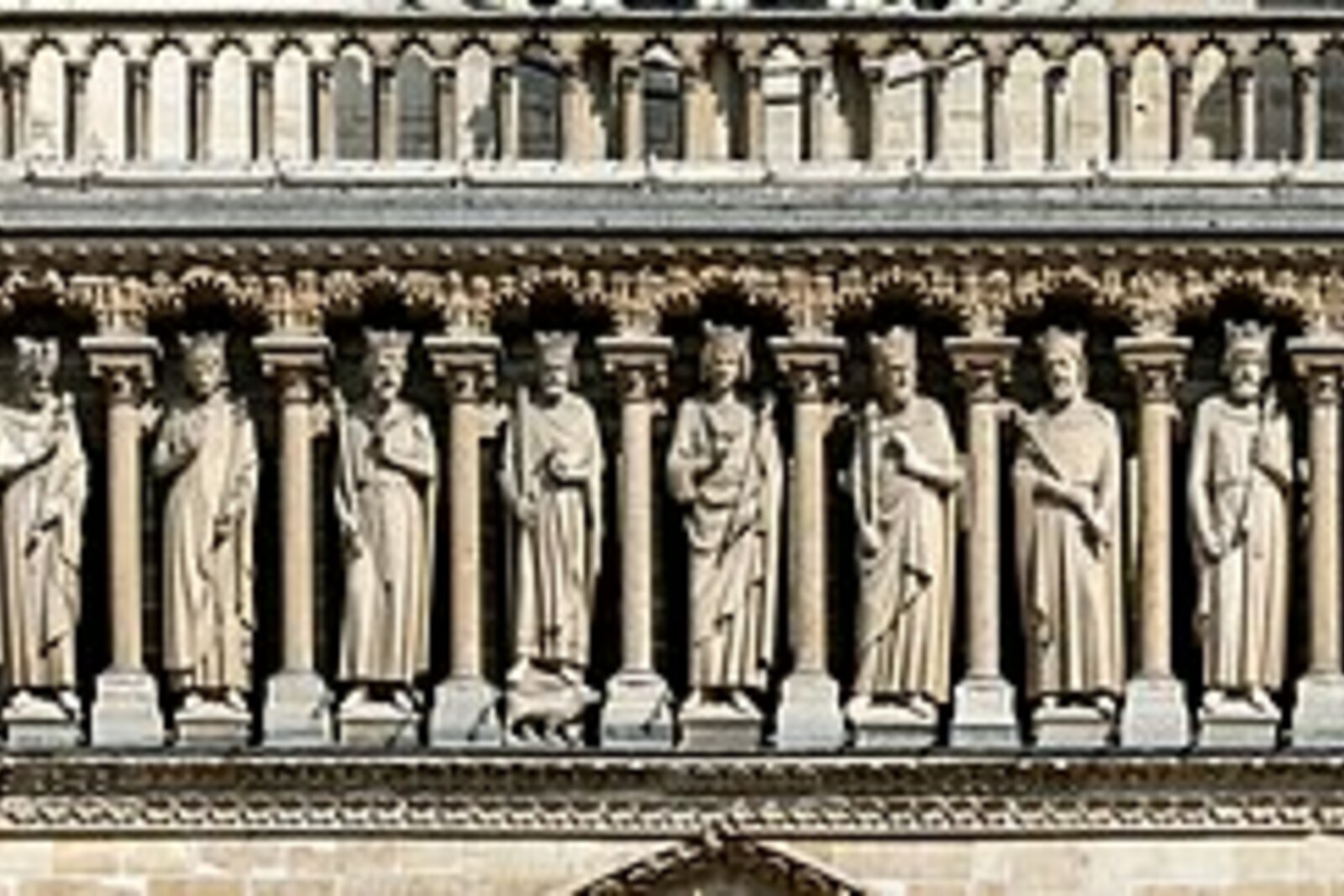
Look around first
What to notice
- The cathedral's western portals
- The stone facade
- The space of the parvis
The story of the place
Today, a queue forms on Parvis Notre-Dame for the western portals of Notre-Dame de Paris. In France, a parvis is the square in front of a church entrance. It was once much smaller: houses and narrow streets crowded in front of the facade. It was the church threshold that made this spot the setting for one of the most dangerous weddings in French history.
On August eighteenth, fifteen seventy-two, a high platform draped in gold cloth was erected above the square. Catherine de' Medici, the mother of the French king Charles IX, was marrying off her nineteen-year-old daughter Marguerite de Valois to Henry of Navarre. Marguerite did not want this marriage. Henry, her contemporary, had recently inherited a small kingdom by the Pyrenees and was considered France's leading Protestant prince.
The country had already been enduring religious wars for ten years. Catherine hoped to unite the Catholic royal family with the leader of the Protestants by marriage and secure the recent peace. The terms of the ceremony showed how fragile that calculation was. Henry refused to attend the Catholic Mass. So the cardinal pronounced the wedding blessing at the cathedral doors, on the platform. After that, the groom escorted Marguerite to the choir and left through the nave before the Mass began. A church threshold divided one ceremony: the bride remained inside, while the groom returned outside.
Hundreds of Protestant nobles came to Paris for the wedding. Four days later, an unknown person fired from a window at their leader, Admiral Gaspard de Coligny, who was seeking the punishment of those responsible. Coligny was wounded. His supporters demanded an investigation, and the king's entourage feared a retaliatory strike. On the night of August twenty-fourth, the royal council authorized the killing of several Protestant leaders.
The perpetrators began with Coligny, then the killings went beyond the compiled list. Thousands of people died across Paris and other cities. The wedding did not create this hatred, but it brought Protestant nobility together in a city where their opponents knew whom and where to seek.
Henry was spared as a close relative of the French kings. He saved his life at the cost of renouncing the Protestant faith and remained at court for about three years, effectively a prisoner. He then escaped, returned to his lands, and became a Protestant again. Marguerite and Henry soon lived apart; they had no children, and their marriage was annulled in fifteen ninety-nine.
Twenty-two years later, Henry returned to Notre-Dame de Paris as King Henry IV of France. To gain Paris, which refused to recognize a Protestant, he converted to Catholicism. After entering the city, the king went to the cathedral for a thanksgiving service.
The gold platform was dismantled, and the houses surrounding the square were demolished in the nineteenth century. The western entrance remains: in fifteen seventy-two, Henry left through it so as not to attend Mass; in fifteen ninety-four, he went inside as King of France.
Useful on site
The square is often crowded: step away from the queue and the main flow of people to listen. Plan your visit inside the cathedral separately; the point of this stop is also revealed in front of the facade.