 Guide On Map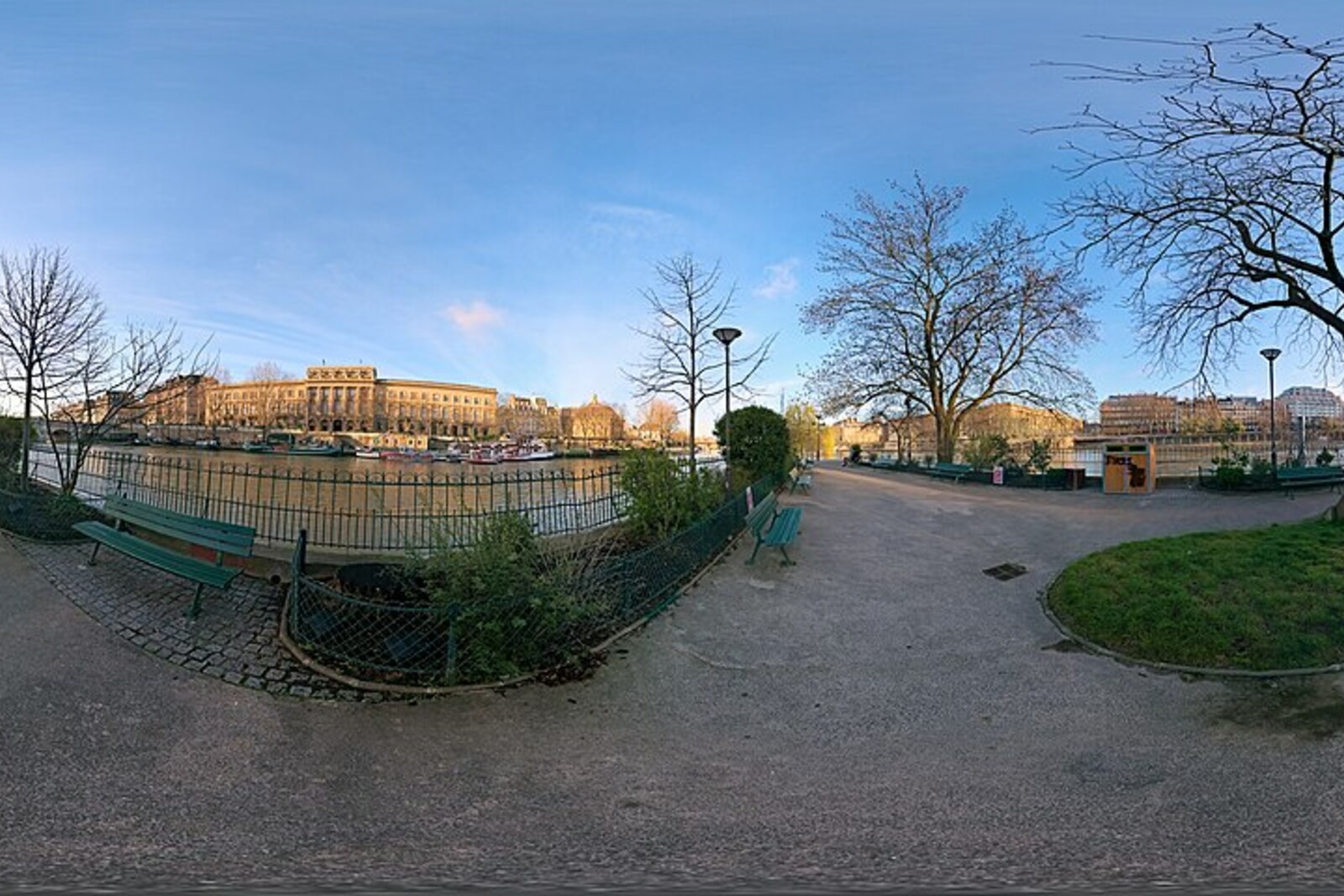
Look around first
What to notice
- Plaque bearing the name of Jacques de Molay
- Equestrian statue of Henry IV
- The tip of land between the branches of the Seine
The story of the place
At the very tip of Île de la Cité, a path leads from Pont Neuf beneath the equestrian statue of Henry IV to a small garden between two branches of the Seine. The city created it in eighteen eighty-four and named it Vert-Galant after the king’s nickname. This was the name for a man no longer young but still keen on women; the king retained it because of his mistresses and acknowledged illegitimate children.
At the beginning of the fourteenth century, there was no garden here. Behind the royal garden, separate from Île de la Cité, lay a small islet. It was called Île aux Juifs: the name was associated with the executions of Jews carried out here in the Middle Ages. The islet belonged to the Abbey of Saint-Germain-des-Prés, but stood very close to the royal palace. In March thirteen fourteen, two men condemned to be burned were brought here.
One was Jacques de Molay, the last Grand Master of the Knights Templar. He had joined the order more than forty years earlier. The order gave him rank, an income, and the only calling of his adult life: the Knights Templar were warrior monks, and de Molay led them after the Crusaders lost their last possessions in the East.
In thirteen oh seven, King Philip IV of France ordered the secret preparation of the simultaneous arrest of the Knights Templar throughout France. De Molay was seized in Paris. During questioning, he admitted some of the charges of heresy, then withdrew his testimony and explained that he had feared torture. After that, he spent almost seven years in captivity while Pope Clement V examined the case of the order. The pope did not declare the entire order heretical, but in thirteen twelve dissolved it and transferred its property to the Knights Hospitaller.
De Molay still had to hear his personal sentence. Three cardinals sentenced him to life imprisonment. This spared his life, but permanently confirmed his earlier confession. De Molay then publicly rejected the charges against the Knights Templar. He was supported by Geoffroi de Charney, who administered the order’s holdings in Normandy. To the church court, they became relapsed heretics: a repeated withdrawal of a confession was punishable by burning at the stake.
That same evening, both men were taken to the islet beneath the palace walls and burned. De Molay died, the order was not restored, and its property was not returned to it. A legend later arose that from the stake he summoned the king and the pope before God’s judgment and predicted that they would die within a year. Both did indeed die soon afterward, but there is no testimony contemporary with the execution about such a curse.
A plaque bearing the name of Jacques de Molay hangs at the entrance to the square. It gives the date as March eighteenth, thirteen fourteen; historians dispute whether the execution took place on March eleventh or March eighteenth. The islet itself disappeared two and a half centuries later. During the construction of Pont Neuf, the channels between it, neighboring sandbanks, and Île de la Cité were filled in.
Henry III of France laid the first stone of the bridge, but the Wars of Religion halted the work. Henry IV ordered construction to resume and opened Pont Neuf in sixteen oh seven. His equestrian statue now stands above the entrance to the garden. The square, created by the city in eighteen eighty-four, was named Vert-Galant after Henry’s later nickname. This was the name for a man no longer young who remained an ardent admirer of women; the king kept the name because of his many mistresses and acknowledged illegitimate children.
Beneath Henry’s horse, a path descends into the garden, on land that was joined to Île de la Cité during the construction of his bridge. The plaque of Jacques de Molay marks the former islet, concealed within this tip of land.
Useful on site
The low riverbank may be closed during high water, and the steps become slippery after rain. Do not go beyond the barriers; if the descent is inaccessible, view the square and the confluence of the channels from Pont Neuf.