 Guide On Map
Central Park: Nature by Design
From Grand Army Plaza to Belvedere Castle
Guide On Map on your phone
Open the walk like a regular app
It takes about 10 seconds to install. No app store needed.
The whole path
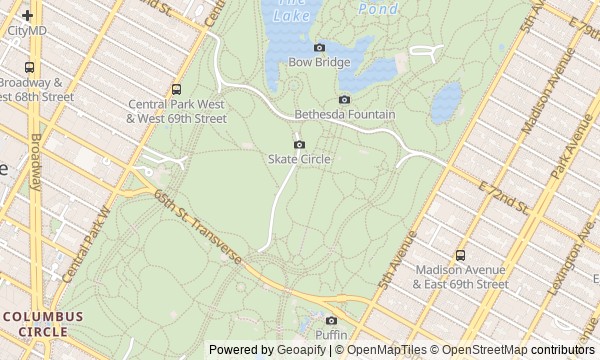
Route map
About the walk
You will enter Central Park from Fifth Avenue, walk along The Pond, and make your way up to the straight line of The Mall. Then the route will take you to Bethesda Terrace, The Lake, and Bow Bridge, turn toward Strawberry Fields, and end at Vista Rock beside Belvedere Castle.
The park will change as you walk: a city plaza will give way to water and stone, a formal avenue to winding shores, and a busy public space to a garden of remembrance. But this will not be a survey of sights. You will be looking at decisions, disputes, and traces of redesign. Why did an overgrown channel beneath a stone arch have to be defended? How did money from a vanished theater stage end up at Literary Walk? Why was a patch of turf for instruments placed beside a decorative castle?
The story will be precise and unhurried: no picture-postcard park, no ready-made answers in advance. By the end, you will read Central Park as a sequence of human decisions—from the water level to a place for shared memory.
Why this order
Grand Army Plaza comes first as the boundary between Fifth Avenue and the park: from here, the city story moves straight to The Pond, where a natural-looking scene turns out to be the result of clearing and restoration. From winding water, the route rises to the straight Mall so that two opposing design approaches come into view side by side. The Mall leads to Bethesda Terrace for a reason: the avenue was conceived as an approach to the main meeting place, and Bethesda Fountain fixed its center. From the terrace, The Lake opens up, making Bow Bridge the next stop—a transition from a public plaza to a body of water shaped by people. The western shore leads to Strawberry Fields, where the park landscape becomes a memorial garden. The final climb to Belvedere Castle replaces an intimate place of remembrance with a high lookout and ends the route where a decorative structure was given practical work.
Those who want to understand how Central Park works Lovers of urban history and landscape architecture Those who value human stories behind familiar views
Those expecting only a walk through filming locations Those who need a short overview of the main sights Those who do not want a long walk across the park
Before you go
Choose comfortable shoes: the route includes stairs, uneven stone, bridges, and the climb to Vista Rock. The route depends almost entirely on its views, so it is best done in daylight. Bring water and allow for pauses: busy areas around Bethesda, Bow Bridge, and Strawberry Fields can slow the walk. Access inside Belvedere Castle and to certain parts of the park is sometimes restricted, but every main story can be heard from outside. Before you set out, it is useful to check official notices about repairs and temporarily closed paths.
When to go
Morning brings more calm to popular stops, while low evening light brings out reflections, arches, and long vistas. After rain, allow extra time and take more care on stone by the water, on bridges, and near the terrace.
Backup plan
If the lower level of Bethesda is inaccessible, take in the composition from the upper terrace: from there you can read the stairs, the fountain's axis, and the way out toward The Lake. A closed passage by the water can usually be replaced by a nearby park path while keeping the order of stops. If Bow Bridge is very crowded, there is no need to walk to the middle—its curve and cast-iron pattern are easier to see from the shore. If you cannot enter Belvedere Castle, finish the route outside at Vista Rock: the castle's stone shell and the open panorama still provide the right ending.
Route conditions
Surface. Paved — 3.1 km; unpaved — 14 m (data covers 97% of the route)
Stairs. Flights: 7, 32 m in total
Access. Wheelchair — no; stroller — limited (stairs)
Facilities. Toilets — 6; drinking water — 12
Elevation. Ascent — 35 m; descent — 16 m
OpenStreetMap extract of June 18, 2026: database data, not a check on the ground. Data © OpenStreetMap contributors, ODbL licence
Walk plan
Open in maps ↗- 1
Grand Army Plaza
The plaza sets the urban prologue and shows that the route's story begins even before entering among the trees. - 2
The Pond and Gapstow Bridge
Here, an accidental stretch of shallow water brings the interests of birds, city services, and park restorers into conflict. - 3
The Mall & Literary Walk
The avenue’s first statue will link the park promenade to a theater that no longer exists. - 4
Bethesda Terrace & Fountain
The fountain will show how personal loss, a city commission, and clean water came together in one public space. - 5
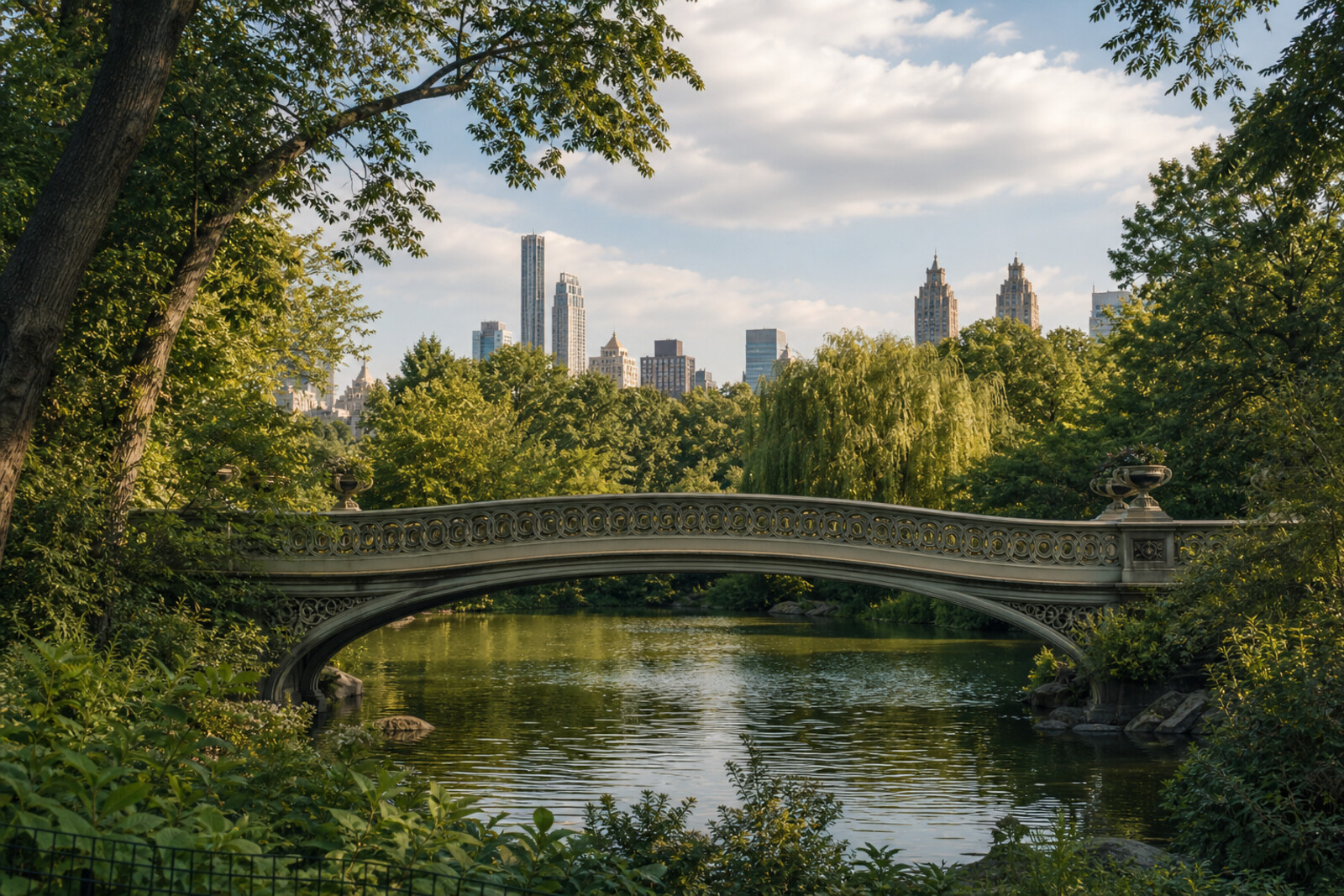
The Lake & Bow Bridge
This stop links the park landscape to the first major test of the new public space. - 6
Strawberry Fields
The garden will explain why a mosaic and living plantings, rather than a statue, were chosen for shared remembrance. - 7
Belvedere Castle
The final stop connects the park's designed view with the real work of a weather station.
Route features
Everything you need stays in the browser
Progress, saves and your trip plan are stored on this device.
Add Guide On Map to your home screen so the walk opens outside the browser.
How we handle sources, maps and corrections: our editorial standards