 Guide On Map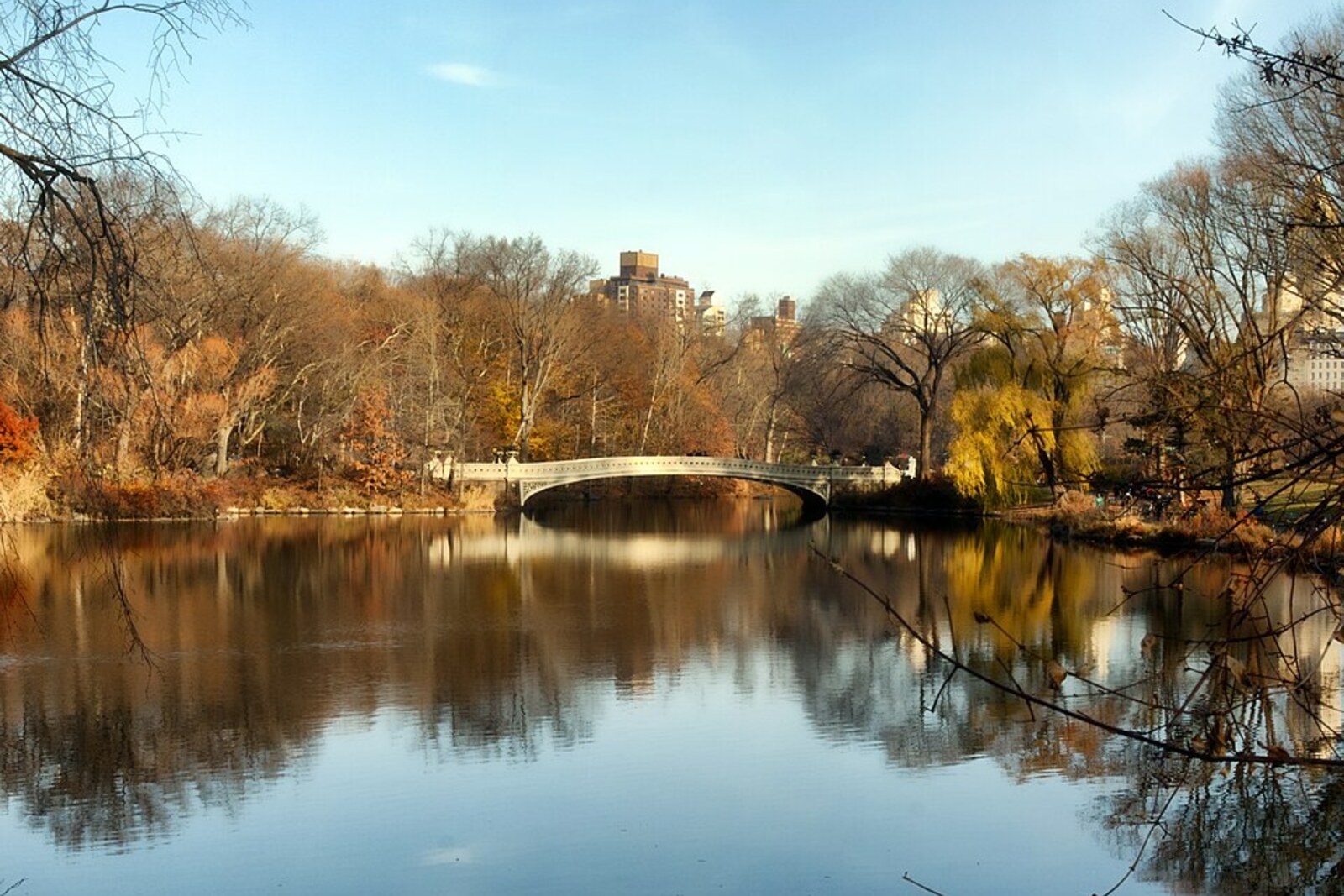
Look around first
What to notice
- The cast-iron arc of Bow Bridge
- The artificial lake
- The indented shoreline
- The bridge’s pedestrian deck
The story of the place
A low cast-iron arc crosses the water: its pedestrian deck connects Bethesda Terrace with the overgrown Ramble on the opposite shore. Beneath the bridge lies an artificial lake with winding bays, although people calculated its shape and depth. The water came to a former swampy lowland containing the remnants of Sawkill Creek and is connected to the city water supply. Boats now travel across the lake, while the bridge’s profile resembles a taut bow—the resemblance from which its name came.
Ice came first. Bow Bridge did not yet exist, the park was still a construction site, and in December eighteen fifty-eight New Yorkers were already stepping onto the frozen lake. About eight thousand people were counted here at Christmas. This was the first part of Central Park to open to the public.
That order had been planned in advance. In eighteen fifty-seven, the city announced a competition for designs for the new park and required entrants to provide a place for winter skating. Calvert Vaux, an architect living on private commissions and seeking the right to design the entire park, persuaded the city to hold this competition. He then persuaded Frederick Law Olmsted to join him—the salaried superintendent of the future park, responsible for draining and preparing the land. For Vaux, winning meant the commission itself; Olmsted gained the chance to determine what the space would become, when until then he had only been bringing it into a state fit for construction.
Their Greensward Plan won. On the drawing, what is now The Lake was plainly labeled: “Skating Pond.” In the lowland lay the swampy remnants of Sawkill Creek. Under Olmsted and Vaux’s plan, they were turned into a body of water connected to the city water supply. Before freezes, the water could be lowered to a level at which it froze faster and more reliably. The shoreline, with its bays, looked natural, but people controlled the depth and the ice.
After that first Christmas, several thousand visitors became tens of thousands. Seasonal vendors appeared by the lake: for a license costing one hundred fifty dollars, they gained the right to set up a small pavilion and sell food, while other lessees rented out skates and chairs at rates set by the city. For some, the ice was entertainment; for others, it was a winter-long livelihood.
Such a crowd had to be guided. Attendants came out with equipment to rescue people who had fallen through, cleared the surface, and made sure people did not gather on one side of a crack: even a thick sheet of ice could tilt. A flag above the round pavilion in the middle of the lake indicated whether skating was safe. Red meant danger or a request to clear the ice before a new layer was laid. Fears that the new park would empty out in winter disappeared; the city commission soon linked the spread of skating across the country to this lake.
The project’s success gave Olmsted the post of the park’s chief architect, and Vaux work on its bridges and buildings. Between eighteen fifty-nine and eighteen sixty-two, Vaux and the architect Jacob Wrey Mould built a low cast-iron arc over the lake. It connected the path from Bethesda Terrace with The Ramble on the opposite shore. The English word “bow” in the name means a bow: the profile of the span resembles the taut curve of a weapon or a violin bow.
Today, The Lake no longer freezes reliably enough for mass skating. The round pavilion with its signal flags is gone as well. Boats travel on the water, provided for here from the start for the summer season, and above them remains the pedestrian bridge—the very cast-iron arc from which it got its name.
Useful on site
The bridge and shore are open on the park schedule: daily 6:00–1:00. Boat rentals begin on 1 April and depend on the season and weather; the restrooms at the boathouse are usually open from 7:30 until dusk.
Checked: June 29, 2026. Check the official source before visiting.First, look at the whole bridge from the shore, then cross it. If there are many people, do not linger in the narrow section for a photograph.