 Guide On Map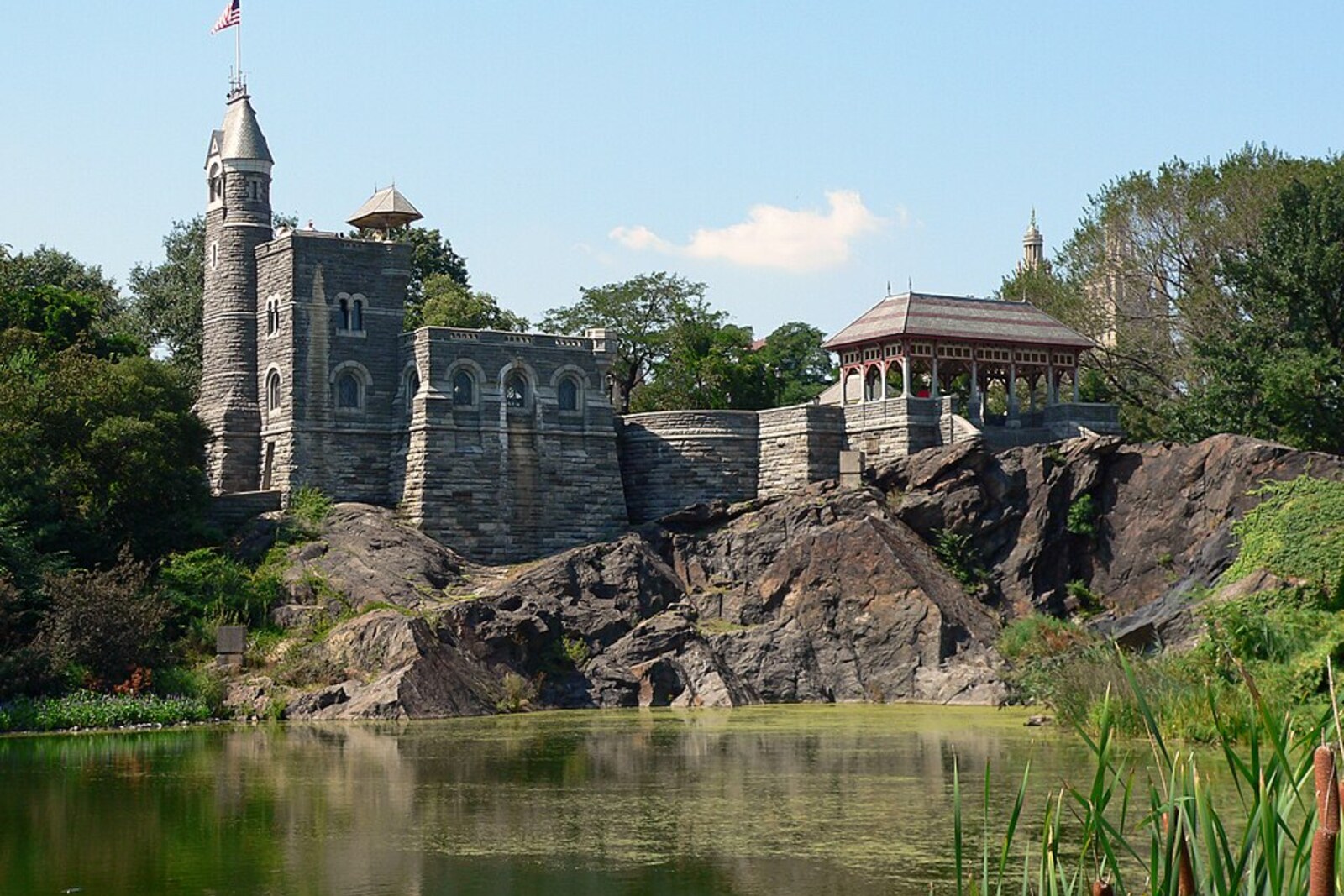
Look around first
What to notice
- Stone tower
- Pointed top
- Clear windows
- Meteorological instruments beyond the fence
The story of the place
The stone Belvedere with its pointed tower was prepared neither for residents nor for soldiers. Its fortress-like silhouette served as a park architectural folly, while its open openings and empty rooms offered shelter from the rain to people walking among the rocks and trees. Today, glass in the windows lets light inside, while outside the stone tower, unusual for the park, is still clearly visible.
The name “Belvedere” means “beautiful view” in Italian. A view was the original purpose of this castle. In eighteen sixty-six, Central Park’s creators, Frederick Law Olmsted and Calvert Vaux, envisioned an open viewing platform on Vista Rock. Vaux and the architect Jacob Wrey Mould gave it the appearance of a medieval fortress. They placed it on the site of the service bell tower of the old receiving reservoir, which occupied the area of today’s Great Lawn.
No residence or garrison was planned inside. There were no doors or glazed windows: the tower served as shelter from bad weather and as a high point from which the park opened out to the north and south. Such decorative structures were called architectural follies. The word “castle” described Belvedere’s appearance, not its function.
Federal meteorologists found its first real use. At the time, their observers worked at The Arsenal—the park administration building on Fifth Avenue. They regularly recorded temperature, pressure, humidity, precipitation, wind speed, and wind direction. By the beginning of the twentieth century, neighboring buildings had risen and begun to interfere with the instruments. The Arsenal’s roof leaked: water threatened the observation logs, while employees on duty beneath it had to continue taking measurements.
In nineteen thirteen, the U.S. Weather Bureau proposed moving the observatory closer to the center of the park, farther from tall buildings, and chose Belvedere. The meteorologists did not move immediately. In nineteen eighteen, they compared readings at The Arsenal and at the castle, then waited for gas to be brought here to heat the workrooms.
In the summer of nineteen nineteen, the staff selected a site for thermometers on the open rock south of the tower. Bare rock could heat up and distort the temperature, so they enclosed it with a low wall, covered it with soil, and laid sod over it. An instrument shelter was placed on this plot; rain gauges were set closer to the ground, and wind equipment higher up. The city provided rooms in the castle for the observers, while the U.S. Weather Bureau supplied personnel, instruments, and cables.
On January first, nineteen twenty, the observatory officially began operating here. For its sake, builders added doors and windows, fitted out offices, and adapted the top of the tower for meteorological equipment. Visitors were no longer allowed inside: the structure created for viewing became the observers’ workplace for several decades.
In the early nineteen sixties, measurements were automated and the readings were sent to the bureau at Rockefeller Plaza. Staff no longer kept a constant watch at the castle, and the doors were boarded up. In the nineteen seventies, the empty building was covered in graffiti and looted. The Central Park Conservancy, founded in nineteen eighty, chose Belvedere as one of its first restoration projects. Restorers returned the tower’s pointed top, rebuilt the pavilions, and in nineteen eighty-three opened a visitors’ center inside.
Now the park is visible again through the clear glass, the park for which Olmsted and Vaux chose this rock. And beyond the fence south of the castle, instruments still measure temperature, wind, and precipitation for the Central Park report—almost on the same plot that meteorologists prepared more than a century ago.
Useful on site
The interior is open daily 10:00–17:00; closed on Thanksgiving, Christmas, and New Year's Day; access to the terrace ends five minutes before closing. The surrounding paths are accessible according to the park's schedule.
Checked: June 29, 2026. Check the official source before visiting.The castle can be fully understood from outside, so the closed interior does not deprive this stop of its meaning. Move carefully on the rock and steps, especially in wet weather.