 Guide On Map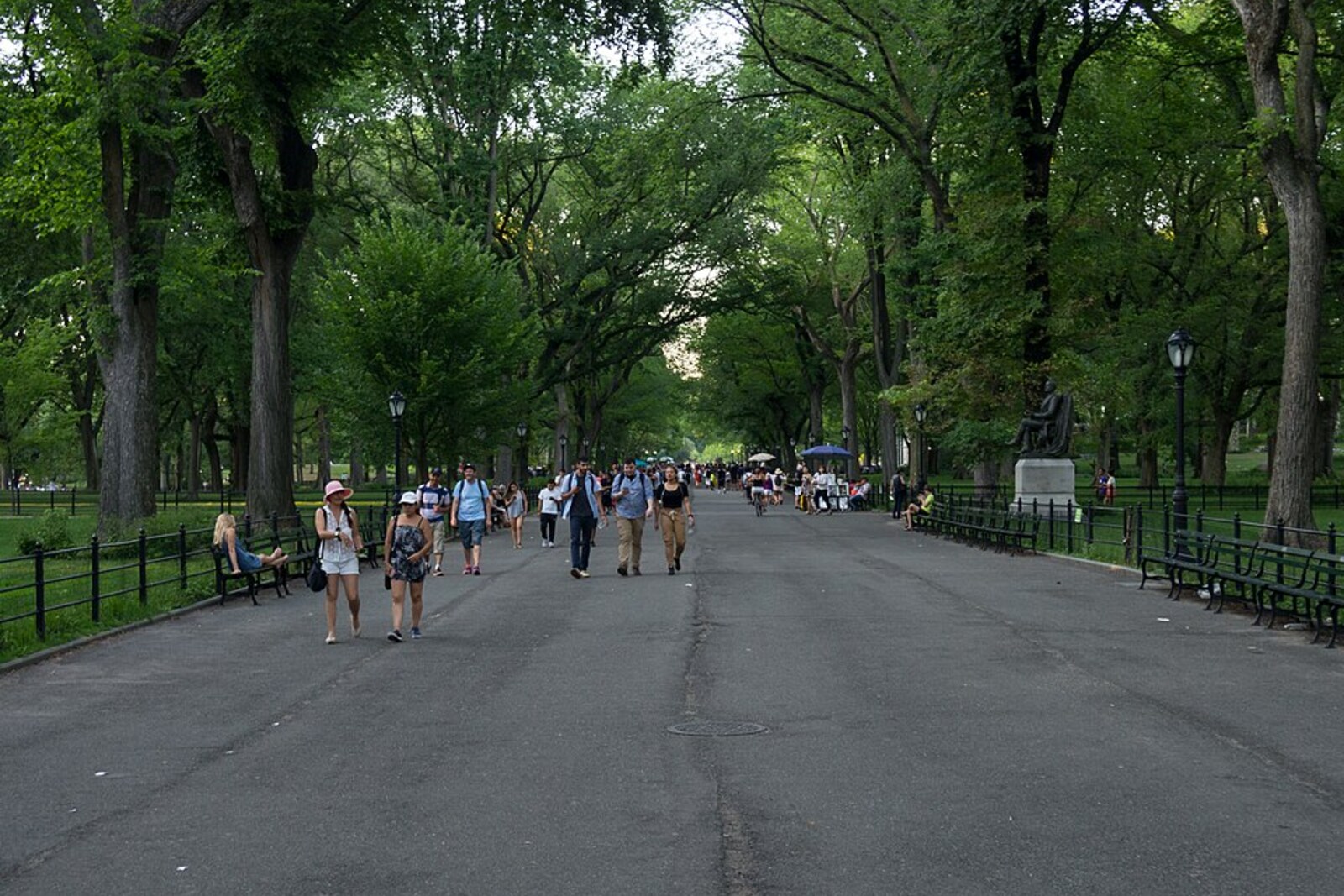
Look around first
What to notice
- The Shakespeare statue
- The straight line of The Mall
- Rows of trees
- Literary monuments
The story of the place
Between rows of trees, The Mall stretches in a straight vista, and its southern section is marked by bronze figures along the path. The sculptures were not part of the park’s original design: city residents themselves brought them here, raising money and securing permissions. That is how Shakespeare, Scott, Halleck, and Burns came to stand together, and this part of The Mall acquired the name Literary Walk.
The Mall is a broad, straight avenue amid the winding paths of Central Park. The park’s designers, Frederick Law Olmsted and Calvert Vaux, sought to bring together people whom the other roads separated into different streams: pedestrians, riders, and carriages. They called The Mall an open-air reception hall. A large group could walk along the avenue, stop, see acquaintances, show off their clothes, and then continue to Bethesda Terrace. Walking, sitting on benches, and watching passersby were part of the plan from the very beginning.
There were no monuments in Olmsted and Vaux’s original design. New Yorkers made this part of the avenue literary when they began placing monuments here with their own money. City actors and theater managers took up the first such project. They wanted to mark the three-hundredth anniversary of William Shakespeare’s birth and secured permission to install his statue at the southern end of The Mall.
On April twenty-third, eighteen sixty-four, the cornerstone was laid here. There was no bronze figure above it yet. Because of the American Civil War, the committee could not finish raising the money for several years.
Edwin Booth, the celebrated performer of Shakespearean roles and manager of the old Winter Garden Theatre on Broadway, took on the task of seeing the statue through. His income and reputation depended on the stage. On November twenty-fifth of that same year, he staged a benefit performance of Julius Caesar and, for the first time, brought the three Booth brothers together in one production. Edwin played Brutus, the older brother played Cassius, and the younger brother, the successful actor and supporter of the Confederacy John Wilkes Booth, played Mark Antony. The proceeds went to the monument fund.
Less than five months later, John Wilkes Booth, who regarded President Abraham Lincoln as an enemy of the defeated South, shot him dead in a Washington, D.C., theater. John himself was killed during his capture twelve days later. Edwin condemned his brother and announced that he would never again go on stage: the family name that had once sold tickets had become linked to the murder of a president. But refusing would deprive him of his profession and leave him with theater debts. On January third, eighteen sixty-six, Edwin returned to that same Winter Garden Theatre as Hamlet and continued his career.
Meanwhile, the sculptor John Quincy Adams Ward completed the commission in bronze. He composed Shakespeare’s face from three old portraits and used a live actor for the pose. On May twenty-third, eighteen seventy-two, the committee unveiled the statue—eight years after the cornerstone had been laid.
Then the Scottish novelist Walter Scott, the New York poet Fitz-Greene Halleck, and the Scottish poet Robert Burns appeared along the avenue. Because of these four, the southern part of The Mall came to be called Literary Walk, although people with no connection to literature stand nearby as well.
The old Winter Garden Theatre, where the Booth brothers performed together only once, burned down in eighteen sixty-seven. There is no longer a theater on its site. The money raised on that stage remains here—in the bronze Shakespeare at the beginning of Literary Walk.
Useful on site
Open according to Central Park hours: daily 6:00–1:00. Temporary construction restrictions are possible on the Concert Ground; check park notices on the day of your walk.
Checked: June 29, 2026. Check the official source before visiting.Do not try to take in every monument one after another. Choose several figures from the story and compare how their poses and placement define their public role.