 Guide On Map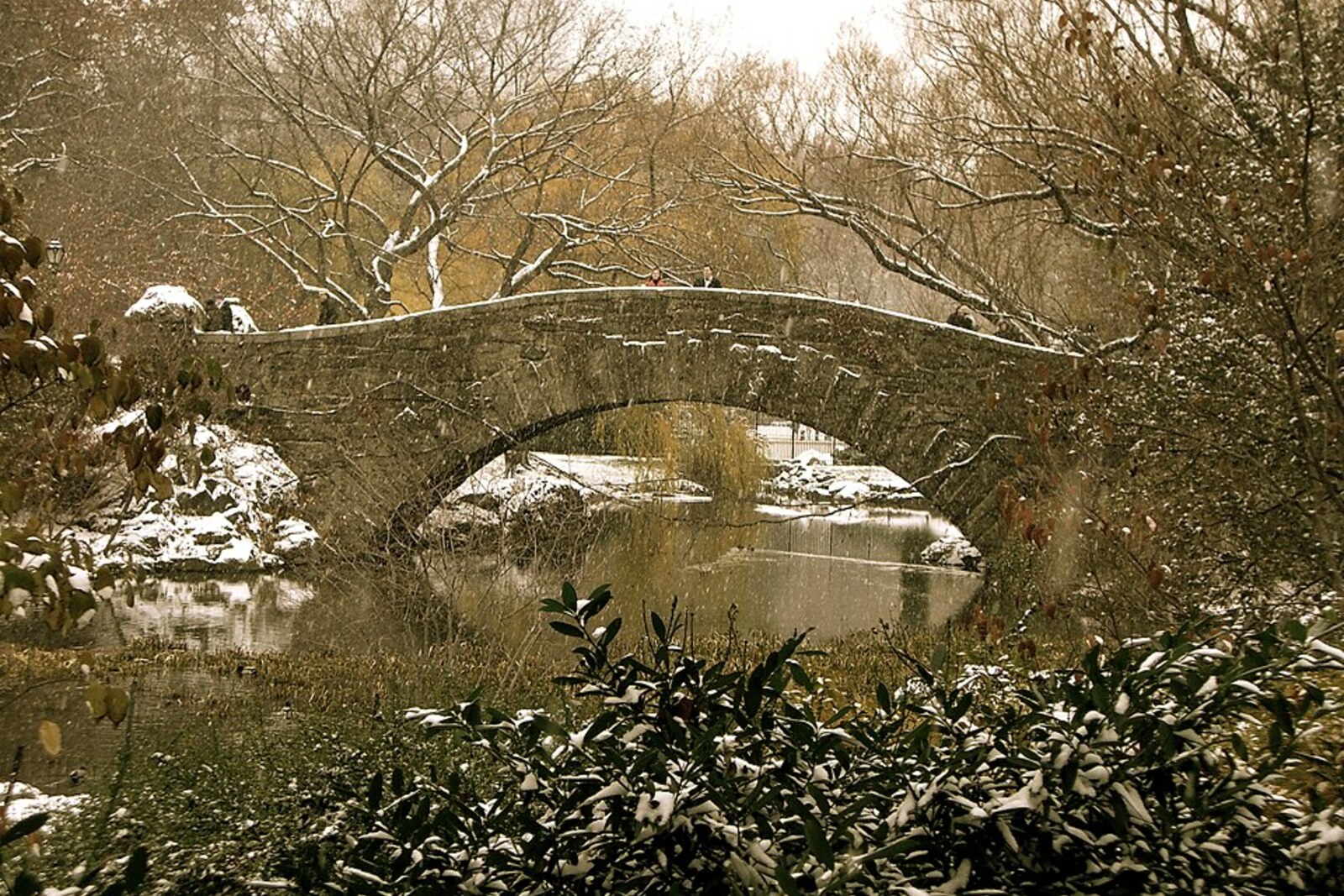
Look around first
What to notice
- The stone arch of the bridge
- The narrow channel beneath the bridge
- The open water of The Pond
- Stone bank reinforcements
The story of the place
Beneath the stone arch begins a narrow channel through which water from the southern part of Central Park enters the pond's basin. The pond itself was created in a former marshy hollow, where water from a millstream once flowed. A watertight lining at the bottom now holds the water, and city pipes replenish the pond from the general system. The stone banks and the passage beneath the bridge direct all runoff from this part of the park here, so silt settles first in the narrow channel.
Gapstow Bridge carried a pedestrian path over the narrowest point of The Pond in eighteen seventy-four. The architect Jacob Wrey Mould built the first bridge from wood and cast iron: two tall wooden arches rose above the deck, with openwork railings running between them. The structure lasted twenty-two years. When the wood rotted, the city dismantled the bridge entirely. In eighteen ninety-six, the architect John Galen Howard built the present arch of Manhattan schist on the same banks.
Frederick Law Olmsted and Calvert Vaux created The Pond in a marshy hollow fed by De Voor's Millstream. Today, a waterproof lining holds the water at the bottom, and underground pipes bring water here from the city system. The narrow channel beneath the bridge serves as the entrance to the pond's main basin—so everything washed from the southern part of the park settles here first.
By nineteen seventy-seven, the open water beneath the arch had nearly disappeared. The slopes were eroding, and there was not enough money to clean the catch basins. Workers digging a subway tunnel beneath the park pumped water with clay and silt from the excavation into the same stormwater system. The sediment clogged the channel, passed beneath Gapstow Bridge, and formed a long strip of cattails, reeds, and willow scrub.
Birds that had previously rarely lingered in Central Park appeared in the new shallow water. The ornithologist Roger Pasquier, who had recently worked as an assistant curator at the American Museum of Natural History, observed a lesser yellowlegs here—a sandpiper that usually bypassed the park. Pasquier and his colleagues from the Linnaean Society of New York asked for some of the cattails to be preserved or replanted at the neighboring bird sanctuary. They wanted to leave the birds this accidentally created shelter.
State specialists recognized the overgrown channel as a freshwater wetland. That status required a separate permit for clearing it. For Martin Lang, the city parks commissioner, it meant stopping the project for which he was responsible by virtue of his office. Silt was already backing up the stormwater system: during heavy rains, the police sometimes closed the cross-town road near Sixty-fifth Street. The bank reinforcements were collapsing, and the water was stagnating.
One day, Lang got up at four in the morning and went to Albany to prove to state officials that the growth had formed from construction and city silt. The wetland status was removed. Lang then persuaded the federal government to include the artificial The Pond in a lake-cleanup program and received almost four hundred ninety-eight thousand dollars in federal funds.
By nineteen eighty-one, the accumulated silt had been removed, the inlet and outlet structures had been restored, and the banks had again been reinforced with stone. Pasquier's temporary shallow water disappeared. Open water again lies beneath Howard's arch; the growth for which the ornithologist and the commissioner traveled to see officials was located precisely here, in the passage beneath the bridge.
Useful on site
Open according to Central Park hours: daily 6:00–1:00.
Checked: June 29, 2026. Check the official source before visiting.The best overall view opens up from the shore, not from the bridge itself. After rain, do not go close to the slippery water's edge.