 Guide On Map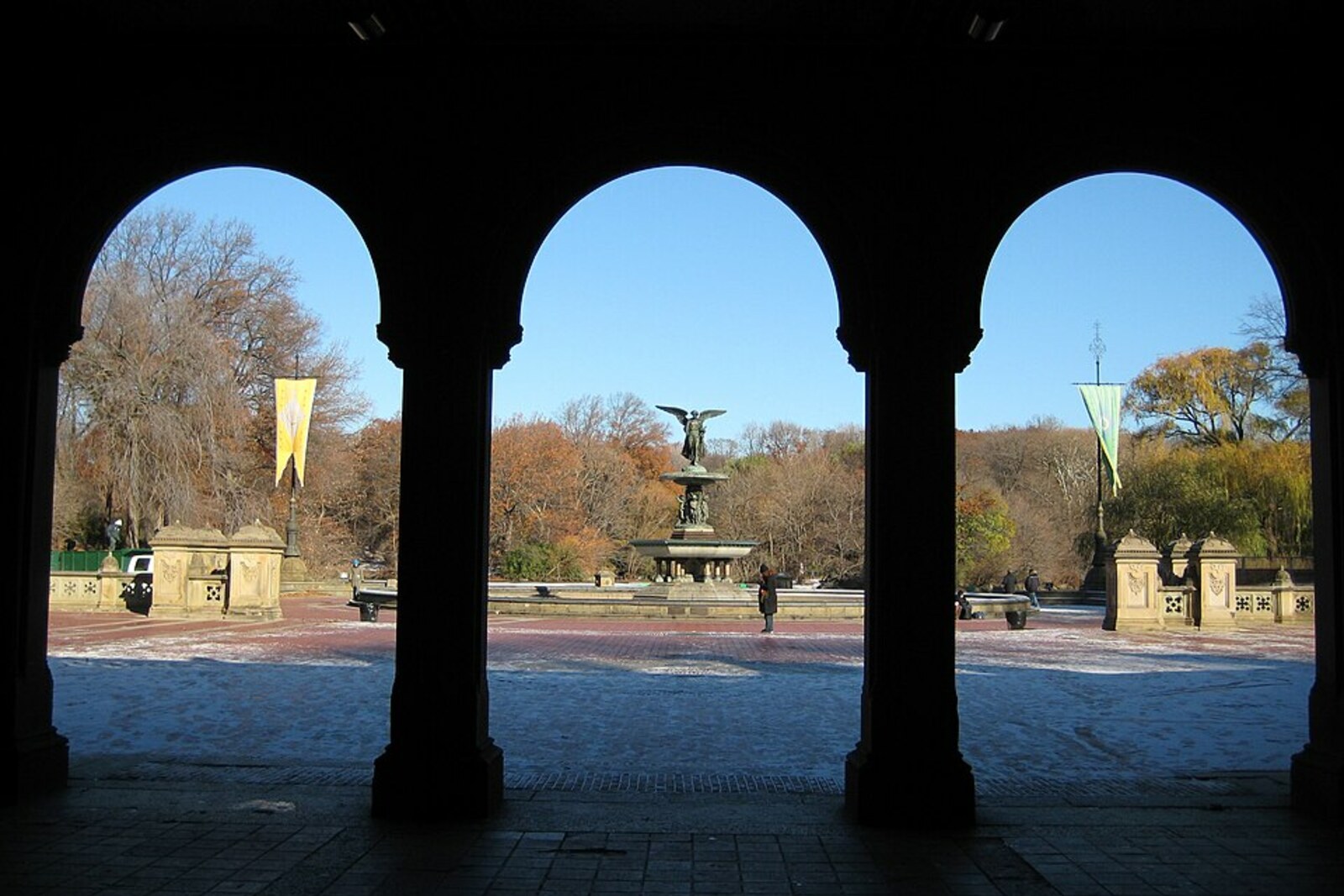
Look around first
What to notice
- Bronze angel
- Lily in its hand
- Four child figures
- Stone fountain basins
The story of the place
For meeting and recreation, the park’s designers set aside a large plaza above The Lake. At its center, they placed a fountain with stone basins; four child figures sit by the lower basin: Health, Purity, Temperance, and Peace. Bethesda was first the name of the fountain because of the sculptural composition, and then the name was transferred to the entire terrace.
In eighteen sixty-one, the New York City artist Emma Stebbins sent drawings of an angel from Rome for the still-empty fountain in Central Park. She wanted to receive a city commission as a professional sculptor. Women in New York City had almost nowhere to learn the craft, so Stebbins left for Italy when she was already over forty. The daughter of a wealthy banker could support a studio, but family and acquaintances still gave her access to major commissions.
The park board commissioned the fountain from her. Its president and the chair of the architecture commission was Henry G. Stebbins, Emma’s brother, who needed to complete the terrace’s central composition. Their kinship immediately prompted accusations of favoritism. But Stebbins brought a finished idea that she had been working on even before the official commission, and the park’s creators accepted it. This made her the first woman to receive a commission from New York City for a public sculpture.
Its location had already been chosen. The designers led The Mall to a large plaza above The Lake and intended it for meeting and recreation. The fountain was to anchor the center of this public space. Stebbins’s subject explained what the water in its basins would mean.
The Gospel of John tells of the Pool of Bethesda in Jerusalem: people believed that an angel stirred its water, and that the first person to enter afterward would be healed. Stebbins linked this story to the Croton Aqueduct, which had been supplying New York City with clean water since eighteen forty-two. Before the aqueduct, residents drew water from contaminated wells and springs; cholera claimed thousands of lives. Stebbins’s own father and brother died of it. While the sculptor was creating the angel, she was also working on a posthumous bust of her brother.
In the opening program, Stebbins explained her idea without promising a miracle: New Yorkers did not have a crowd of sick people waiting for the angel’s touch, but clean water came to the city every day. The lily in the bronze figure’s hand means purity. Below sit four children—Health, Purity, Temperance, and Peace. Stebbins based their faces on her five-year-old nephew. The biblical name Bethesda was given to the fountain specifically because of this sculptural composition, and then passed to the entire terrace.
Stebbins completed the model in Rome in eighteen sixty-seven. Wars delayed the casting and delivery of the bronze, and the angel was unveiled only in eighteen seventy-three. The New York Times reported that the public had expected a majestic work but saw a weak, idea-less figure. For Stebbins herself, the day was the high point of a career that had already ended. Her companion, the famous actress Charlotte Cushman, who supported the sculptor’s work and helped her seek patrons, fell ill with breast cancer. Stebbins left her studio, returned to America with Cushman, and cared for her until Cushman’s death.
Emma Stebbins’s signature remains on the bronze at the base. Above it stands the angel that New York City critics greeted with ridicule; below it are the faces of her nephew and the monument’s stone basins honoring clean water. People still gather around this pool, as the terrace’s creators intended.
Useful on site
The terrace is open on the park’s schedule: daily 6:00–1:00. The restrooms by the terrace usually operate daily 6:30–21:00 from late March to early November; they are not equipped for wheelchair access.
Checked: June 29, 2026. Check the official source before visiting.View the fountain from both the upper and lower levels, if the stairs are comfortable for you. In the arcade, do not block the passage while looking at the ceiling.