 Guide On Map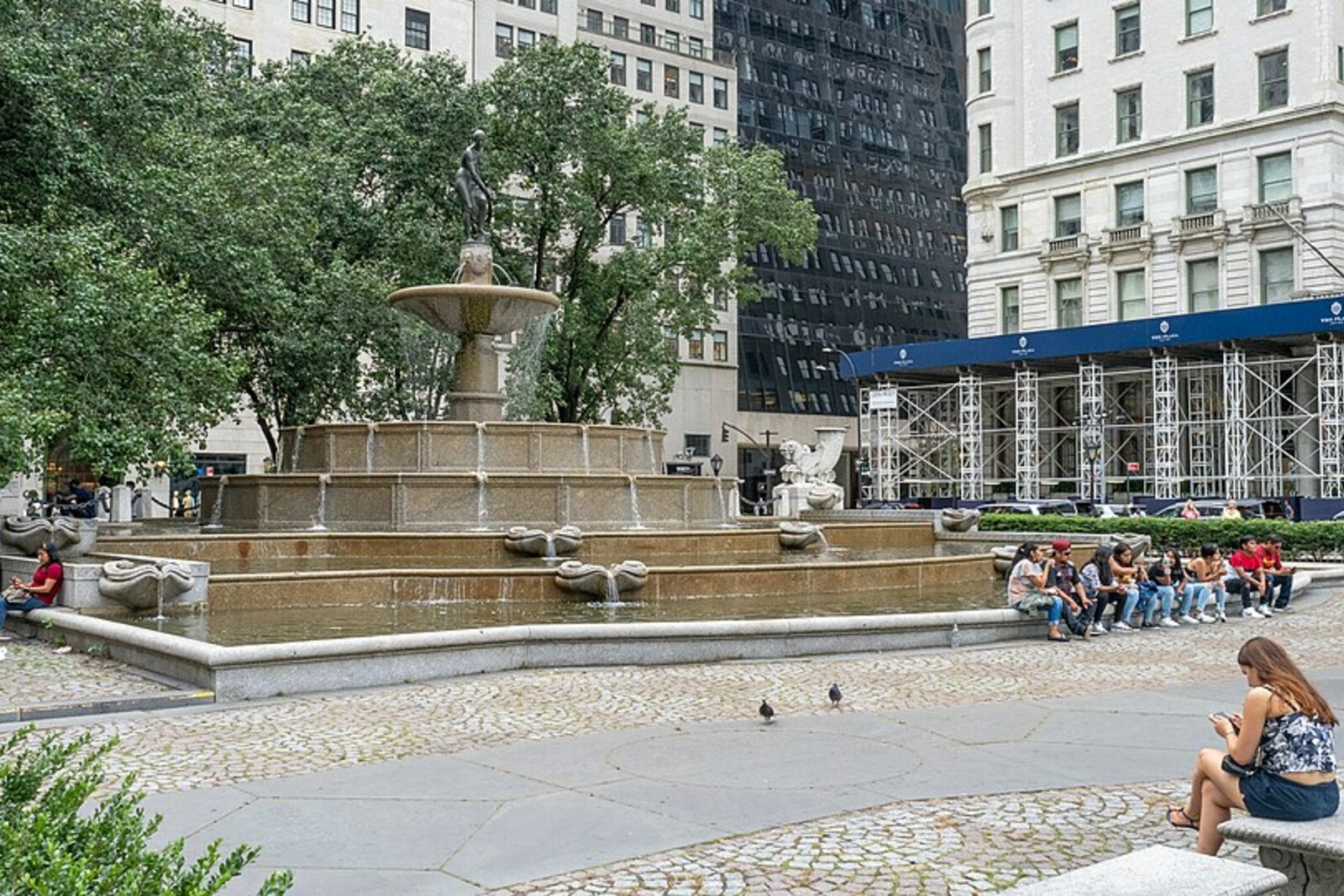
Look around first
What to notice
- The gilded equestrian statue of Sherman
- Pulitzer Fountain
- 59th Street
- Fifth Avenue
The story of the place
Grand Army Plaza consists of two areas at the southeastern corner of Central Park. 59th Street runs between them. The gilded General William Tecumseh Sherman rises on the northern area, while the southern one contains a tiered fountain. Here, people leave Fifth Avenue for the park, transfer to carriages, wait for one another, and briefly step out of Midtown's flow.
The plaza's military name is connected with the equestrian statue. Sherman commanded Union armies in the American Civil War and worked to secure the Confederacy's surrender. His monument was installed here in nineteen oh three and unveiled on Memorial Day—a holiday introduced by the Grand Army of the Republic, an association of Union veterans. Twenty years later, the city officially named this space Grand Army Plaza, the plaza of the Grand Army. Thus, the name retained the people who fought for the Union, and Sherman became their most prominent representative at the entrance to the park.
Six years before the official renaming, another column began gathering near the gilded general.
In the summer of nineteen seventeen, white mobs killed dozens of Black residents of East St. Louis and burned entire blocks; thousands of people were left homeless. James Weldon Johnson, the new field secretary of an American organization defending the rights of Black people, was seeking a federal ban on lynching and extrajudicial killings. This was his everyday work: opening branches, recruiting members, and turning a small association into a force that would have to be reckoned with. The entire organization then had about nine thousand members. Johnson expected to bring about the same number onto Fifth Avenue.
On July twenty-eighth, participants lined up between 55th Street and 59th Street; the northern boundary of the column was at what is now the plaza. Children in white clothing were placed at the front, followed by women in white, then men in dark suits. Some of the men came in military uniforms. Their placards reminded people that Black Americans served in the army of a country that did not protect their families from murderers.
About ten thousand people set out from here along Fifth Avenue toward Madison Square. They did not chant slogans: the demands were written on banners, and the order of the column was meant to rule out the familiar accusation of disorder. The children at the front showed those whom neither law nor citizenship had saved; the men brought up the rear without blocking them from view.
Four days later, eleven organizers brought a petition to President Woodrow Wilson in Washington, D.C. He did not receive them: his secretary said that the president was too busy. The participants received no federal protection, and two years later new mass killings showed that the march had not stopped the violence. Johnson continued opening branches; by nineteen nineteen, the organization's membership had grown from about nine thousand to ninety thousand, and silent marches were repeated in other American cities.
The route of that day can be read without a commemorative plaque. 59th Street still runs between the equestrian Sherman and the fountain, and from the eastern edge of the plaza, Fifth Avenue runs straight south toward Madison Square.
Useful on site
Open according to Central Park hours: daily 6:00–1:00. The southern part of the plaza is open after restoration; individual plantings and the fountain may be serviced on the current schedule.
Checked: June 29, 2026. Check the official source before visiting.The two compositions are separated by a street; view each from its own side and cross only on a permitted signal.