 Guide On Map
Spaccanapoli and the Decumani: Transformations of Old Naples
From Piazza del Gesù Nuovo through Via San Gregorio Armeno to Naples Cathedral
Guide On Map on your phone
Open the walk like a regular app
It takes about 10 seconds to install. No app store needed.
The whole path
Route map

About the walk
You will cross two Decumani of old Naples from west to east: from Piazza del Gesù Nuovo along Spaccanapoli, then through Via San Gregorio Armeno onto Via dei Tribunali and on to Naples Cathedral.
First come a palace façade, a monastic complex, and a square with a spire. Then the way narrows to a marble statue and shops filled with terracotta figurines. Beyond the craftsmen’s street, the city’s larger institutions return: the square of the old civic government, a judicial magistracy, and the cathedral.
This is not a tour of the major churches, and it is not a walk in search of street food. Questions will keep appearing. Why did a church preserve the façade of someone else’s palace? Whom did the headless statue portray? Why did the city need a notary beside the altar? The story rests on documents, civic decisions, and visible traces, while legend remains legend.
By the end of the walk, you will understand why a church in central Naples wears a palace façade, how a decapitated statue gave a square its name, and why the city’s chief relic cannot be reached with a single key.
Why this order
Gesù Nuovo and Santa Chiara stand side by side for a reason: a prince cleared the square where nuns’ houses had stood, so after the story of his lost palace, the route immediately turns to the complex that reshaped the neighboring urban space. Spaccanapoli then leads to San Domenico Maggiore, where a royal burial place gives way to the palace of an official whose wealth also depended on the Crown’s favor. A few steps away, the Statue of the Nile God continues the conversation about loss through an object whose image the townspeople restored. Beyond it, the lower Decumanus reaches Via San Gregorio Armeno, where the reworking of stone gives way to a living craft that changed the trade calendar. The street ends at Piazza San Gaetano: a private shop yields to the square of the civic government and its vow after the plague. From here, Via dei Tribunali leads into the story of the courts, because the old straight road ends at the castle where the tribunals were brought together. A turn onto Via Duomo completes the sequence at the cathedral: after confiscations, monastic rules, trade risk, and the courts comes the agreement through which the whole city secured its rights to the chapel and the relics.
a first substantial walk through the historic center those interested in the fates of buildings and civic institutions those who enjoy well-sourced stories without guided-tour grandiosity
a route focused only on church interiors those looking above all for a walk about food and markets a quick pass without long historical stories
Before you go
Wear shoes with sturdy soles: the old paving is uneven, and the stone can be slippery after rain. On narrow streets, keep close to the edge, watch for scooters, and do not stop with your whole group in the middle of the passage. Most of the route’s meaning is available from outside, so a closed church does not break the walk. If you want to see the cloister at Santa Chiara, Caravaggio at Pio Monte della Misericordia, the Treasure of San Gennaro, or other interior spaces, treat them as separate visits and check the official pages in advance: access may depend on services and events. Via San Gregorio Armeno is especially crowded in the weeks before Christmas; morning is better for a calmer look around.
When to go
About 2 hours with pauses; the walking line is about 1,5 km.
Backup plan
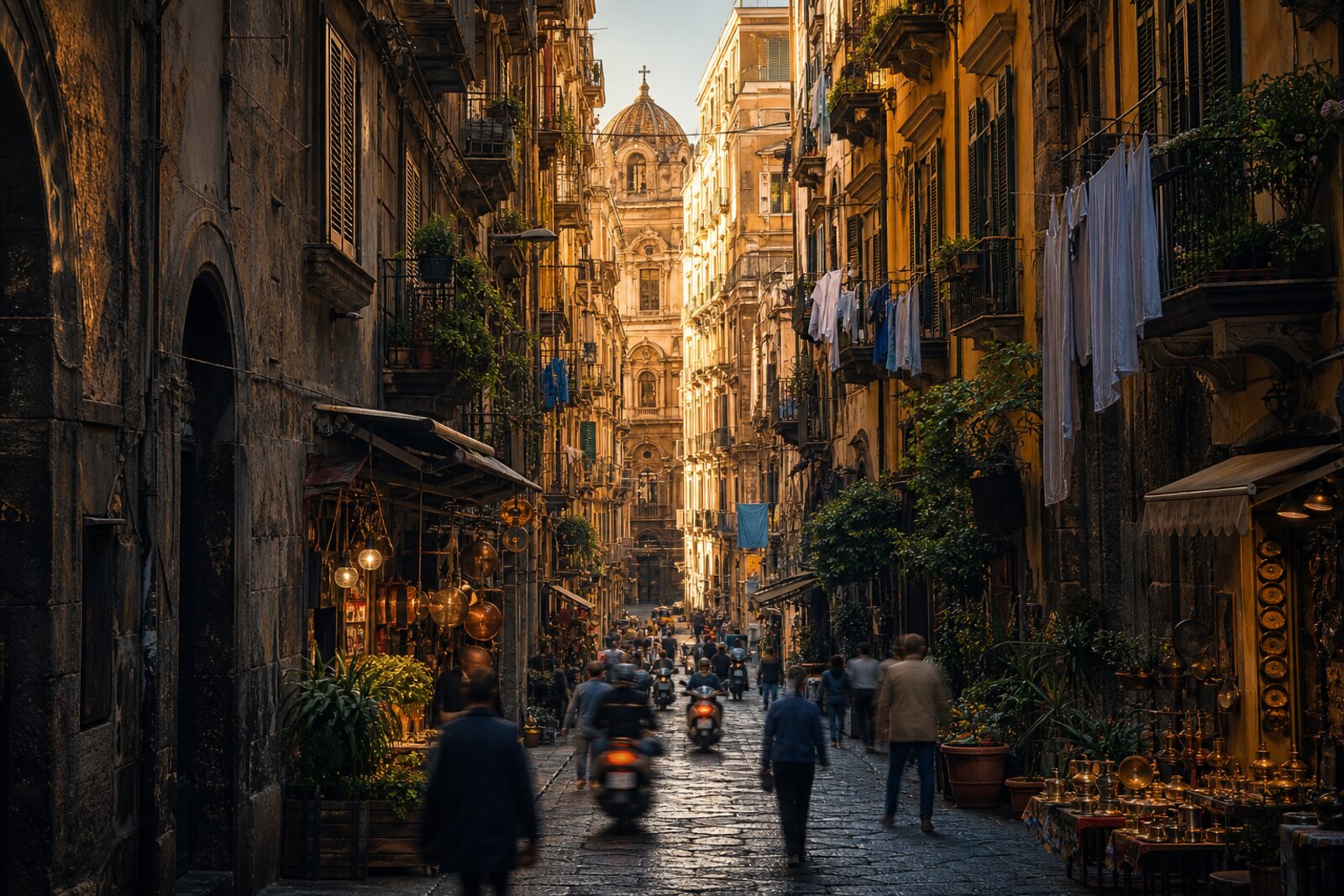
If particular churches are closed, follow the whole route through the streets: façades, squares, portals, the Statue of the Nile God, and craftsmen’s displays carry its story without any required entry. In rain, shorten long stops in open squares, listen to the audio under safe cover, and take extra care on smooth stone. If Via San Gregorio Armeno is very crowded, do not try to inspect every shop or linger in the center of the flow: a few displays are enough, then continue toward Piazza San Gaetano. If your energy runs low, leave the square for the final stretch and end the walk at Naples Cathedral.
Route conditions
Surface. Paved — 1.5 km
Stairs. Flights: 1, 16 m in total
Access. Wheelchair — no; stroller — limited (stairs)
Facilities. Toilets — 3; drinking water — 3
Elevation. Ascent — 14 m; descent — 8 m
OpenStreetMap extract of June 18, 2026: database data, not a check on the ground. Data © OpenStreetMap contributors, ODbL licence
Walk plan
Open in maps ↗- 1
Piazza del Gesù Nuovo
Here the route begins with a space that a prince cleared for his own residence, but which was named after a church. - 2
Complesso di Santa Chiara
The royal complex shows how its founder's personal choice diverged from the dynastic burial place she created. - 3
Piazza San Domenico Maggiore
This stop links the monastery staircase to the career of a man whose family depended on royal favor. - 4
Largo Corpo di Napoli
Here, a lost head changed both the image of an ancient statue and the name of a small urban open space. - 5
Via San Gregorio Armeno
This artisan street shows how one out-of-season figurine changed the calendar of neighboring shops. - 6
Piazza San Gaetano
The low monument preserves the trace of a vow the city’s elected representatives made when ordinary administration could not cope. - 7
Via dei Tribunali
This straight street explains why an ancient urban route acquired the name of the castle at its eastern end. - 8
Naples Cathedral
The finale will show why the cathedral’s principal shrine remains under the shared control of the church and the city’s residents.
Route features
Everything you need stays in the browser
Progress, saves and your trip plan are stored on this device.
Add Guide On Map to your home screen so the walk opens outside the browser.
How we handle sources, maps and corrections: our editorial standards