 Guide On Map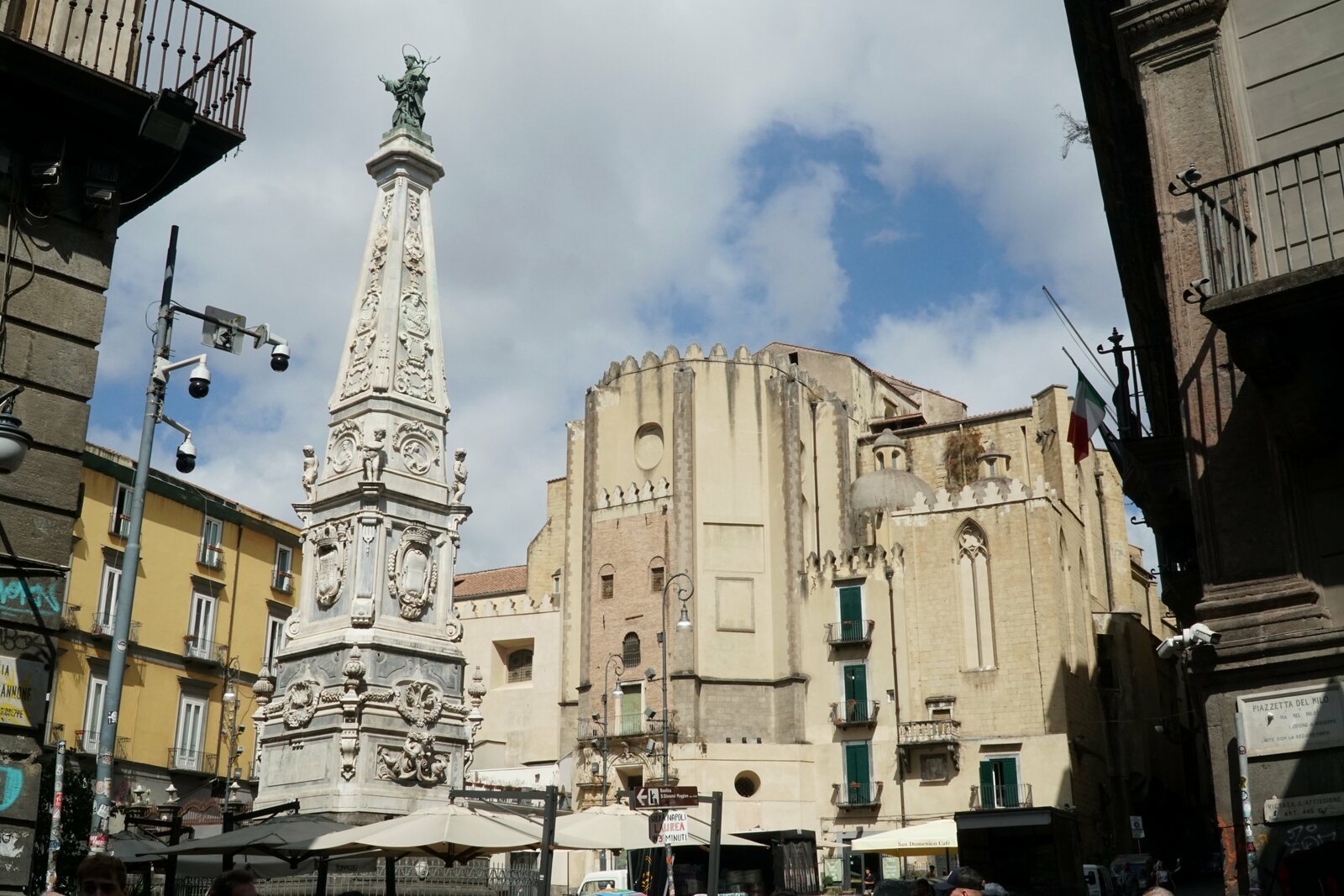
Look around first
What to notice
- Marble spire
- Massive basilica apse
- Staircase to the side entrance
- Door frame of gray volcanic stone
The story of the place
The marble spire in the square by the Dominican monastery stands in front of the church's altar wall. The monument was erected in thanks for the city's salvation from the plague; the first money was provided by the city's elected representatives and the monks. Further donations were expected, but the collection stretched over decades, and the obelisk was completed only in seventeen thirty-seven. Thus the square became a shared monument to the city's disaster and the monastery's vow.
At the center of the square, atop a tall Baroque obelisk, stands Dominic de Guzman, the Castilian priest who founded the Order of Preachers, that is, the Dominicans. For his brothers, study was preparation for preaching: before persuading people, a monk had to understand theology and know how to argue. The Neapolitan Dominicans received the church of San Michele Arcangelo a Morfisa, which stood here, in twelve thirty-one. Later, the Angevin kings built a large basilica beside it. They called it San Domenico Maggiore to distinguish the order's principal house from Naples's other Dominican churches. The square ends at the church's sanctuary; the entrance on this side is reached by a high side staircase.
The obelisk appeared after the plague of sixteen fifty-six. The city's elected representatives and the monks vowed to erect a monument of thanks to Saint Dominic. A monastery record preserves the decision of Prior Domenico di Capua: the city would provide five hundred ducats, the monastery another two hundred, and the work already begun was to encourage the faithful to continue the collection. The first stone was laid two years after the epidemic, but far more donations and patience were needed than the prior had expected. The obelisk was completed only in seventeen thirty-seven.
The most important story of this monastery began in the old church. In the middle of the thirteenth century, Thomas Aquinas studied here, the son of a count and the future author of the Summa Theologiae. He decided to join a mendicant order: a Dominican monk renounced personal property and lived with his brethren. His family did not accept this choice. When the monks sent Thomas to continue his education, his brothers caught up with the group on the road, tore off his religious habit, and held him in the family castle for almost two years. Thomas did not renounce his decision, was released, and returned to the Dominicans.
A quarter of a century later, the order sent him to Naples again—this time to head the school at this monastery and to teach. Thomas lived here with his secretary and assistant, Reginald of Piperno, while continuing the third part of the Summa. In one work, he tried to set out the whole path of humankind, from knowledge of God to rules of conduct and the sacraments of the Church.
On December sixth, twelve seventy-three, Thomas celebrated Mass in the Chapel of Saint Nicholas and afterward stopped writing and dictating. When Reginald asked him to continue the work, his teacher replied that everything he had written seemed like straw to him beside what had been revealed to him. Dominican tradition connects the change with a vision before a painted crucifix and recounts that Christ spoke to Thomas. What exactly happened during the prayer cannot be established. Its consequence is known: the man who taught and dictated every day to several assistants at once never returned to the manuscript. The Summa Theologiae remained unfinished.
Pope Gregory X soon summoned Thomas to a church council in Lyon. Despite his worsening health, the monk set out from Naples, but could not reach France. He died on March seventh, twelve seventy-four, at Fossanova Abbey.
His small cell has survived on the first floor of the monastery. The painted thirteenth-century crucifix before which Thomas is said to have prayed was moved to its altar. A copy is now in the chapel by the side entrance from the square; the original is kept in the room where the Summa Theologiae was left unfinished.
Useful on site
The square is accessible at any time; the church and neighboring complexes may restrict entry during services and events.
Checked: date not specified. Check the official source before visiting.First look around the square from outside; the monastery rooms and individual parts of the church may be inaccessible.