 Guide On Map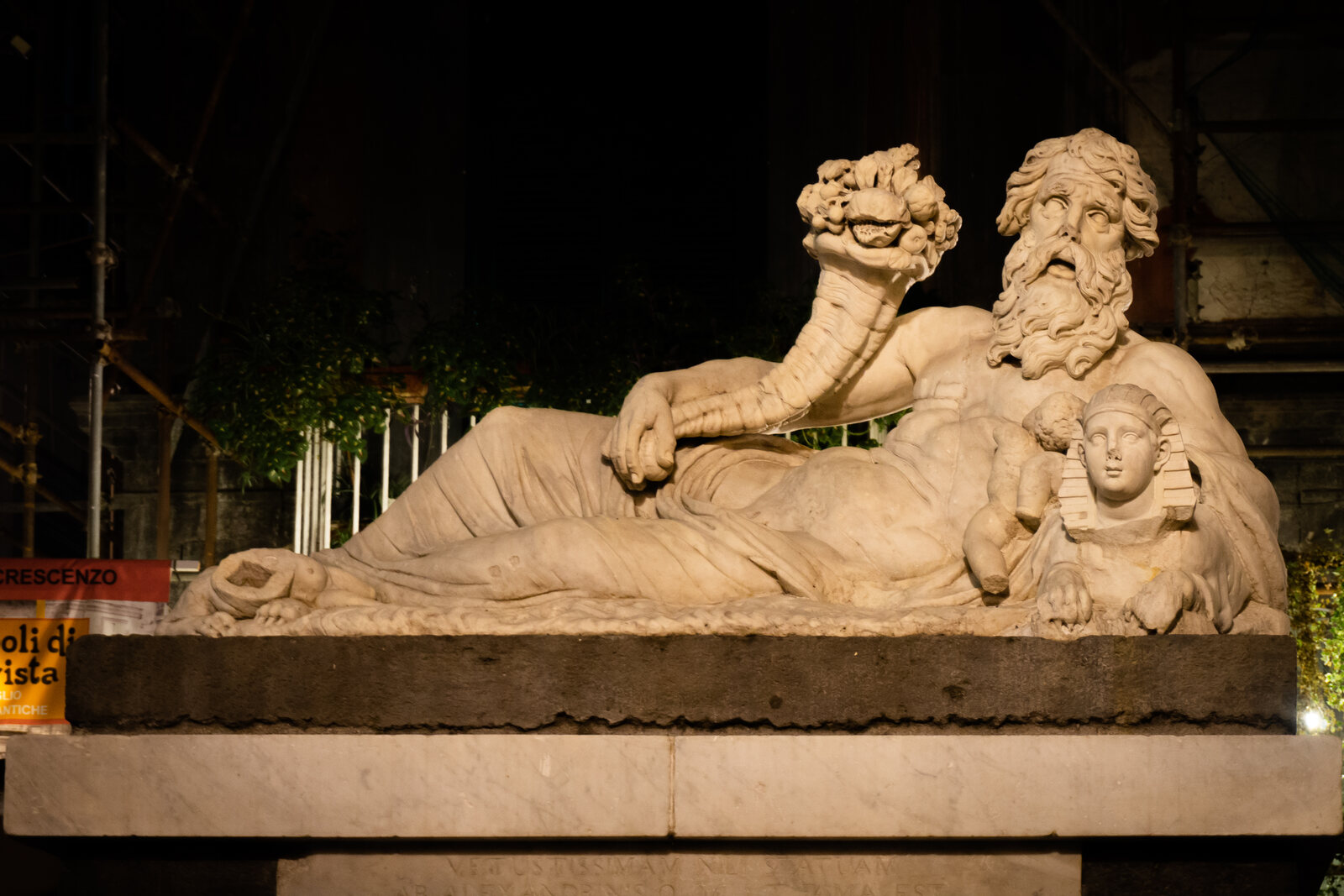
Look around first
What to notice
- Ancient marble torso
- Bearded head
- Cornucopia
- Sphinx and crocodile
The story of the place
In a narrow gap between the streets lies a marble river god; at his feet, the waves, a sphinx, a crocodile, and small figures of the river’s floods have survived. The torso was carved around the second century CE, when people from Alexandria—merchants, sailors, travelers, and slaves—lived in this part of ancient Naples. The community is believed to have commissioned the Statue of the Nile God as a symbol of the river on which the well-being of its distant homeland depended. The ancient torso, legs, waves, and parts of the animals now stand alongside later marble additions, bringing different centuries together in a single figure.
In sixteen fifty-seven, the old building of the Sedile del Nilo—the council of the neighborhood’s noble families—was being dismantled here. Nearby lay a headless marble figure that had given the council its name. The families hired the sculptor Bartolomeo Mori: he was to set the ancient fragment on a separate pedestal and restore its recognizable appearance.
The marble torso is dated to the middle of the second century CE. It was found in the part of ancient Naples where people from Alexandria lived: merchants, sailors, travelers, and slaves. For the first two groups, the sea was both a livelihood and a constant risk. Tradition attributes to them the commission of the Statue of the Nile God—a river on which the well-being of their homeland depended. The inscription on the pedestal cautiously repeats that the statue was erected by Alexandrians, “as is reported.” Archaeologists do not know the exact patron or the original location; the sculpture may even have stood in the garden of a wealthy house. Its Egyptian origin, however, is clear: an old man lay among waves, with a sphinx, a crocodile, and small figures representing the river’s floods beside him.
By the Middle Ages, the old man’s head had disappeared. The remaining body with its marble children came to be understood differently. In the Chronicle of Parthenope, compiled in the fourteenth century, the figure is described as a beautiful woman feeding five infants. People saw Naples itself in her—a mother city nourishing its inhabitants. The statue was called ’O Cuorpo ’e Napule, the Body of Naples, and the name then passed to the small urban open space around it: Largo Corpo di Napoli.
Mori gave the figure a male head with a beard, made a new right arm with a cornucopia, restored the heads of the sphinx and crocodile, and added the missing children. After his work, the Nile God once again lay before the city’s residents, while the families of the Sedile preserved the neighborhood’s old emblem on a new pedestal.
In the current statue, the torso, legs, left shoulder, waves beneath the body, and parts of the animals are ancient. The bearded head, right arm, and cornucopia appeared in later restorations. The square’s name remained from the centuries when the head was still missing and the Nile God was mistaken for a woman with children.
Useful on site
The small square is open at all times.
Checked: date not specified. Check the official source before visiting.The statue stands in an active street space; view it without blocking pedestrian or vehicle passage.