 Guide On Map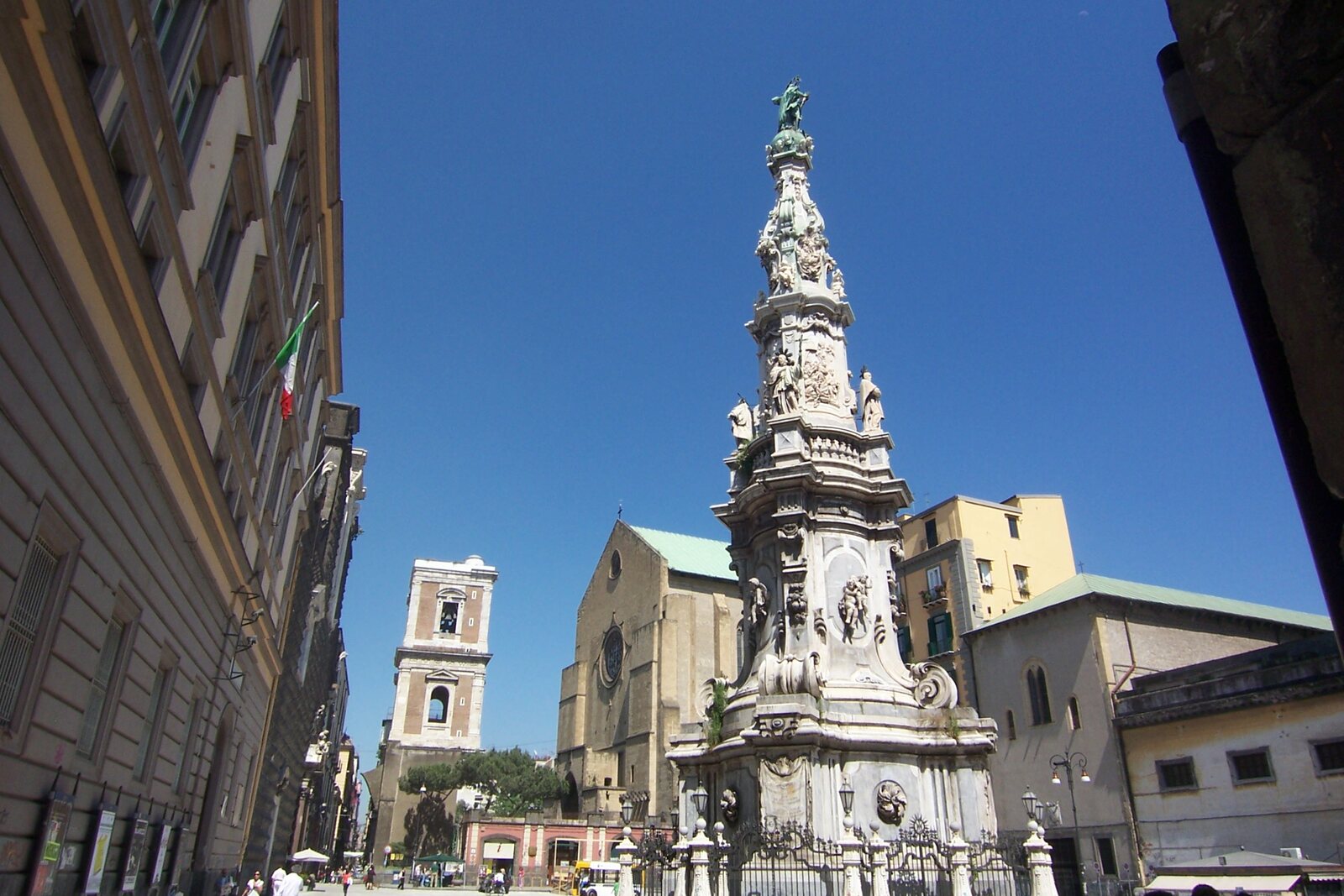
Look around first
What to notice
- Façade of dark stone diamonds
- Stone portal
- The open space of the square
The story of the place
Services are held behind the dark diamond-patterned masonry and stone portal of this church of the Society of Jesus. In fifteen eighty-four, the order bought the old residence, dismantled most of its rooms, and established a church within its stone shell. The façade and portal remained outside, which is why the church still resembles an austere palace.
The dark façade with its stone diamonds originally belonged to a palace. In the first half of the sixteenth century, Ferrante Sanseverino lived here—the Prince of Salerno, the owner of extensive feudal estates, and a man who wanted to turn his Neapolitan residence into the main stage for his family. The princely court was supported by income from inherited lands; losing the favor of the Spanish Crown meant losing money, house, and title.
Ferrante wanted the palace to be visible in its entirety. He bought the houses opposite from the nuns of Santa Chiara and ordered them demolished. A broad space opened before the façade in their place—the foundation of today's square.
In fifteen forty-seven, the viceroy Pedro de Toledo attempted to establish an Inquisition tribunal in the Kingdom of Naples, modeled on the Spanish one. Such a court answered to the Crown, and an accusation of heresy could destroy a political opponent along with his property. The people of Naples entrusted Ferrante with securing the reversal of the decision from Emperor Charles the Fifth. The tribunal did not then appear in the form intended, but the prince's clash with the viceroy and the Spanish court became open.
In fifteen fifty-two, Ferrante fled to France. He was declared a rebel, and all his possessions were confiscated. He died in exile, and with him the senior line of the Princes of Salerno came to an end. The palace, for which he had cleared an entire square before him, passed to the treasury and was put up for sale.
In fifteen eighty-four, the Society of Jesus bought it. They dismantled most of the living quarters and created a church behind the old façade. The stone cladding and portal of the princely house were preserved; that is why the active church still looks like a fortified palace from the outside.
“Gesù” means “Jesus” in Italian. The Society of Jesus already had a church in Naples with that dedication. After this church appeared, the earlier one came to be called Gesù Vecchio—Old Jesus—and the new one, Gesù Nuovo—New Jesus. Ferrante's palace left behind its façade and portal. His wish to open the palace to view left behind the space of the square. The square was named after the church established in his confiscated house.
Useful on site
The square is accessible at any time; the church interiors and neighboring complexes operate on separate schedules.
Checked: date not specified. Check the official source before visiting.The history can be read from the square itself; go inside only if the church is open and no service is in progress.