 Guide On Map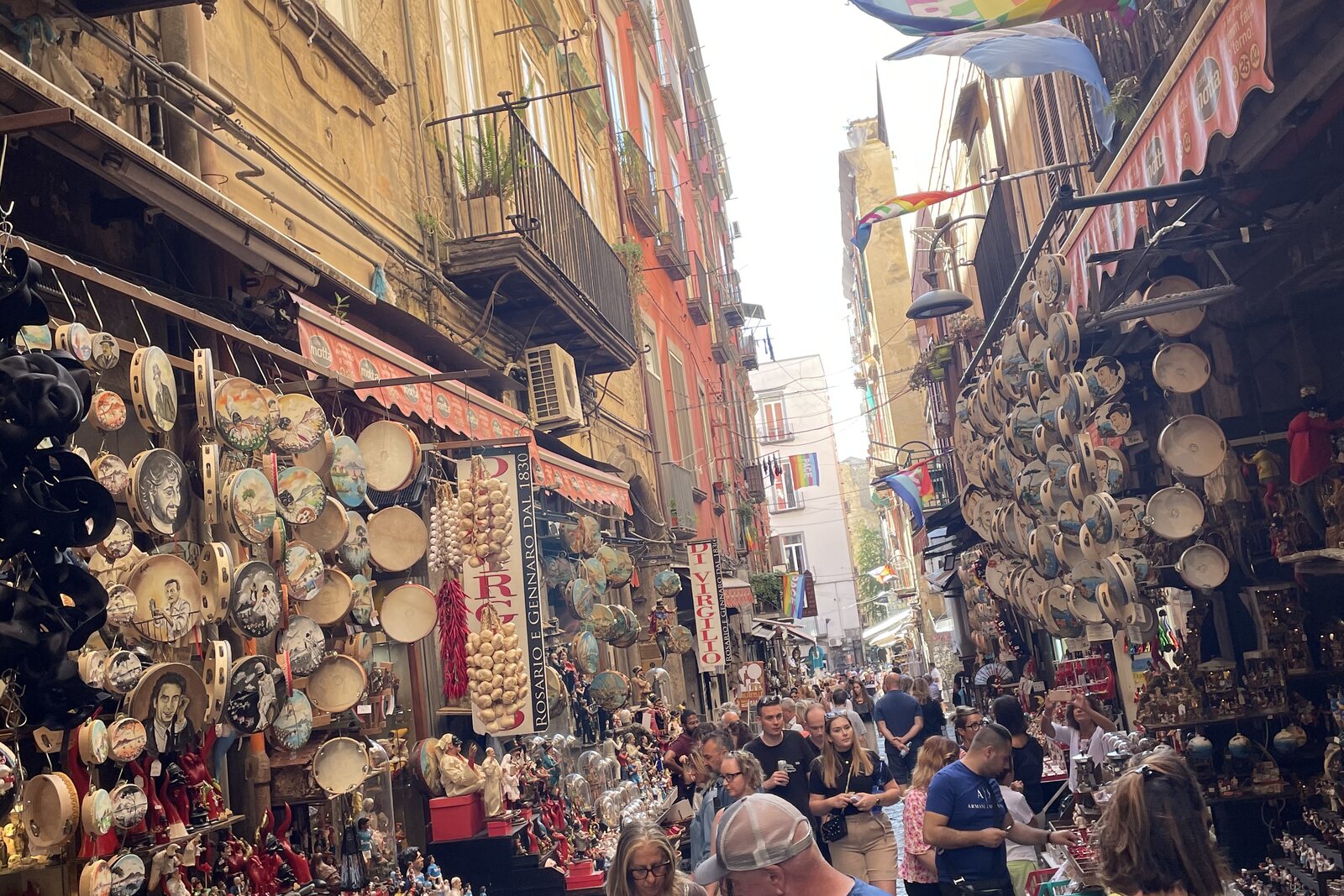
Look around first
What to notice
- Bell tower above the street
- Nativity-scene displays
- Terracotta figurines
- Figurines of footballers and actors
The story of the place
A customer who came for a home nativity scene went from shop to shop on this short street: by the nineteenth century, family workshops of pastoraio, who made characters for Christmas scenes, had gathered here. A bell tower runs above the narrow display windows, once linking parts of the monastery. The street is named after the church dedicated to Gregory the Illuminator; according to monastery tradition, nuns came here from Constantinople with his relic and settled nearby.
Among the Magi, shepherds, and the Holy Family stand footballers, actors, and people whose names appeared in the news only very recently. This practice was introduced by Giuseppe Ferrigno, a maker of nativity-scene figurines, born on Via San Gregorio Armeno and working in the family shop founded in eighteen thirty-six.
The Neapolitan nativity scene had long allowed itself such freedom. In the eighteenth century, Christmas scenes moved from churches into palaces and wealthy homes. Patrons competed in size and detail, while craftsmen populated the space around the manger with merchants, beggars, innkeepers, and tavern visitors. A separate profession emerged to make them: the pastoraio. By the nineteenth century, family workshops had concentrated on this short street: a customer who came to one craftsman passed all the others. That is how the craft became tied to this address.
Yet trade remained seasonal. According to the recollections of Marco Ferrigno, Giuseppe's son, the shops opened on the first of November and closed on the twenty-fourth of December. The premises then became grocery and toy shops again. In nineteen seventy-seven, Giuseppe decided to keep his workshop open all year round. He was taking a risk by selling Christmas goods when nobody yet needed Christmas.
Football brought him customers. In nineteen eighty-seven, Napoli became champions of Italy for the first time, and Giuseppe placed Diego Maradona in a nativity scene. People came for the figurine even after the holidays. Five years later, the craftsman modeled Antonio Di Pietro, the prosecutor who became the face of the Mani Pulite investigation. Giuseppe was accused of blasphemy, and hundreds of people stood outside the shop. The terracotta figurines were supposed to be fired for twelve hours at a temperature of about nine hundred sixty degrees. The kilns could not keep up, and some customers agreed to take Di Pietro unfired.
After that, journalists began asking Ferrigno who would become the character of the year. Then one hero a year proved too few: craftsmen began responding to events almost every month. The street gained customers outside the Christmas season, and other shops also switched to year-round work. After Giuseppe's death, Marco took over the workshop; when Marco was six, his father would give him a piece of clay while his parents worked nearby.
A bell tower arches over the shops, linking parts of the monastery. It explains the street's name. “Armeno” here means “Armenian,” and Gregory is Gregory the Illuminator. According to a Christian hagiography, at the beginning of the fourth century he brought about the conversion of the Armenian king Tiridates to Christianity and became the first head of the Armenian Church. Gregory never visited Naples.
According to monastery tradition, in the eighth century nuns fled Constantinople from the persecution of those who venerated sacred images and brought part of his remains here to save them from destruction. The precise route taken by the relics is not confirmed by documents—it is a monastery tradition. The nuns settled here, dedicated the church to the saint they had brought, and the name passed from the church to the street. Gregory's skull is still kept in a side chapel.
Maradona is still sold beneath the bell tower among the shepherds and Magi. It is the figurine for which customers first came to Giuseppe Ferrigno not in November and not in December.
Useful on site
The street is always open; the workshops keep their own schedules and greatly change the rhythm of the flow in high season.
Checked: date not specified. Check the official source before visiting.Do not linger too long in front of one display window if a flow is gathering behind you; plan a visit to the monastery separately.