 Guide On Map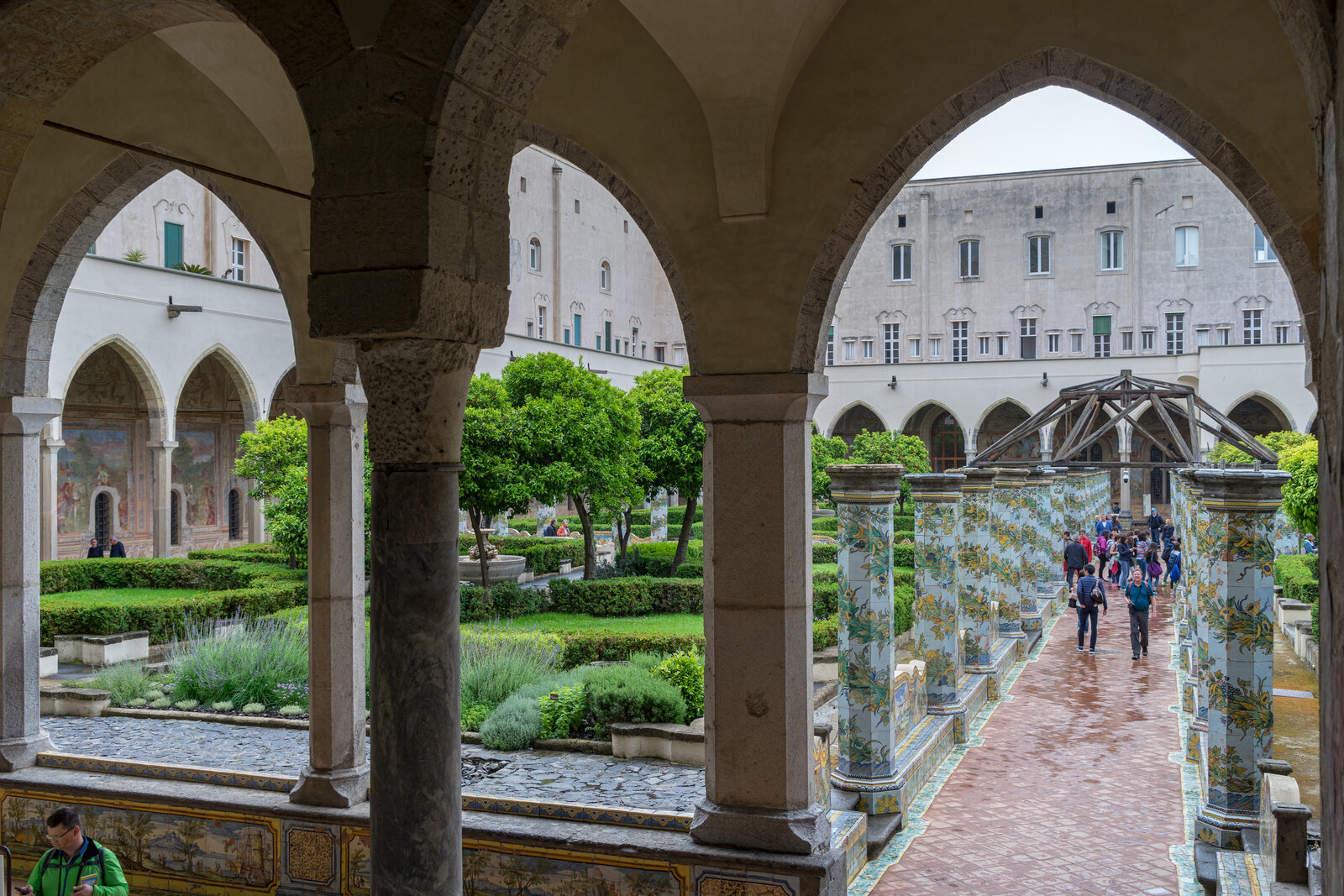
Look around first
What to notice
- Sancia's coat of arms above the entrance
- The wall behind the high altar
- Robert's tomb
The story of the place
The creators of the complex placed the church between the women's and men's Franciscan monasteries. Townspeople and the brothers came into the church, while the Poor Clares lived in enclosure. Behind the high altar, the wall separating their choir from the nave has been preserved; the nuns heard the service through three barred openings.
The coat of arms on the façade belongs to Sancia of Majorca, Queen of Naples, who wanted to live by the Franciscan vow of poverty but had to fulfill the duties of a monarch's wife. At eighteen, she was married to Robert of Anjou: the marriage cemented an alliance between two dynasties. Sancia brought an enormous dowry, received income from lands, and, contrary to the customs of her time, managed this property herself. She had her own stewards, money, and the means to found monasteries.
After the couple's coronation in thirteen oh nine, Sancia set about what she needed these funds for. Together with Robert, she began building an entire Franciscan citadel here: a convent for Poor Clares, a men's monastery for Franciscan brothers, and a shared church between them. The two communities lived side by side, but separately.
The Poor Clares took their name from Clare of Assisi, a follower of Francis of Assisi and founder of the women's community. Clare secured from the pope the right to live without property—even the phrase “privilege of poverty” seemed unusual to her contemporaries. Sancia sought to follow precisely this strict model. She ordered nuns to be recruited for the Neapolitan convent from across the Kingdom of Naples and personally intervened in its rules and administration. The church was first dedicated to the Holy Body of Christ, but because of the large community of Poor Clares, it was almost immediately called Santa Chiara.
The queen herself planned to become one of them. In thirteen thirteen, she announced that after her husband's death she would retire to this convent. Later, she wanted to observe chastity while still married and renounce secular life altogether. John XXII opposed this: the queen remained involved in governing the kingdom, and among the Franciscans close to her were supporters of strict poverty who disputed with the pope. In thirteen thirty-three, John even stripped Sancia of leadership of Santa Chiara and entrusted its supervision to his trusted head of the order.
Robert, King of Naples and Sancia's husband, saw another purpose for this place. The Poor Clares and Franciscans were to pray for his family, while the church was to become the burial place of the Angevin dynasty. That is why a wall appeared behind the high altar: on one side was a large church for townspeople and the brothers, and on the other, the enclosed choir of the nuns. The Poor Clares took part in services through three barred openings, without leaving their enclosure.
When Robert died in thirteen forty-three, he charged his wife with leading the council for the young heiress Giovanna and carrying out his will. Sancia ordered an enormous tomb for her husband to be built above the high altar and organized memorial prayers throughout the kingdom. Robert's tomb depicts him as both king and Franciscan: in monastic dress, but with a crown.
Sancia could not preserve the previous order after her husband's death. Robert's relatives disputed the inheritance, and the pope sent his representative to oversee the affairs of the kingdom. After completing the prescribed widow's mourning, on January twenty-first, thirteen forty-four, Sancia gave up her duties and became a Poor Clare. But she did not go here, instead entering another Neapolitan monastery she had founded—Santa Croce. There she took the name Sister Clare and died a year and a half later.
Inside Santa Chiara, Robert's tomb still stands on the wall that separated the main nave from the choir of the Poor Clares. From the church side, the king is visible on his throne; on the side of the former monastic choir, there is another depiction of him. The two communities did not see one another, but they prayed for the same deceased man. Robert remained at the center of the burial place created by the spouses, while Sancia is represented here by her coat of arms above the entrance.
Useful on site
The complex, cloister, museum, and archaeological area operate according to the operator's schedule; check the official website on the day of your visit.
Checked: date not specified. Check the official source before visiting.The basilica and monastic section may have different access arrangements; consider the paid courtyard a separate extra.