 Guide On Map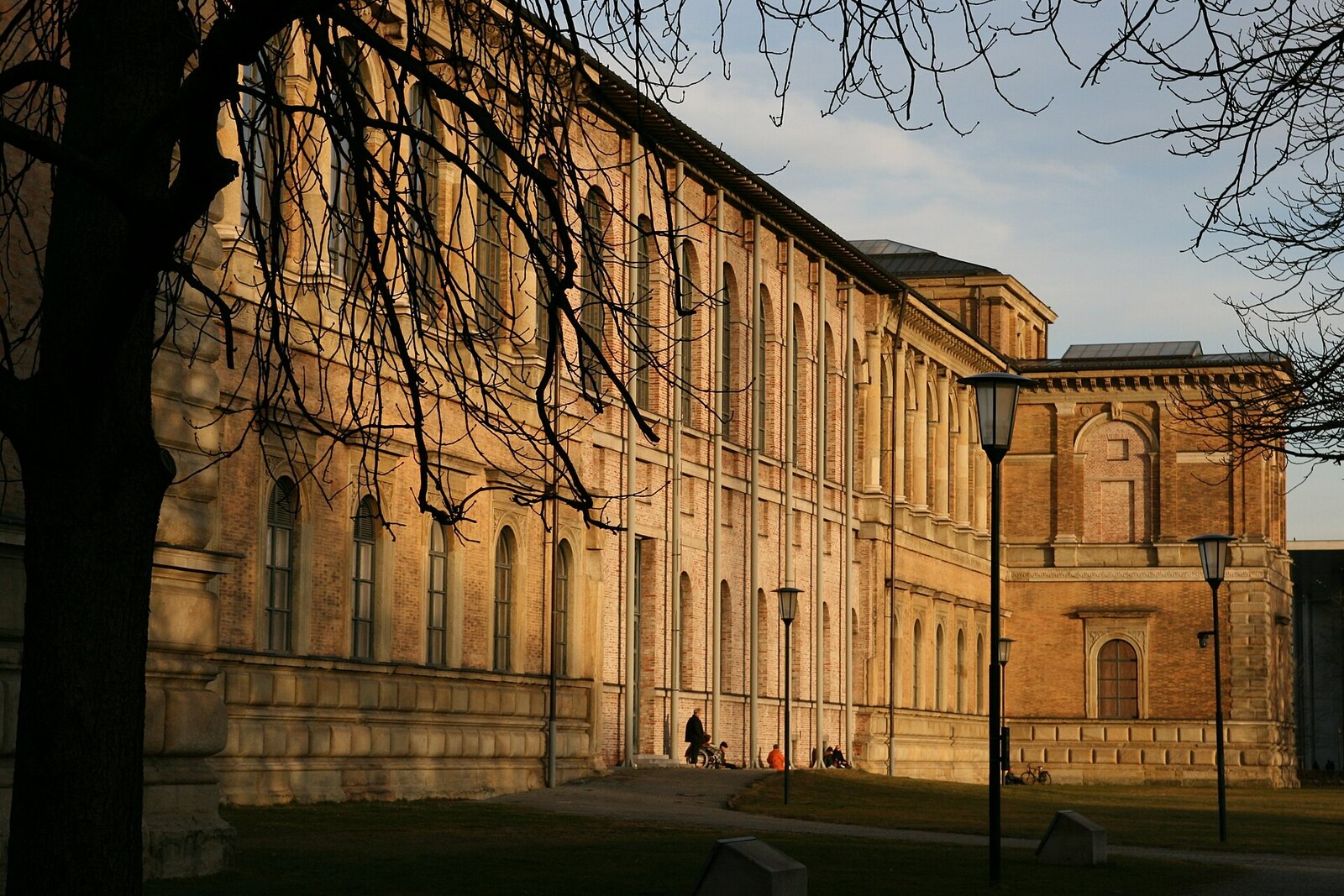
Look around first
What to notice
- The boundary between the old and new masonry
- The broad staircase
- The eastern portal with stone lions
The story of the place
For six years, Munich architect Hans Döllgast drew up a plan to save this gallery without a commission and without knowing whether his work would ever be accepted. He began in nineteen forty-six, when the Alte Pinakothek had no roof, its rooms had burned out, and a breach about forty meters wide gaped in its southern wall.
Before the war, old European masters from the House of Wittelsbach collection were displayed here. King Ludwig I of Bavaria wanted to turn the dynastic collection into a public museum and commissioned court architect Leo von Klenze to build a separate gallery for it. The site was chosen beyond the city limits of the time: there was open space around it, and fire posed less of a threat to the paintings. The building opened in eighteen thirty-six and was called simply the Pinakothek—from the Greek word for a collection of paintings. When a museum of painting modern for that era was built nearby, the word “Old” was added to the former name.
During the war, staff moved the paintings to safe storage, including Neuschwanstein Castle and Herrenchiemsee Palace. The paintings could return, but there was nowhere for them to return to. In the first postwar years, officials compared the cost of restoration with the price of a new building and seriously discussed demolishing Klenze’s fire-damaged walls.
Döllgast insisted on preserving these very walls. His estimate was so far below the state budget estimate that the Bavarian Landtag allocated half a million marks for the work. In nineteen fifty-two, the architect finally received an official commission.
He was allowed to save the ruin, but far from all his decisions were accepted. Döllgast proposed closing the breach with a glass façade and leaving the loggia open. The building authority rejected this plan and demanded a brick wall. Staircases that were already half built were dismantled; the interior layout, too, was carried out not exactly according to his drawings. The architect preserved the surviving section and made up for what had been lost with simplified forms. For the new sections, bricks were taken from the ruins of neighboring barracks on Türkenstraße, and their different shade was not concealed with plaster.
In nineteen fifty-seven, the paintings returned to the newly opened halls. European painting from the Middle Ages to the eighteenth century is displayed here again, but the route inside now belongs to Döllgast: he moved the main entrance from the eastern side to the northern one and created a broad staircase on the site of the southern loggia.
On the southern façade, the boundary between the old and new masonry outlines that same forty-meter breach. Döllgast’s staircase begins behind it. The stone lions on the eastern side still mark Klenze’s entrance, although visitors enter from the opposite side.
Useful on site
A city route stop; if you plan to go inside, check the venue’s schedule and visiting rules on its official website.
Checked: date not specified. Check the official source before visiting.The traces of restoration are visible from outside without a ticket. Allow separate time in the halls for Albrecht Altdorfer, Albrecht Dürer, and the Boisserée Collection.