 Guide On Map
Merchant Zamoskvorechye: from Sofiyskaya Embankment to Bolshaya Ordynka Street
From Pavel Kharitonenko City Estate through Kadashi to Marfo-Mariinsky Convent
Guide On Map on your phone
Open the walk like a regular app
It takes about 10 seconds to install. No app store needed.
The whole path
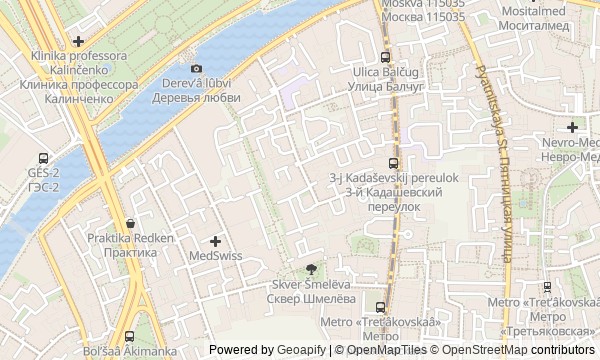
Route map
About the walk
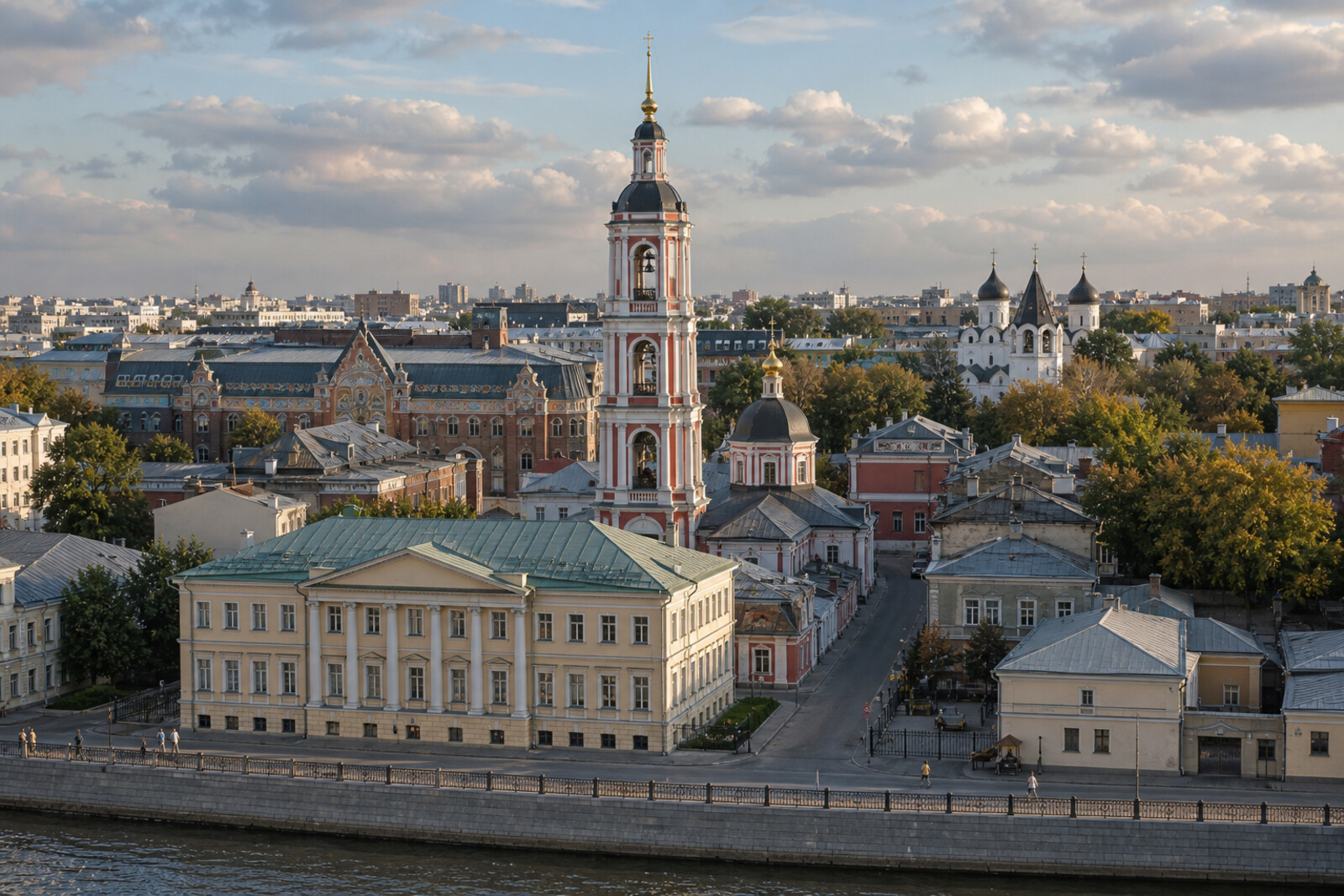
From Sofiyskaya Embankment, you will walk through Kadashi toward Bolshaya Ordynka Street. Open space by the water will give way to narrow lanes, old chambers to church courtyards. Then the route will reach the main façade of Tretyakov Gallery and continue among the estates.
This walk is not about wealth put on display. You will see what Moscow merchants did with the money they earned, and what happened to their homes, collections, and institutions once the owners were gone. Why would a collector lock up a free gallery? How would children live in an estate that no longer belonged to their family? What was a tower doing in the courtyard of an apartment building?
The story rests on private choices and small human scenes, without the grand rhetoric of Moscow. By the end, you will be able to read Zamoskvorechye through the things people invested their fortunes in: paintings for the city, science, a parish, and care for the sick.
Why this order
On Sofiyskaya Embankment, the route begins with a merchant house set before the Moscow Kremlin; crossing the Vodootvodny Canal into Kadashi shifts the focus from a grand façade to the inner workings of an old sloboda. The Chambers of Kadashevskaya Sloboda reveal its economic foundations, followed by the parish church—the shared undertaking of those same merchant households. From the bell tower, Lavrushinsky Lane leads to Tretyakov Gallery: a private collection shows how a fortune passed from a home into the city. Just behind the gallery, Dolgov–Zhemochkin Estate turns the idea around: after the revolution, the public order entered a private courtyard. From its corner, Klimentevsky Lane brings you to a church where a merchant funded not only construction, but its continuing service. The return to Bolshaya Ordynka Street continues with Arshinov House, where family money became an Institute of Mineral Resources. The neighboring convent completes the route with one more transformation of a private estate—into lasting help for others.
Those who want to understand merchant Zamoskvorechye through the fates of its houses and the money invested in them Fans of urban architecture, private collections, and the history of charity Those planning to pair the walk with the permanent collection at Tretyakov Gallery
Those looking for a route made up only of Moscow’s best-known postcard sights Those who do not enjoy detailed historical stories and frequent stops Those seeking a walk without churches and religious history
Before you go
Think of this primarily as an outdoor route: Pavel Kharitonenko City Estate, the chambers, Dolgov–Zhemochkin Estate, and the Arshinov complex do not offer regular tourist entry. Decide in advance whether you will visit Tretyakov Gallery: its collection requires separate time and preparation, so it is easier either to limit yourself to the story outside the building or to make it an independent part of the day. The Church of the Resurrection of Christ in Kadashi and Church of St. Clement the Pope are active; if the doors are open, enter quietly, do not disturb the service, and be prepared to remain outside. For a visit to the house museum or a tour of Marfo-Mariinsky Convent, check booking requirements in advance. Comfortable shoes matter more than museum pace: there are many stops, and the stories are best heard without rushing.
When to go
Allow about three hours for the full route with exterior viewing and audio stories. Visiting the permanent collection at Tretyakov Gallery will take at least two more hours, so it makes sense to treat it as a separate part of the program.
Backup plan
In bad weather, spend less time at the estates and chambers, but do not skip their stories: you can easily finish listening beneath the nearest shelter without trying to get inside. The longest pause can move to Tretyakov Gallery if you have prepared the visit in advance, or to Church of St. Clement the Pope when it is open and no service is underway. Do not count on access to the Church of the Resurrection of Christ in Kadashi or Marfo-Mariinsky Convent without checking their current arrangements. If museums are unavailable, the route still works as a sequence of outdoor stops: the façades and ensembles offer plenty to see, while Soviet reuse and losses are explained in the audio.
Route conditions
Surface. Paved — 2.4 km (data covers 79% of the route)
Facilities. Toilets — 3
Elevation. Ascent — 22 m; descent — 18 m
OpenStreetMap extract of July 9, 2026: database data, not a check on the ground. Data © OpenStreetMap contributors, ODbL licence
Walk plan
Open in maps ↗- 1
Pavel Kharitonenko City Estate
This is where the story begins of a merchant's house that preserved its ceremonial rooms but lost the family collection. - 2
Chambers of Kadashevskaya Sloboda
This stop explains which craft enabled the residents of the sloboda to build stone houses amid wooden Moscow. - 3
Church of the Resurrection of Christ in Kadashi
The story of one bell that was taken down will reveal an unexpected consequence of the church’s closure. - 4
Tretyakov Gallery
The route’s main stop shows how a private house and a painting collection became a municipal museum. - 5
Dolgov–Zhemochkin Estate
The fate of one family makes it possible to see nationalization not in documents, but within a familiar courtyard. - 6
Church of St. Clement the Pope
Here it will become clear why paying for the walls was not enough, and how a merchant provided for the parish's future life. - 7
Arshinov House and “Lithogaea”
A private laboratory will link a merchant family project with a major state institute. - 8
Marfo-Mariinsky Convent
The final stop will show how a private estate was adapted for a hospital, a shelter, and the work of the Sisters of Mercy.
Route features
Everything you need stays in the browser
Progress, saves and your trip plan are stored on this device.
Add Guide On Map to your home screen so the walk opens outside the browser.
How we handle sources, maps and corrections: our editorial standards