 Guide On Map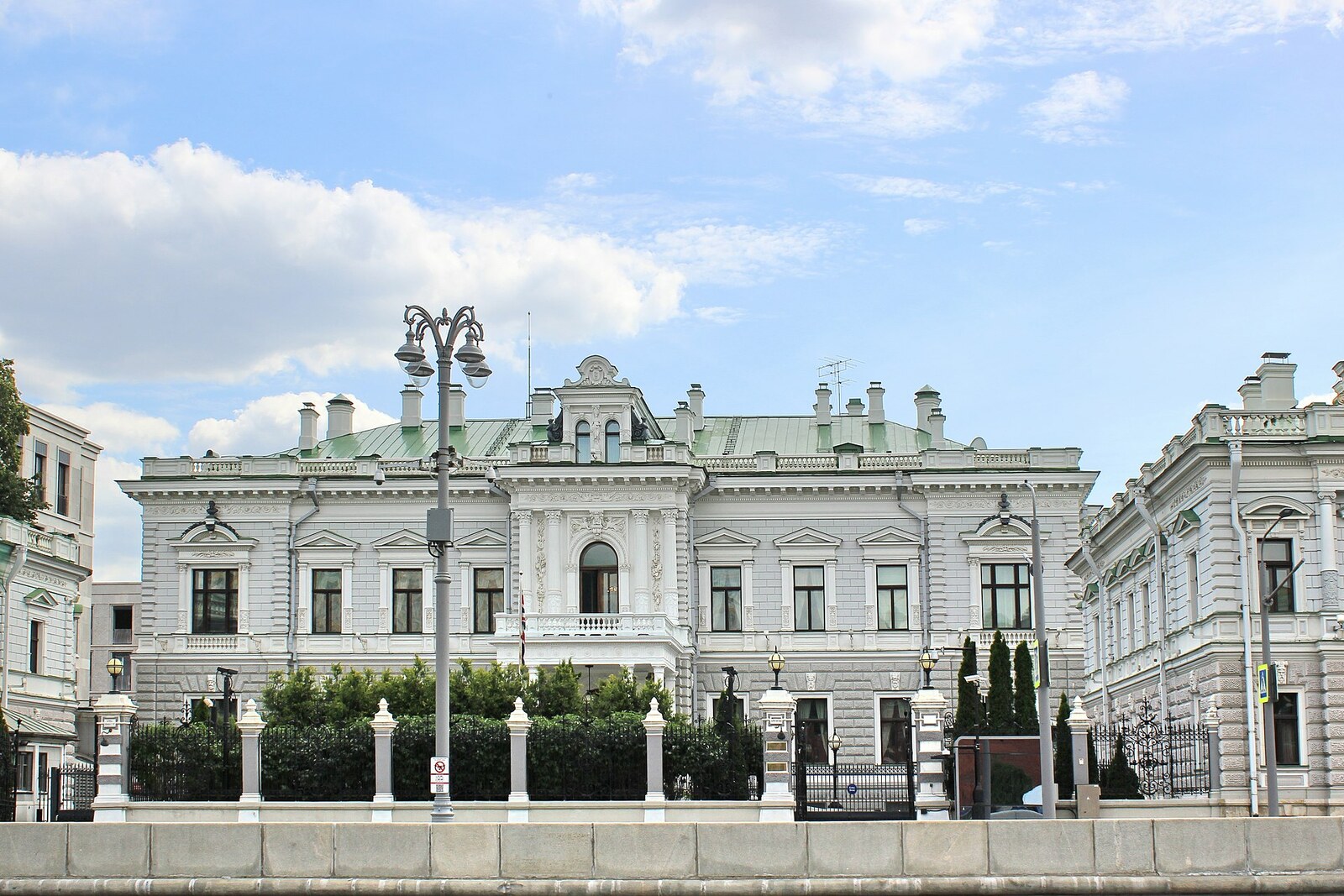
Look around first
What to notice
- The main house above the embankment
- Two side wings
- The balcony on the river side
- Plaques on the gateposts
The story of the place
The house number and the former owner's surname can still be read on the gateposts at the entrance. Behind them stands the main house with two side wings, raised above Sofiyskaya Embankment; its balcony faces the Moscow Kremlin across the river. The ceremonial rooms, ballroom, and painting gallery now form part of a diplomatic residence.
Pavel Kharitonenko settled on Sofiyskaya Embankment thanks to sugar. He inherited seven sugar factories and one refinery and ran the family trading house. His father Ivan bought this property for the Moscow office and warehouse. Pavel moved to Moscow for good and decided that the heir to such a fortune needed a house befitting his new position.
The site was convenient for business: the firm's warehouse stood nearby. It had another advantage too: from the balcony, the Moscow Kremlin could be seen across the river. In eighteen ninety-one, Kharitonenko commissioned Vasily Zalesky to build the main house and two wings, and Fyodor Shekhtel to decorate the ceremonial rooms. Construction was completed two years later. The date was carved into a wooden panel by the inner staircase: eighteen ninety-three.
Kharitonenko collected Russian and European paintings and ancient icons. A separate gallery was arranged for paintings beside the ballroom. The owner did not embrace the latest art and was considered a man of old-fashioned taste among Moscow collectors, yet he invited the finest artists. In nineteen oh one, Valentin Serov sat for him here—a celebrated portrait painter whom clients feared for his habit of painting faces without courtly flattery. Serov portrayed Kharitonenko in a black suit, with a grave, attentive gaze. The portrait remained in the owner's collection alongside paintings by Kramskoy, Repin, Surikov, and other masters.
Pavel Kharitonenko died in nineteen fourteen. His widow Vera continued to run the firm, but after the revolution the family lost the estate and left the country. A struggle of another kind began over the house. The Tretyakov Gallery, a museum of Russian painting, and the Rumyantsev Museum, a major Moscow collection of books and art, wanted to open a museum branch here. Everything was already ready for it: the gallery hall, the ceremonial rooms, and the collection on the walls.
The People's Commissariat for Foreign Affairs occupied the house—an institution responsible for the new state's relations with other countries. Diplomats promised to transfer the estate to the Tretyakov Gallery later, but did not do so. For the Kharitonenko family, the house was lost; the museums received the paintings, but not the building. In the mid-nineteen twenties, the collection was removed and divided among the Tretyakov Gallery, the Museum of Fine Arts, the Russian Museum, and the Hermitage Museum. In nineteen thirty, the People's Commissariat for Foreign Affairs transferred Serov's portrait of the owner himself to the Tretyakov Gallery.
A year later, the British Embassy moved into the vacated rooms. It remained here for almost seventy years, and after the embassy's offices moved in nineteen hundred, the estate became the residence of the British ambassador.
Kharitonenko's gallery hall has survived, but its paintings are no longer there. The owner's portrait is in the Tretyakov Gallery, the ceremonial rooms serve as a diplomatic residence, and old plaques bearing the house number and the owner's surname remain on the gateposts.
Useful on site
View from the publicly accessible Sofiyskaya Embankment; no public entry to the estate is stated.
Checked: June 24, 2026. Check the official source before visiting.This is an active diplomatic residence: view the house only from publicly accessible space and do not expect to see the interior.