 Guide On Map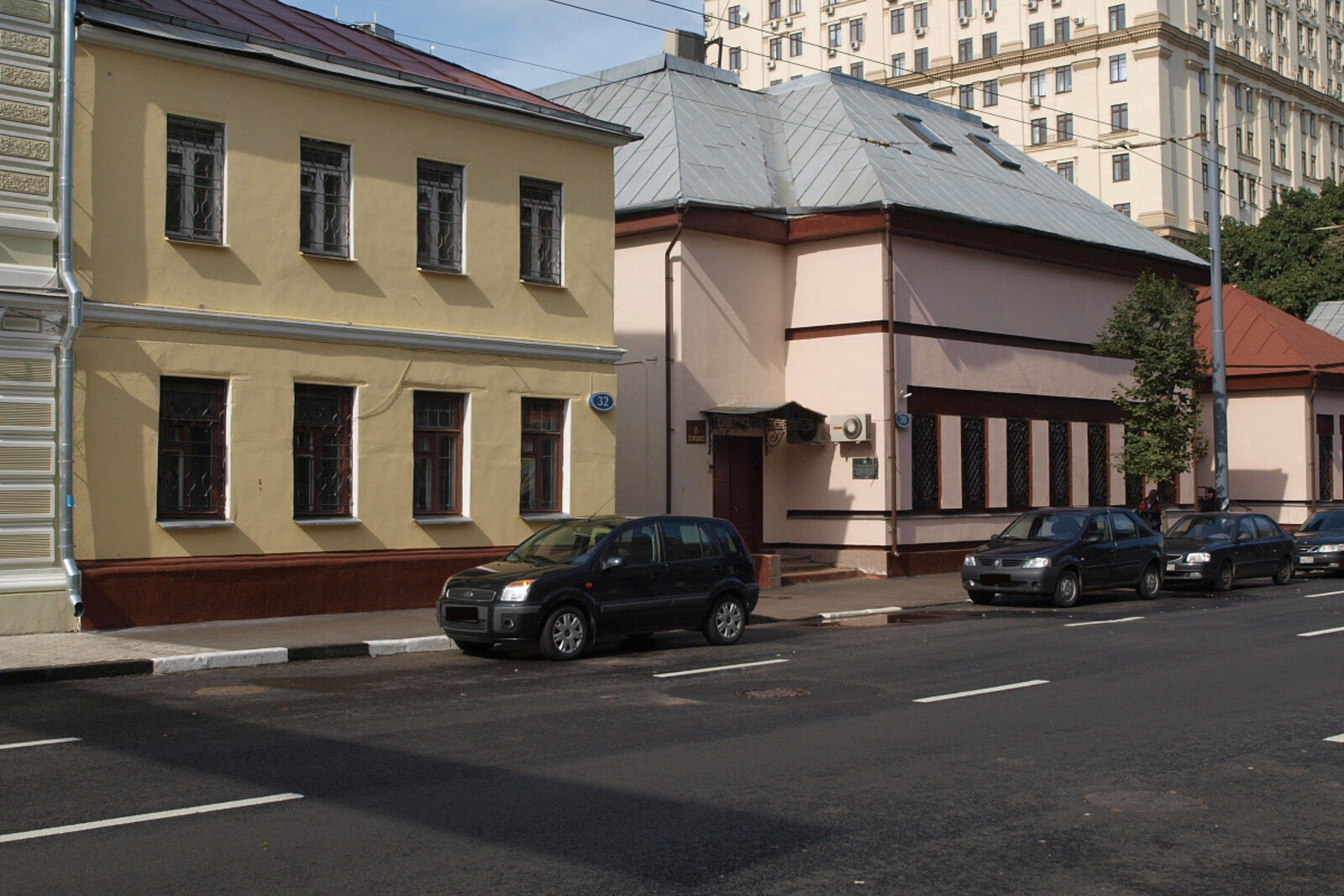
Look around first
What to notice
- The two-story building deep within the quarter
- The tower above the old building
- Later laboratory buildings
The story of the place
A low building with a tower is hidden among the later laboratory buildings on Bolshaya Ordynka Street. Here, geologists turned pieces of rock into almost transparent plates and examined them under polarizing microscopes to see the structure of minerals. Samples were brought from the Urals, the Caucasus, and other regions of the country, in hopes of finding tungsten, copper, sulfur, or corundum in them. Later, the buildings of the present-day Institute of Mineral Resources rose around it, while the old house remained inside this scientific quarter.
In nineteen oh four, the merchant Vasily Arshinov commissioned Fyodor Shekhtel to build a two-story house at the back of his plot on Bolshaya Ordynka Street. The family already lived here; the new building was intended for his eldest son, Vladimir, a mineralogist who wanted to study rocks and Russian mineral deposits.
Vasily Arshinov began as a boy in a cloth shop, grew wealthy through the textile trade, and established his own partnership. He himself received almost no systematic education, but he paid for his son's university studies, an internship in Germany, and a separate laboratory. Vladimir brought back polarizing microscopes, reagents, scientific books, and instruments. Shekhtel arranged rooms for research and a tower with an observatory. According to archival estimates, the father invested about seven hundred thousand rubles, earned from cloth, in the undertaking.
In the laboratory, stone was turned into the finest transparent plates—thin sections. Under a polarizing microscope, minerals revealed a structure and composition that could not be seen in an ordinary fragment. Vladimir named the institution “Lithogaea,” meaning “stone earth.” Here, they studied rocks brought from the Urals, the Caucasus, and other regions, searching for tungsten, copper, sulfur, and corundum. The small laboratory became Russia's first private geological research institute. Nineteen ten is considered the official beginning of its work, when Arshinov published the first volume of the proceedings of Lithogaea.
After the Revolution, it became impossible to support a private institute with family money. Vladimir proposed transferring it to the state. On October first, nineteen eighteen, the Council of People's Commissars declared Lithogaea a state institution; along with the laboratory, the Arshinov properties on Bolshaya Ordynka Street and in neighboring Pyzhevsky Lane were transferred to the state. Vladimir lost his own institute, but gained the opportunity to preserve its staff and research. He was appointed director, and the staff soon grew from sixteen to forty people.
In nineteen twenty-three, the institute was headed by Nikolai Fedorovsky, an organizer of mining. Under him, a large laboratory building was constructed between Bolshaya Ordynka Street and Staromonetny Lane; the present-day Institute of Mineral Resources now bears Fedorovsky's name. Vladimir Arshinov remained here to head the petrographic laboratory and worked at the institution until the end of his life.
The old two-story building with its tower has survived in the depths of the scientific quarter. Lithogaea was housed there; later institute buildings were erected around the laboratory that the cloth merchant built for his son.
Useful on site
Exterior viewing; the building does not operate as a freely accessible museum.
Checked: June 24, 2026. Check the official source before visiting.Plan to view it from outside: the laboratories, library, and courtyard spaces are not a standard stop on the route.