 Guide On Map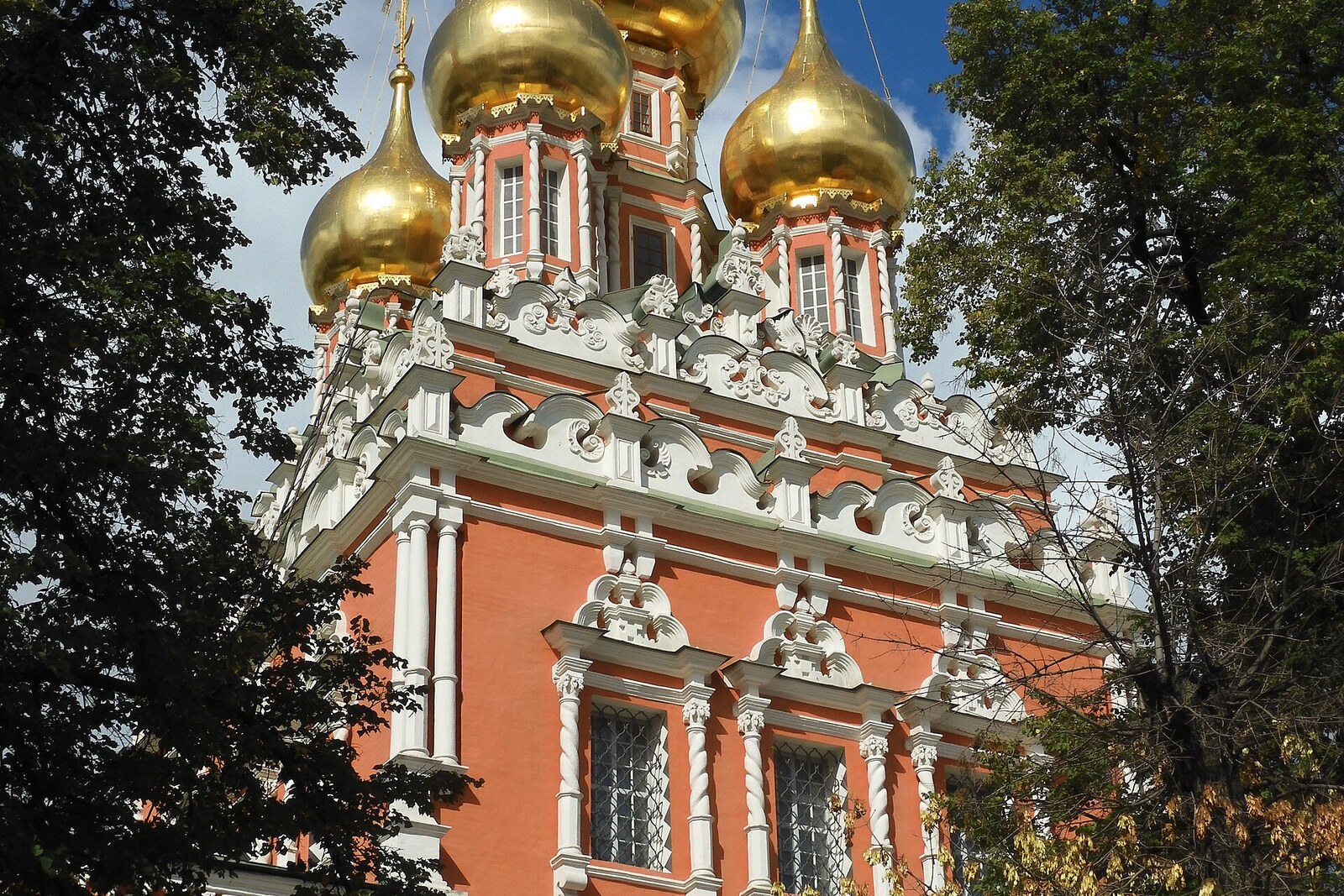
Look around first
What to notice
- White-and-red bell tower
- Two-story church
- Upper church volume
- Church courtyard
The story of the place
In severe frosts, parishioners prayed downstairs, in the warm Church of the Dormition of the Mother of God, while in summer they went up to the cold upper church. Hence the tall two-story volume and the white bell tower with red accents. Kadashi merchants paid for the construction of the present building at the end of the seventeenth century, and the main altar upstairs was dedicated to the Resurrection of Christ, which gave the church its name.
Ten-year-old Nikolai Shulenin stood by the church and watched workers lower a large bell from the bell tower. The small bells came down quickly; this one was being lowered on a rope with great difficulty. The adults were crying, while the boy was curious whether they would manage to move such a weight.
Nikolai was an altar server here: he lit candles, kindled charcoal for the censer, and passed memorial notes to the priests. His father worked as a driver, and his mother had no profession. His peers teased the boy by calling him “little priest”; the adult parishioners were afraid to say an unnecessary word, yet services took place every day. In winter they prayed in the lower, warm Church of the Dormition of the Mother of God; in summer they went up to the upper, cold church. Its main altar was dedicated to the Resurrection of Christ from the dead—the Easter event that gave the whole church its name.
This arrangement appeared here at the end of the seventeenth century, when Kadashi merchants paid for construction of the present two-story building. The tall bell tower was added to it before its consecration in sixteen ninety-five. Later, parishioner Ivan Sadovnikov, who owned a silk factory, bequeathed money for the main bell, weighing three hundred poods. His income depended on trade in expensive fabric; he ordered that part of the factory’s capital be left to his parish church.
In seventeen fifty, Moscow bell founder Konstantin Slizov fulfilled the order on a grand scale: he cast a bell of four hundred poods—about six and a half tons. This bronze giant hung in the Kadashi bell tower for almost two centuries.
In nineteen thirty-four, the church was closed. It was then that Nikolai Shulenin saw Sadovnikov’s bell being lowered. The boy himself began going to other Moscow churches with his mother. Later, when Nikolai married, his wife feared losing her position in a state institution because of her husband’s church involvement, so he came to pray only during trips to visit his mother in Kadashi.
The bells that had been taken down were transferred to the Bolshoi Theatre. This saved them from being melted down: the authentic Kadashi ringing was used in Mussorgsky’s opera Boris Godunov. Meanwhile, the church served as an archive, a sports club, and then restorers’ workshops.
Now services are once again held in both the upper Church of the Resurrection of Christ in Kadashi and the lower Church of the Dormition of the Mother of God. But the six-ton bell is absent from the white-and-red tower. Two historic Kadashi bells still remain at the Bolshoi Theatre.
Useful on site
Accessible from outside without museum restrictions; the interior follows the actual schedule of the active parish.
Checked: June 24, 2026. Check the official source before visiting.The story is easy to follow from outside; if the church is open, remember that it is an active parish and do not turn a service into a tour.