 Guide On Map
The Birrarung Shore: First Peoples and Urban Melbourne
From Federation Square along the river to Yarra Park and the Melbourne Cricket Ground (MCG)
Guide On Map on your phone
Open the walk like a regular app
It takes about 10 seconds to install. No app store needed.
The whole path
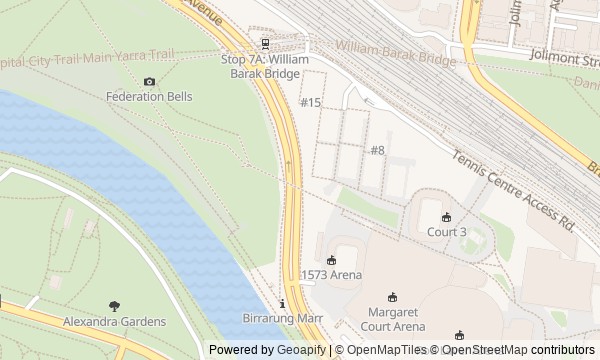
Route map
About the walk
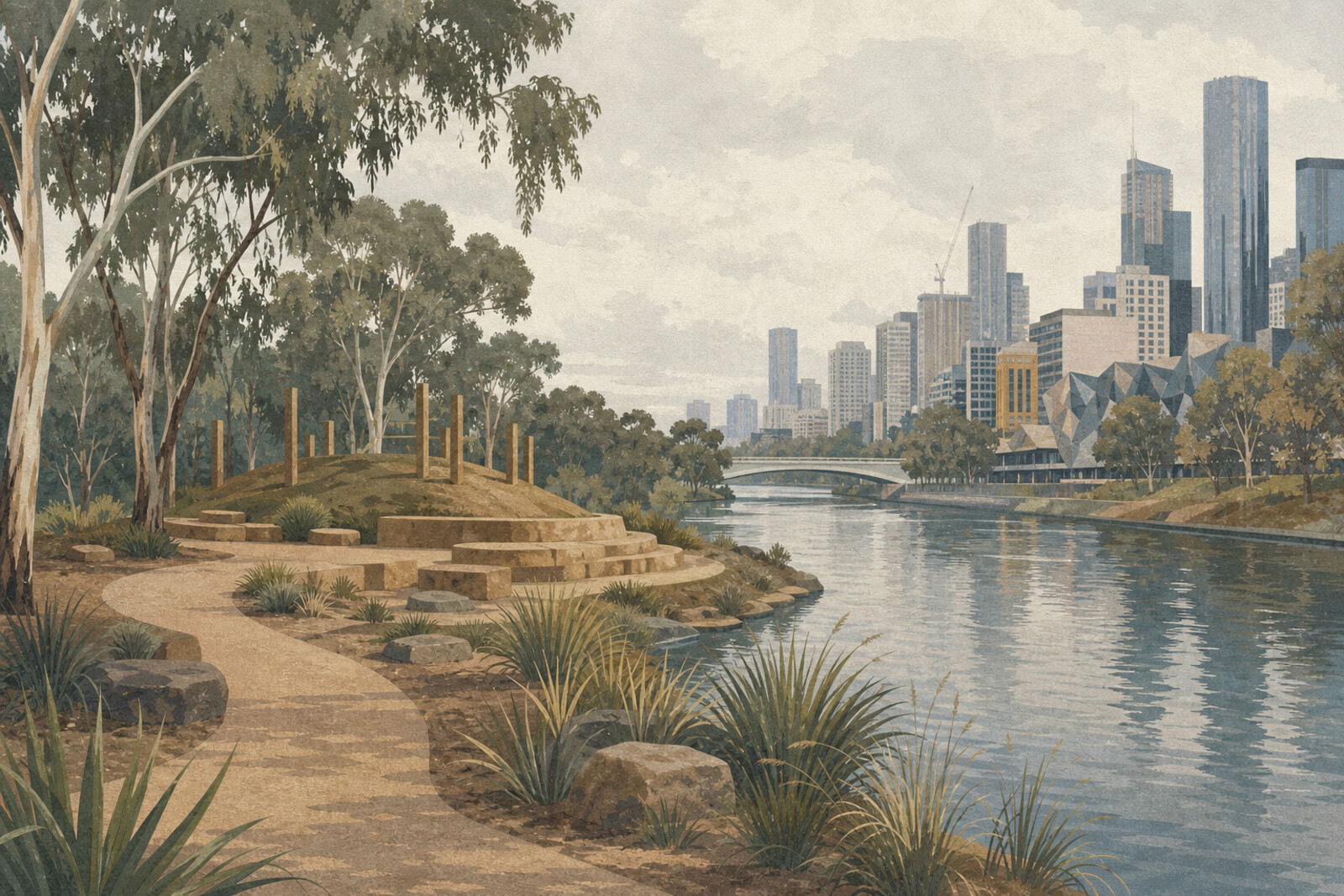
You will walk from Federation Square to the river, then through Birrarung Marr and across the bridge into Yarra Park, to the walls of the Melbourne Cricket Ground (MCG).
At first, the route stays close to the water. There will be an earth embankment, old speaking platforms, and a field of upturned bells. Then the city promenade gives way to a crossing above the tracks, a living scarred eucalyptus, and bronze athletes.
This is not an overview of the center or a parade of landmarks. You will see one edge of the city through the actions of people who returned objects, relearned a lost craft, challenged institutions, and demanded room for their own voices. The stories stay with particular things and carefully separate what is established from what is assumed. Why did the first returned stone have to be given back to the Museum of Victoria? What will people listen to early in the morning beneath bronze bowls?
By the end, you will read the path to the stadium differently: as a shore where the city square, public voice, the mark of stripped bark, and sporting memory remain on the same ground.
Why this order
The Koorie Heritage Trust is the starting point because this is where cultural objects first came into the hands of an organization governed by the communities themselves. The descent to Birrarung Wilam shows the next step: what was preserved indoors returns to the river, to craft, and to shared ceremony. Farther on, the shore leads to Speakers Corner, where the right to gather takes on an urban form—a grove and permanent platforms. The climb from the old embankments to the Federation Bells continues the conversation about public space: now its existence depends not only on people, but on working technology. Nearby begins William Barak Bridge; the voices in its walls and the name above the crossing carry the route from an urban structure to the struggle for land and self-determination. Beyond the bridge, the scarred eucalyptus gives that history a physical trace in the old floodplain. The final loop around the stadium connects the land of Yarra Park with sporting traditions and shows how differently the city preserves their participants—in large statues and on a small plaque by the entrance.
Those who want to see Melbourne through the history of Victoria’s First Peoples Those interested in urban spaces for gathering, speech, and music Those who enjoy routes where the past can be read through objects on site
Those looking for a walk focused only on central architecture Those not comfortable with difficult themes of displacement and separated families Those who do not want to end the route at a large stadium
Before you go
Check access to the Koorie Heritage Trust and the stadium’s event calendar: opening hours, tours, and closures can change. Arrange a Trust tour separately if you need one. Bring water and sun protection—the open stretches by the river, in the park, and near the arena do not always offer comfortable shade. Headphones are useful for listening outdoors, but keep one ear free on the bridge and busy paths.
When to go
Daytime is best, when the scars in the bark and the details of the statues are easy to make out. If you want to catch the bells sounding, check the current program in advance: the installation is not required to play when you arrive. On match and concert days, start noticeably ahead of the main flow of spectators.
Backup plan
If the Trust is closed, begin the story at its entrance and continue to the river: the meaning of the first stop remains from outside, though you will not see the collection. If there are temporary barriers in the park, do not go around them across the grass or look for a way through by the water—stay on open public paths and follow official signs to the bridge or stadium. If Yarra Park is occupied by an event, end the walk at the accessible end of the bridge and save the trees and statues for a separate return.
Route conditions
Surface. Paved — 1.4 km (data covers 56% of the route)
Stairs. Flights: 2, 28 m in total
Access. Wheelchair — no; stroller — limited (stairs)
Facilities. Toilets — 5; drinking water — 13
Elevation. Ascent — 28 m; descent — 17 m
OpenStreetMap extract of June 18, 2026: database data, not a check on the ground. Data © OpenStreetMap contributors, ODbL licence
Walk plan
Open in maps ↗- 1
Koorie Heritage Trust
Here it will become clear why an object returned to its people first had to go back into someone else’s storage. - 2
Birrarung Wilam
Here, a craft will return from a museum display case to the ceremonies of communities by the river. - 3
Speakers Corner
Here, a city ban will lead to the creation of a permanent place for speeches and debates. - 4
Federation Bells
Here, an engineering failure will show how much work it takes to keep public art sounding. - 5
William Barak Bridge
Here, a name above the flow of fans will return the story to the struggle for Coranderrk. - 6
Scarred Trees of Yarra Park
Here, a mark on a living trunk will connect today’s park with the old floodplain and a vanished canoe. - 7
Statues at the Melbourne Cricket Ground (MCG)
Here, two sporting stories will diverge: one will gain rules and statues, the other success without profit.
Route features
Everything you need stays in the browser
Progress, saves and your trip plan are stored on this device.
Add Guide On Map to your home screen so the walk opens outside the browser.
How we handle sources, maps and corrections: our editorial standards