 Guide On Map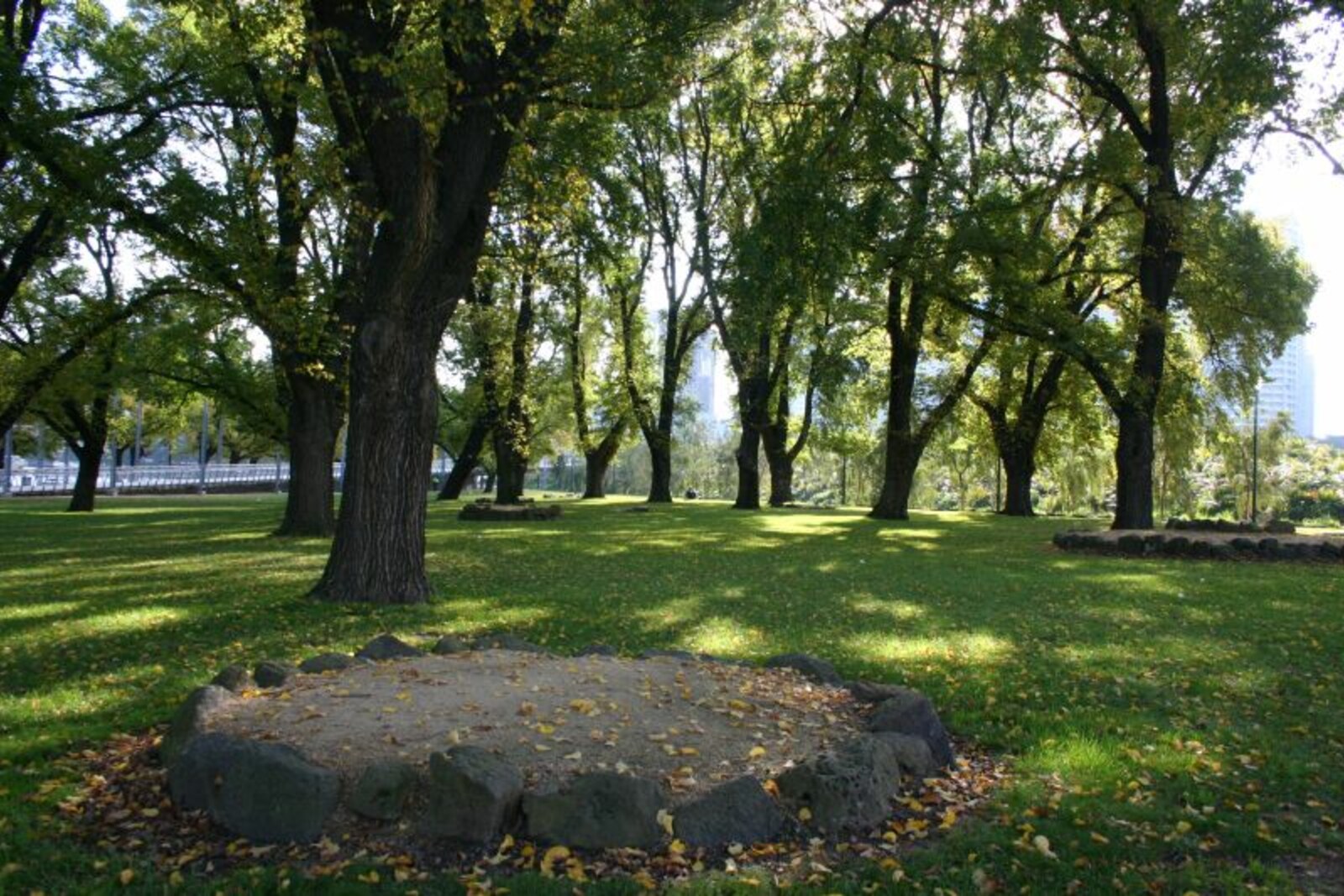
Look around first
What to notice
- A grove of elms
- Stone mounds with bluestone cladding
- Pink-granite steps
- Quotations on the steps
The story of the place
Beneath the elms, the city’s forum for public speech has survived. The bluestone-clad stone mounds appeared here together with the grove: the city council built ten such platforms. Later, low pink-granite steps were laid beside them, with quotations cut into the stone. This strip of riverbank was once an inconvenient outskirts between the morgue, free bathing facilities, the railway, and the tram line.
The stone mounds beneath the elms served as platforms. A speaker climbed onto one, listeners gathered around, and the speaker’s opponent was already arguing from the neighboring mound. The name “Speakers Corner” literally describes this arrangement. In Melbourne, Yarra Bank was the name given to meeting places on the riverbank.
The city’s first planners deliberately did not leave a large public square in the center: colonial leaders feared unrest. People spoke anyway near markets and wharves. In eighteen eighty-nine, the port authority banned gatherings on the wharves. Speakers later settled on the south bank, but in nineteen oh seven a formal garden with a monument to Queen Victoria was laid out there. The Minister for Public Works ordered the gatherings moved here, to the north side of the river.
The site was chosen for its inconvenience: nearby stood the city morgue, free bathing facilities, railway tracks, and a tram line. There were few passersby. For officials, that solved the problem: public speaking was allowed, but sent away from the central streets.
One of those who turned the allotted wasteland into a real forum was John William “Chummy” Fleming, an anarchist shoemaker who campaigned for freedom of public speech. He knew the value of his independence: from the age of ten, he worked in a shoe factory, and in Melbourne he earned a living repairing boots in his own small workshop. As early as eighteen eighty-five, he was arrested for a speech at North Wharf.
On Sundays, Fleming set up his platform here, hung red banners bearing the words “Anarchy” and “Freedom,” and called the public together with a bell. He continued speaking into old age. Nearby, evangelists preached, people defended women’s rights and discussed diet, religion, and the organization of society; poets and clairvoyants also gathered here. Listeners moved from one mound to another, asked questions, and argued with the speakers.
For years, the speakers asked to be granted permanent platforms. In nineteen twenty-five, the city council finally planted a grove of elms and built ten stone mounds. The wasteland to which the gatherings had once been pushed was given purpose-built platforms.
Fleming died in January nineteen fifty and left instructions for his ashes to be scattered here on May first. According to the historian Bertha Walker, his friends remembered the request too late: they had no urn. Fleming’s old comrade Percy Laidler then asked whether it really mattered whose ashes they were. One participant brought a tin of ash, and Laidler scattered it handful by handful over those gathered while speaking about the deceased.
By the nineteen seventies, Sunday debates had almost ceased, and in the nineteen eighties the forum was moved to the city center. During road reconstruction in the late nineteen nineties, some of the old mounds were shifted, and low pink-granite steps with quotations were laid beside them. These steps appeared in nineteen ninety-nine. The bluestone-clad mounds beneath the elms are older: they are the very mounds from which the speakers of Yarra Bank spoke.
Useful on site
Open site with no ticket; temporary closures are possible during city events.
Checked: June 29, 2026. Check the official source before visiting.Do not look for a complete historic platform: the former meeting site itself is what matters. Stand to the side of the path and imagine several arguing groups speaking at once.