 Guide On Map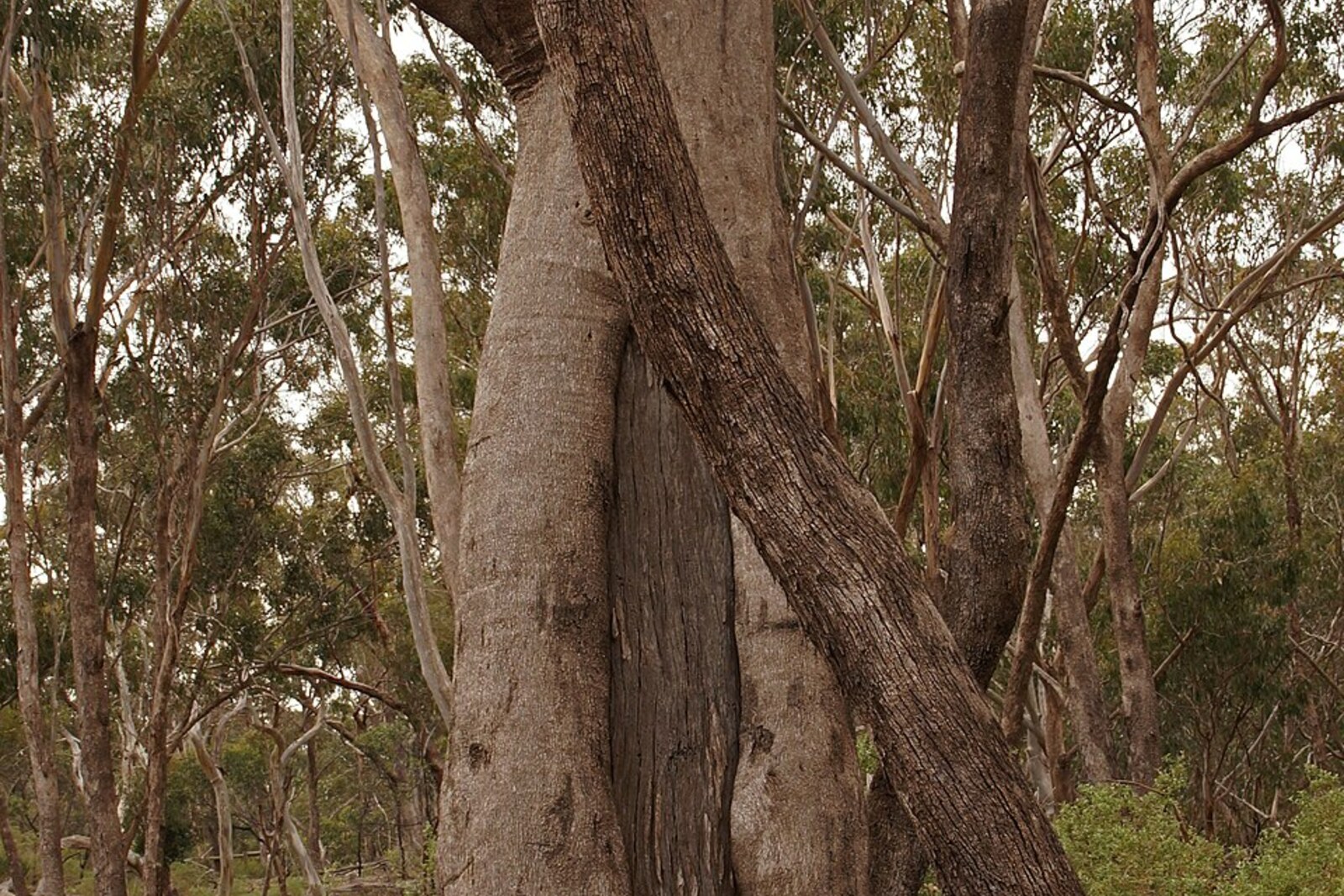
Look around first
What to notice
- A living river red gum
- A long scar on the trunk
- Overgrown edges of the cut
- An explanatory sign
The story of the place
Today’s Yarra Park was once a river floodplain, and mature river red gums grew right beside Birrarung. The railway separated the park from the water, and the sports stadium occupied the land of the former camps. Between Gate 8 and Gate 9, a living trunk survives with a long open mark, about two point two meters high and zero point four meters wide: bark has had time to grow over the edges of the cut, but the middle has never closed. The sign beside it cautiously links this scar to the way Indigenous people took bark here.
Wurundjeri-willam, the local clan of the Wurundjeri people, needed boats for life along Birrarung. Fish and eels from the river and its shoreline lagoons were food, and the water made it possible to transport people and supplies. That is why they selected mature river red gums here: a trunk that was thick enough yielded a single sheet of bark for a canoe hull.
They did not fell the tree. With a stone axe, they marked out a long outline on the trunk, cut through the bark, and gradually separated it with wooden wedges. The removed sheet was heated to make it pliable, its ends were bent up and tied together, and the gaps were sealed with clay. The Wurundjeri gained a light boat, while the healthy gum continued to grow. New bark closed over the edges of the cut, but the middle remained open. That is how the scar formed.
Here, this work made practical sense. Today’s Yarra Park lies on an old river floodplain; Wurundjeri-willam made camps near the site now occupied by the cricket stadium. River red gums grew beside the water, where a finished canoe could be launched. In eighteen sixty-three, a railway corridor separated the park from Birrarung, so today the trees seem farther from the river than they were when the bark was removed.
You cannot determine the purpose of every scar from its shape alone: bark was also taken for shields, containers, and shelters. At the tree between Gate 8 and Gate 9, the sign is more cautious: historical evidence indicates that bark was removed from here for a canoe. The records have preserved neither the maker’s name nor the canoe itself.
One living scarred gum remains in the park; the other evidence has become stumps. The open mark on the living tree was measured as early as nineteen eighty-two: about two point two meters high and zero point four meters wide. The bark that the Wurundjeri carried to the water disappeared along with the boat; its outline remained on the trunk.
Useful on site
Yarra Park is an open park managed by the cricket club; on event days, some activities and access routes are restricted.
Checked: June 29, 2026. Check the official source before visiting.View the tree from behind the fence: do not touch the trunk or enter the protected area for a photograph. The scar reads differently from different sides, but stay on the permitted surface.