 Guide On Map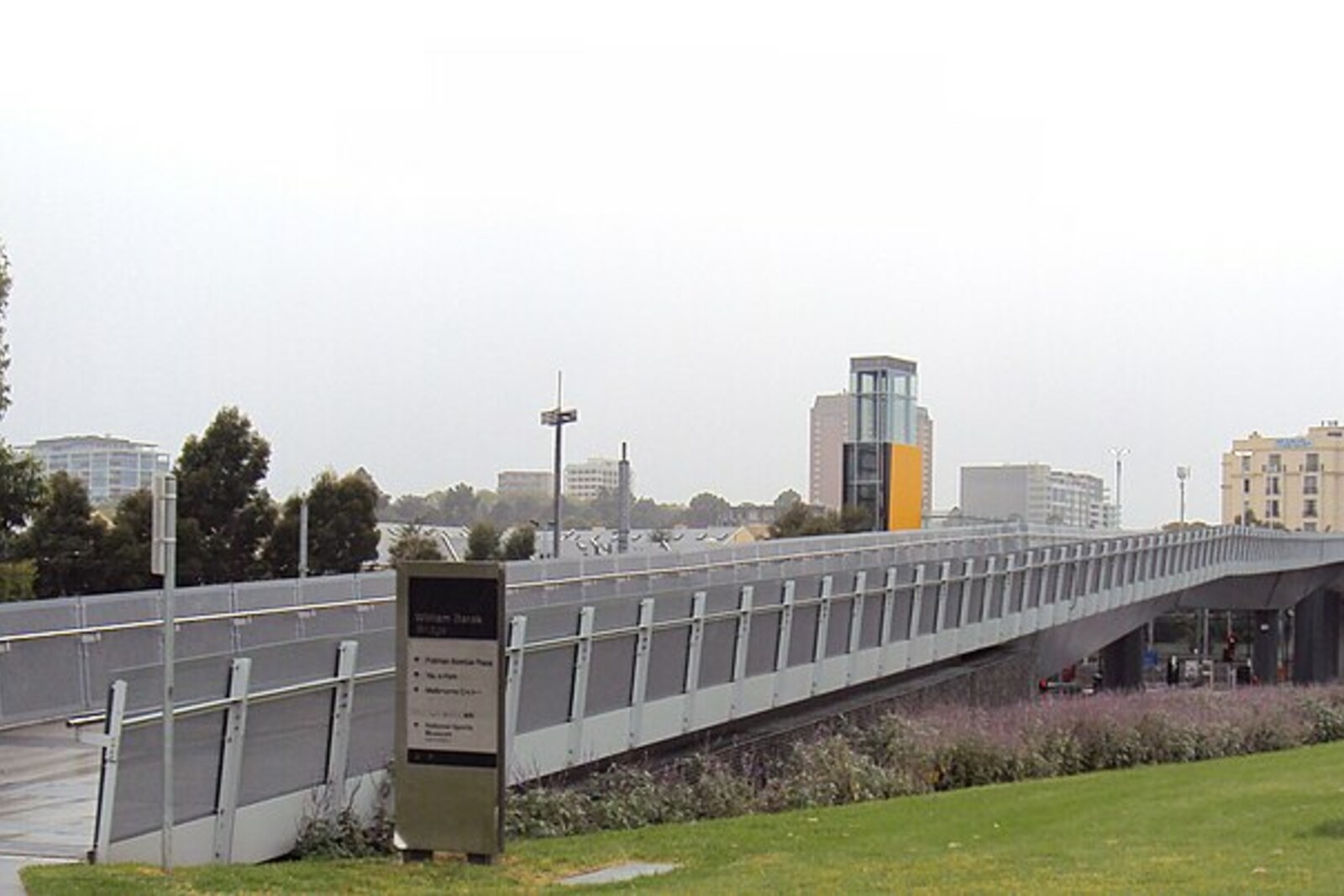
Look around first
What to notice
- The long bridge deck
- The side walls
- William Barak's name
- Railway tracks below
The story of the place
Fifty-six speakers are hidden in the side walls of the long deck above the railway tracks. As people cross the bridge, the speakers alternate recordings by performers from fifty-three Commonwealth countries. In the middle, a greeting in the Woiwurrung language can be heard, recorded by a Wurundjeri elder who is a relative of the person after whom this crossing is named. That is why the route itself is designed as a sound work, not merely as a crossing over the tracks.
This crossing was built for large flows of people. For the Commonwealth Games of two thousand six, a pedestrian and bicycle bridge five hundred twenty-five meters long was built over the railway tracks. It leads from Birrarung Marr to the Melbourne Cricket Ground (MCG), allowing fans to pass above the rails and roads.
Artists Sonia Leber, David Chesworth, and Simeon Nelson were commissioned to turn this passage into a permanent installation. Leber and Chesworth recorded performers representing the song traditions of fifty-three Commonwealth countries. Fifty-six speakers were hidden in the side walls so that the voices would replace one another as a person moves along the bridge. The central place was given to a greeting in the Woiwurrung language. Its performers include Wurundjeri elder Joy Murphy Wandin, a relative of the person after whom the bridge is named.
To the colonists, he was William Barak; at birth, he was named Beruk. Barak became the senior leader of the Wurundjeri Woi Wurrung and defended Coranderrk, a settlement near present-day Healesville. In eighteen sixty-three, he and Kulin leader Simon Wonga led about forty people there, people who needed land for a permanent home. After they appealed to the governor, two thousand three hundred acres were set aside for Coranderrk. The residents ran the farm, sold baskets, bags, boomerangs, and possum-skin cloaks; their woven goods reached a shop on Collins Street.
Ten years later, officials dismissed the manager who supported the residents' independence. The new administrators interfered in everyday life, cut supplies, and planned to move the community to the Murray River, freeing up valuable land. Barak sought the right to remain in Yarra country and to run Coranderrk themselves. He led ten delegations: their members walked sixty-seven kilometers to Melbourne, brought petitions, and demanded to be received.
These journeys forced parliament to investigate the settlement's administration; the threat of immediate closure was averted. The residents did not achieve a complete victory. The law of eighteen eighty-six forced many young people of mixed descent to leave Coranderrk, the population was cut in half, and families were divided. Barak remained there until his death in nineteen oh three. The settlement was closed in nineteen twenty-four.
The modern bridge does not preserve the route of those delegations. Their material trace here is the name above the pedestrian crossing. In the middle of the deck, Joy Murphy Wandin's voice has been added to it: a relative of Barak greets the crowd heading to the stadium in the language in which he was called Beruk.
Useful on site
Public-access pedestrian bridge; on match and concert days, the flow is managed on site.
Checked: June 29, 2026. Check the official source before visiting.On the bridge, do not block the flow of pedestrians and cyclists. The greeting song may sound quietly; stop only where there is enough room to do so.