 Guide On Map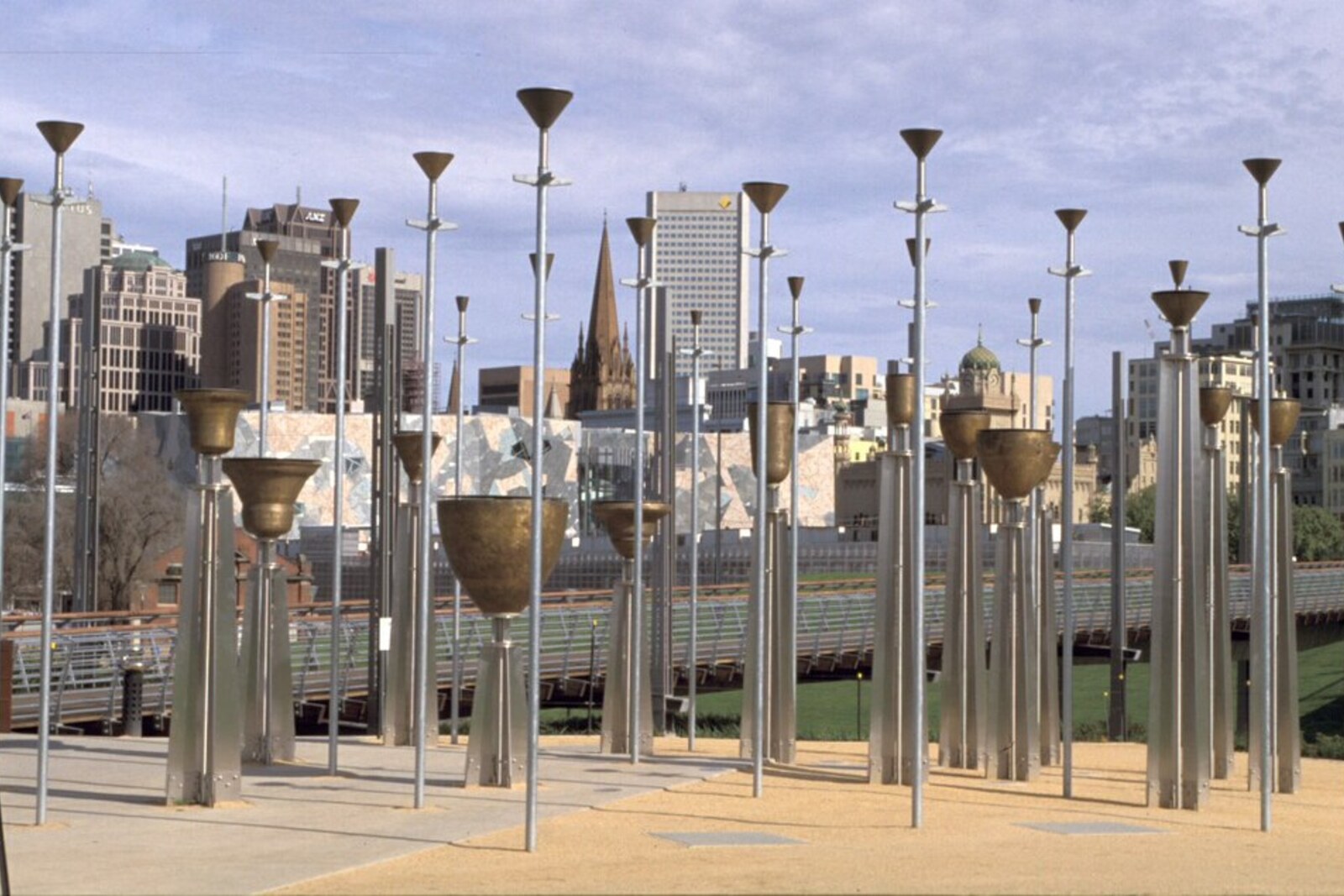
Look around first
What to notice
- Thirty-nine bronze bowls
- Steel masts
- Hammers beneath the bowls
The story of the place
By the end of the two thousands, the Federation Bells had almost fallen silent. The bronze bowls remained intact, but the hammers and the equipment controlling them kept failing. On a good day, roughly one fifth of the installation worked. For an ordinary monument, this would have been an annoying breakdown. Here, the very work for which the object had been created was disappearing.
The name refers to January first, nineteen oh one, when six British colonies united as the Commonwealth of Australia. Ahead of the centenary of that event, Jonathan Mills, artistic director of the celebratory festival, commissioned a permanent musical object for the new riverside park of Birrarung Marr. Sculptor and bell founder Anton Hasell, together with composer and acoustics specialist Neil McLachlan, conceived bells on which contemporary music could be performed.
After being struck, an ordinary bell produces several additional frequencies, and some of them do not fit well into a familiar musical scale. McLachlan and Hasell needed to bring these frequencies under calculation before casting. They brought in aeronautical engineer Behzad Keramati and began testing shapes in a computer model. The starting blank for one calculation was the profile of a disposable polystyrene cup. After repeated changes, they produced the first harmonic bronze bowl: its seven principal frequencies fell into the correct sequence during casting itself, without subsequent manual tuning.
Thirty-nine bells were made for Birrarung Marr. Most continued this harmonic approach, while seven were cast as multi-tonal bells: a single strike on such a bowl produces several distinct pitches. Their creators raised them, open side upward, onto steel masts and spread them across the middle terrace. Twenty-six smaller bells formed a grid, with thirteen large ones placed among them. The result was a carillon without a tower: people walk inside the instrument rather than listen to it from outside. The bells and the new park opened on the same day—January twenty-sixth, two thousand two.
A few years later, it became clear that durable bronze had outlasted its first system of strikers. The city and the arts administration commissioned the engineering workshop Spring Innovations to restore the installation's reliability. The engineers decided to reproduce the force and speed of a human strike, rather than limit themselves to an identical mechanical push. Before installing the new drives on the masts, they assembled a test rig and struck one small bell more than five million times. Wear on the bearings proved negligible. After that, a separate adjustable hammer was installed beneath each of the thirty-nine bowls, and programmer Terry McDermott wrote a new system for playing scores.
The renewed bells were launched in April two thousand twelve. For the first concert, Deborah Cheetham, a composer and soprano of the Yorta Yorta people, wrote Eternal Birrarung—a work for her own voice and these bowls by the river. By the beginning of two thousand twenty-three, the new hammers had already delivered more than one hundred ninety million strikes.
Early in the morning, the equipment performs another short sequence. This is a technical check: the program listens to each bell in turn, compares the response with a reference recording, and sends a report to the technicians. That is how repairs continue beneath the upturned bronze bowls, repairs begun after those years when only one fifth of the Federation Bells was sounding.
Useful on site
The site is usually listed as accessible 08:00–22:00; the bells sound on a daytime schedule of 08:00–09:00, 12:30–13:30 and 17:00–18:00; check the schedule on the city website.
Checked: June 29, 2026. Check the official source before visiting.The bells may be silent even when the installation is accessible for viewing; do not check the mechanisms with your hands. If a performance is underway, step back a few paces and listen to how the sound changes between the bowls.