 Guide On Map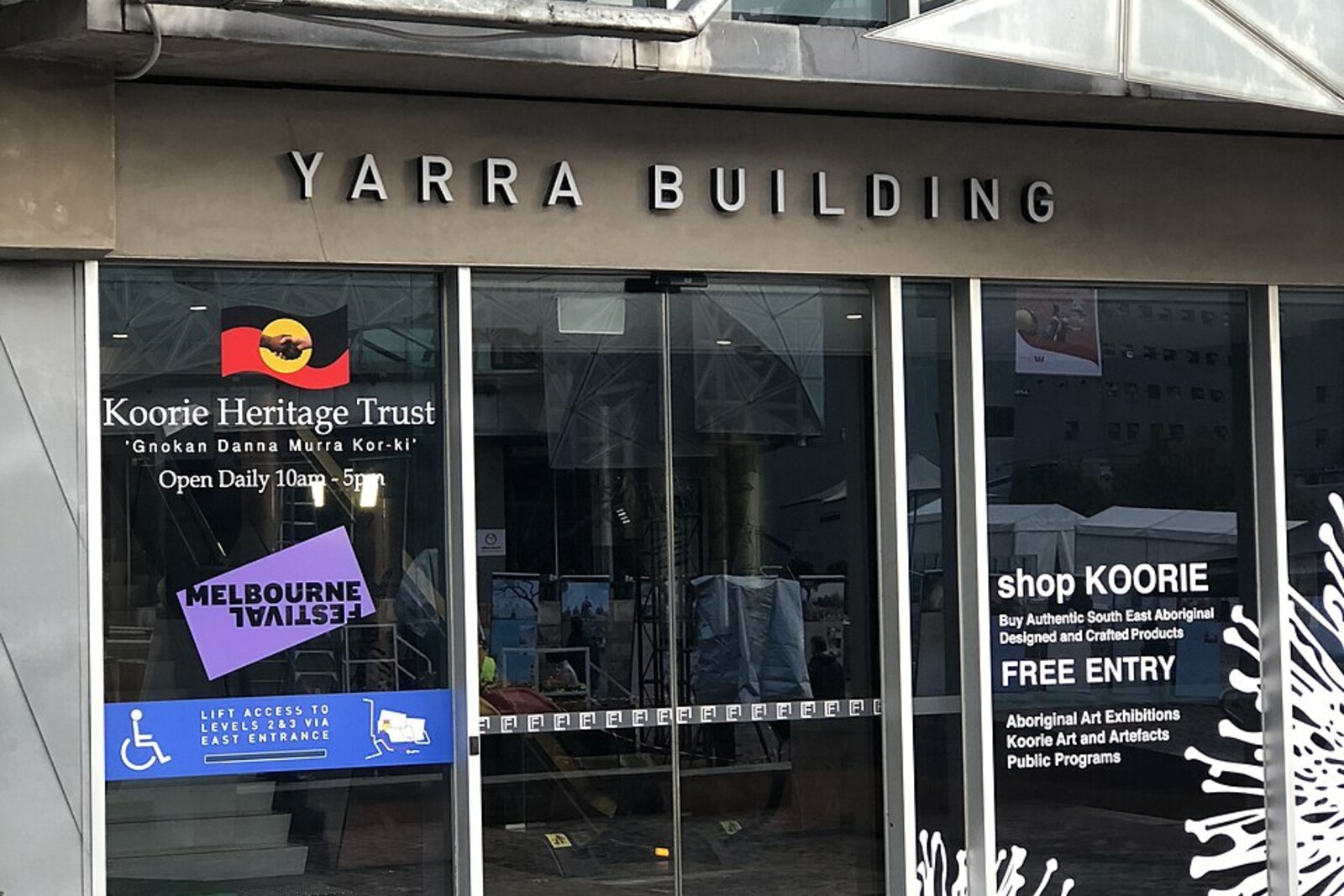
Look around first
What to notice
- Public galleries
- Rotating exhibition
- Koorie cultural heritage objects
The story of the place
The Koorie Heritage Trust collection began with a small grinding stone for preparing food. In the early nineteen eighties, an unknown man brought it, along with several stone axes, to the Victorian Aboriginal Legal Service. He entered the office of the service’s director, Jim Berg, a representative of the Gunditjmara Aboriginal people, and said, “This belongs to you and your people.”
Berg accepted the objects, but there was nowhere to keep them. No organization yet existed that could own cultural objects on behalf of the Koorie themselves. The stones had to be placed in the care of the Museum of Victoria. Then Berg’s wife, Kylie, asked him a short question: why not create their own trust?
Behind that question lay a far heavier history. Berg also served as an inspector under the Archaeological Relics Act. University and museum collections contained human remains removed from Aboriginal burials for scientific research. Berg sought to have the ancestral remains handed over to communities and buried.
In nineteen eighty-four, lawyer Ron Merkel helped him obtain a court order against the University of Melbourne. The university challenged the claim, but the court required it to transfer its collection of remains to the Museum of Victoria, where their origins could begin to be established and they could be returned to their homelands. For Berg, the case carried a personal cost: his relationship with the university remained cold for a quarter of a century, and he was no longer invited to lecture medical students. He used against a large institution the very knowledge and official powers through which he earned his living.
On October seventeenth, nineteen eighty-five, Berg, Merkel, Koorie Elders, and their supporters gathered at a law office on Queens Street. They established the Victorian Aboriginal Cultural Heritage Trust and immediately requested official permission to acquire cultural objects themselves and take ancestral remains into care. A month later, on November twenty-second, thirty-eight people whose exact origins could not be established were buried in Kings Domain. The remains were wrapped in paperbark, a smoke-cleansing ceremony was held, and the grave was closed with a two-ton boulder.
After that, the trustees began raising money and buying back objects from private owners and at overseas auctions. Many Indigenous people in Victoria and southern New South Wales collectively call themselves Koorie, while individual peoples retain their own names. That is why the collection is devoted specifically to the cultures of southeastern Australia and is managed by people from these communities.
In June two thousand fifteen, the collection and services moved from King Street to Federation Square. Here, beside the Birrarung and in one of the city’s main meeting places, they were given public galleries, learning spaces, and community rooms. A rotating part of the collection is now displayed here, oral histories are recorded, young artists are given exhibition spaces, and descendants of the Stolen Generations are helped to trace information about relatives. Walks devoted to Koorie culture by the river also begin here.
That first grinding stone is still listed in the collection. Exhibits change, so it may not be in a display case today. But it is kept here by the very organization Jim and Kylie Berg envisioned after an object returned to the Koorie people had once again had to be taken to someone else’s storage.
Useful on site
Daily 10:00–17:00; closed on Victorian and national public holidays; free admission.
Checked: June 29, 2026. Check the official source before visiting.If the Trust is open, allow time to look around on your own; arrange a guided visit separately. If the doors are closed, listen to the story from outside without lingering in the passageway.