 Guide On Map
Barrio de las Letras: Writers, the Stage, and the Right to Speak
From Plaza de Santa Ana along Calle de León and Calle de las Huertas to Plaza de las Cortes
Guide On Map on your phone
Open the walk like a regular app
It takes about 10 seconds to install. No app store needed.
The whole path
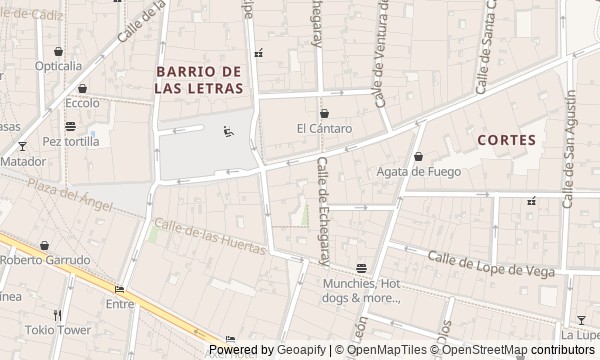
Route map
About the walk
You will begin at Plaza de Santa Ana and walk along Calle de León, Calle de Lope de Vega, Calle de Cervantes, and Calle de las Huertas to the columns of the Congress of Deputies. Along the way, there will be a former book warehouse, a closed convent, Madrid’s oldest stage, a writer’s home, a garden behind a glass-fronted flower shop, and a club where women were long allowed to speak but not accepted as members.
This will not be a parade of famous authors. You will see the quarter as a place of struggle for a room, an income, a name, and the right to speak. Why was a stone grille left on the warehouse façade? Why was a museum room restored from the inventory of a woman who once disappeared from it? What will make gunshots ring out behind the columns of parliament?
The account will be calm and documentary in tone. It will separate the archival record from later legend and will not hide uncertainty behind a prettier version.
After the walk, you will understand why, in Madrid’s Barrio de las Letras, the history of literature ends not at a writer’s home but at the doors of the Congress of Deputies.
Why this order
At Plaza de Santa Ana, you will begin with a convent demolished to make way for the square and the approach to the theatre. Then, on Calle de León, a former church warehouse will show another way of changing a city: the building was not destroyed but given to a new institution. The nearby Convent of the Discalced Trinitarians will continue the theme of preservation, this time with remains that have lost their individual names. Afterward, you will return to the theatre at Plaza de Santa Ana: the first stop was cleared precisely to provide access to this stage, while within the profession actresses had to claim a place of their own. From the public stage, the route will move into a playwright’s home, where the cost of a literary life became a family matter. Calle de las Huertas will bring private loss out into the open, into a city legend beside a garden. At Ateneo de Madrid, the question of the woman author will shift from someone else’s story to her own membership and elected office. Finally, Plaza de las Cortes will widen the scale: after a vote in a private society, you will arrive at the national parliament, where voting was once halted with weapons.
Those interested in human stories behind literary names Those who enjoy documentary narratives with honest qualifications Those who want to see the link between theatre, private life, and political rights
Those expecting chronological biographies of great writers Those looking for a light walk without loss or conflict Those who prefer to see only grand monuments
Before you go
Decide in advance whether you want to go inside: the Lope de Vega House Museum is visited separately, while access to Teatro Español, the Convent of the Discalced Trinitarians, Ateneo de Madrid, and the Congress of Deputies depends on their own schedules, rules, and registration. Before setting out, check the official information for your chosen place and do not plan your entire day around spontaneous entry. For the outdoor version, a phone with audio and comfortable shoes are enough: many of the details are on façades, squares, and paving stones. On Calle de las Huertas, look down more often, but stop to read without blocking the narrow street.
When to go
Allow 1.5–2 hours for the full route and outdoor listening. Treat any visit inside the Lope de Vega House Museum, convent, theatre, Ateneo de Madrid, or Congress of Deputies as a separate part of the day, and add time beyond the route.
Backup plan
If your chosen interior is closed or entry requires registration you cannot obtain, do not reroute the loop: listen to the story at the façade and continue. The Lope de Vega House Museum can be understood through its address and its proximity to Calle de Cervantes, the Convent of the Discalced Trinitarians through its closed convent wall, and Teatro Español and the Congress of Deputies through their ties to the squares. In heavy rain, shorten your pauses at Plaza de Santa Ana and Calle de las Huertas, and listen to the longer sections under available public shelter without occupying venue entrances. The route will remain coherent even without a single interior visit.
Route conditions
Surface. Paved — 1 km
Facilities. Drinking water — 1
Elevation. Ascent — 1 m; descent — 3 m
OpenStreetMap extract of June 18, 2026: database data, not a check on the ground. Data © OpenStreetMap contributors, ODbL licence
Walk plan
Open in maps ↗- 1
Plaza de Santa Ana
Here it will become clear what it cost the city to gain the open space in front of the theater. - 2
Royal Academy of History
This stop shows how a book warehouse became the long-awaited home of scholars. - 3
Convent of the Discalced Trinitarians
Here it will be necessary to distinguish what is known about Cervantes’s burial from what researchers were unable to prove. - 4
Teatro Español
This stage introduces the route's story of actresses fighting for their livelihood and profession. - 5
Lope de Vega House Museum
The house shifts the conversation from the playwright's fame to a family loss whose trace ended up in the museum inventory. - 6
Calle de las Huertas
The garden will link the neighborhood’s theatrical life to a love story that became a posthumous legend. - 7
Ateneo de Madrid
Here, a private literary club will become the site of a specific struggle for membership and elected office. - 8
Plaza de las Cortes
The finale will move the dispute over the right to vote from a cultural society into a parliamentary chamber under arms.
Route features
Everything you need stays in the browser
Progress, saves and your trip plan are stored on this device.
Add Guide On Map to your home screen so the walk opens outside the browser.
How we handle sources, maps and corrections: our editorial standards