 Guide On Map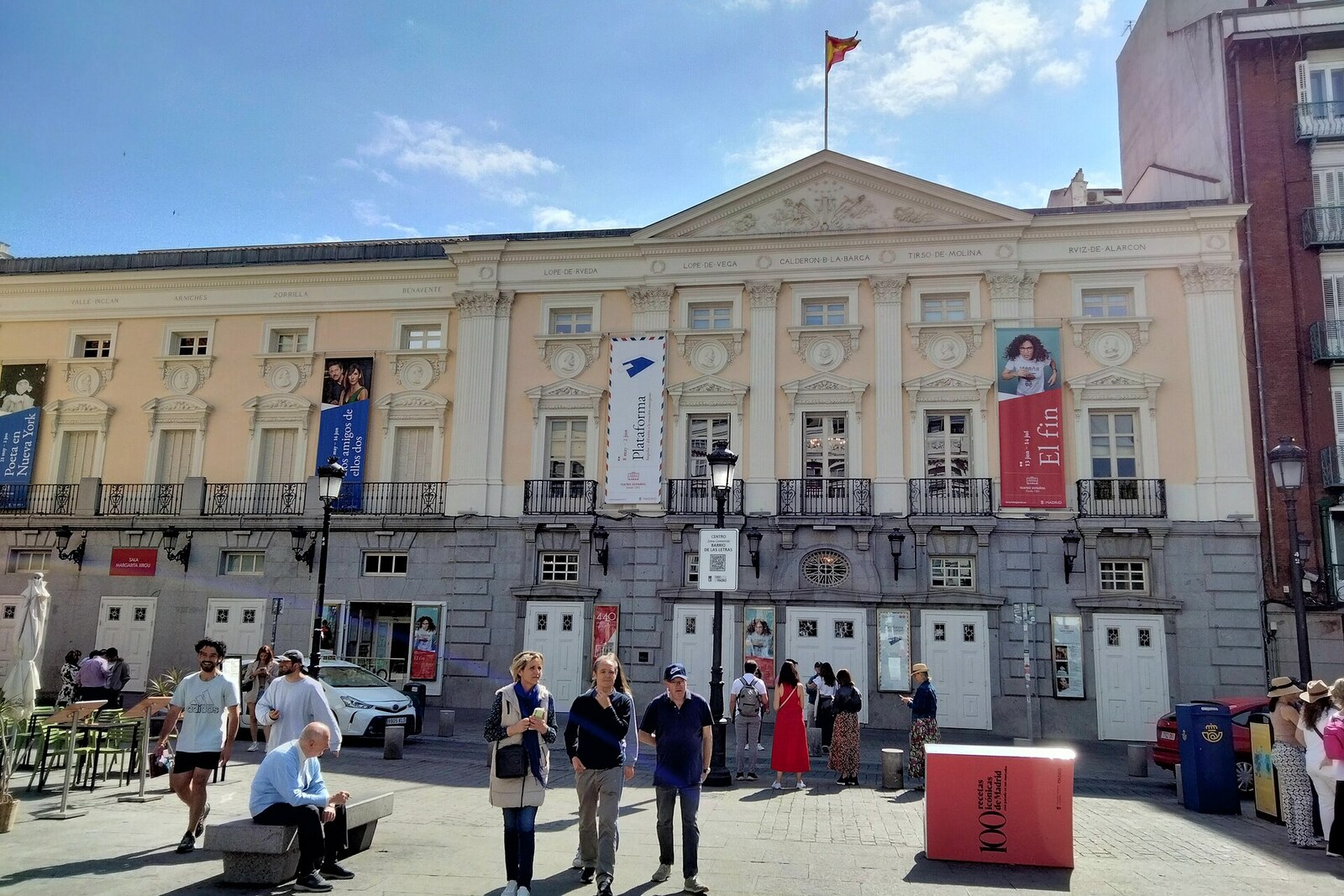
Look around first
What to notice
- Main façade
- Entrance doors
- The theater's name above the entrance
The story of the place
The name of the municipal theater hangs above the entrance doors, although theatrical life was established on this site as early as fifteen eighty-three. It began with the back yard of a private house, which charitable confraternities bought for performances: the takings supported hospitals, and having their own venue freed them from rental payments. The first actors performed here while audience seating and the upper level were still being built around the stage. The halls and buildings changed later, but the stage was always left in the same place; it received its present name in the middle of the nineteenth century.
In fifteen eighty-seven, permission to perform on this very stage changed the position of Spanish actresses. At the time, the Corral del Príncipe stood here—an open-air theater courtyard with a stage, galleries, and the windows of neighboring houses turned into box seats. “Príncipe” referred only to Calle del Príncipe, onto which the courtyard opened.
A year earlier, women had been forbidden to perform in Madrid's theaters. Fourteen actresses, led by Mariana Vaca and María de la O, submitted a petition to the Council of Castile—the chief royal body for administration and justice. Both described themselves as professional actresses and sought to return to the stage. They worked in the same troupes as their husbands and lived on money from performances; after the ban, the women wrote, they suffered hardship, while their husbands went on tour without them. Female roles, meanwhile, were given to boys.
One petition was not enough. The turning point came in November, when Tristano Martinelli and Drusiano Martinelli, leaders of I Confidenti, an Italian troupe touring Madrid, asked for three of their actresses to be admitted to performances at the Corral del Príncipe. The Council verified that all three were married to actors in the same troupe and granted permission.
The Spanish troupe leader Alonso de Cisneros immediately demanded the same terms for his actresses. The ban was lifted, but freedom came with conditions: a woman could perform only if she was married and appeared alongside her husband; she was allowed onstage only in women's attire, and boys were forbidden to portray women. Thus the actresses regained their livelihood, although their right to the profession still depended on marital status and the role assigned by officials. Later, attempts were made again to remove women from the stage, but they could no longer achieve this for long.
By then, the theater had existed for only four years. The charitable Confraternity of the Passion and Confraternity of Our Lady of Solitude, which supported hospitals with performance takings, bought the back yard of a private house here so they would no longer have to pay intermediaries for rented venues. The first performance was given in fifteen eighty-three, when the steps, windows, and upper gallery were still unfinished. The hospitals needed the proceeds, so Vázquez and Juan de Ávila took to the unfinished stage.
The old courtyard has long been gone: it was replaced by a covered theater, then came a fire and a new building. But each time, the stage was arranged in the same place. The name “Teatro Español” appeared in eighteen forty-nine, when the state tried to turn the former Teatro del Príncipe into a model national theater. The experiment lasted two seasons; in eighteen fifty-one, the building returned to Madrid's administration, while the new name remained. The present municipal theater still stages performances where, more than four hundred years ago, women had to fight for the right to step onto the stage.
Useful on site
Open public urban space; choose a viewing point that does not obstruct pedestrian flow.
Checked: date not specified. Check the official source before visiting.For this story, it is enough to view the building from the square; plan a performance or a visit to the interior separately.