 Guide On Map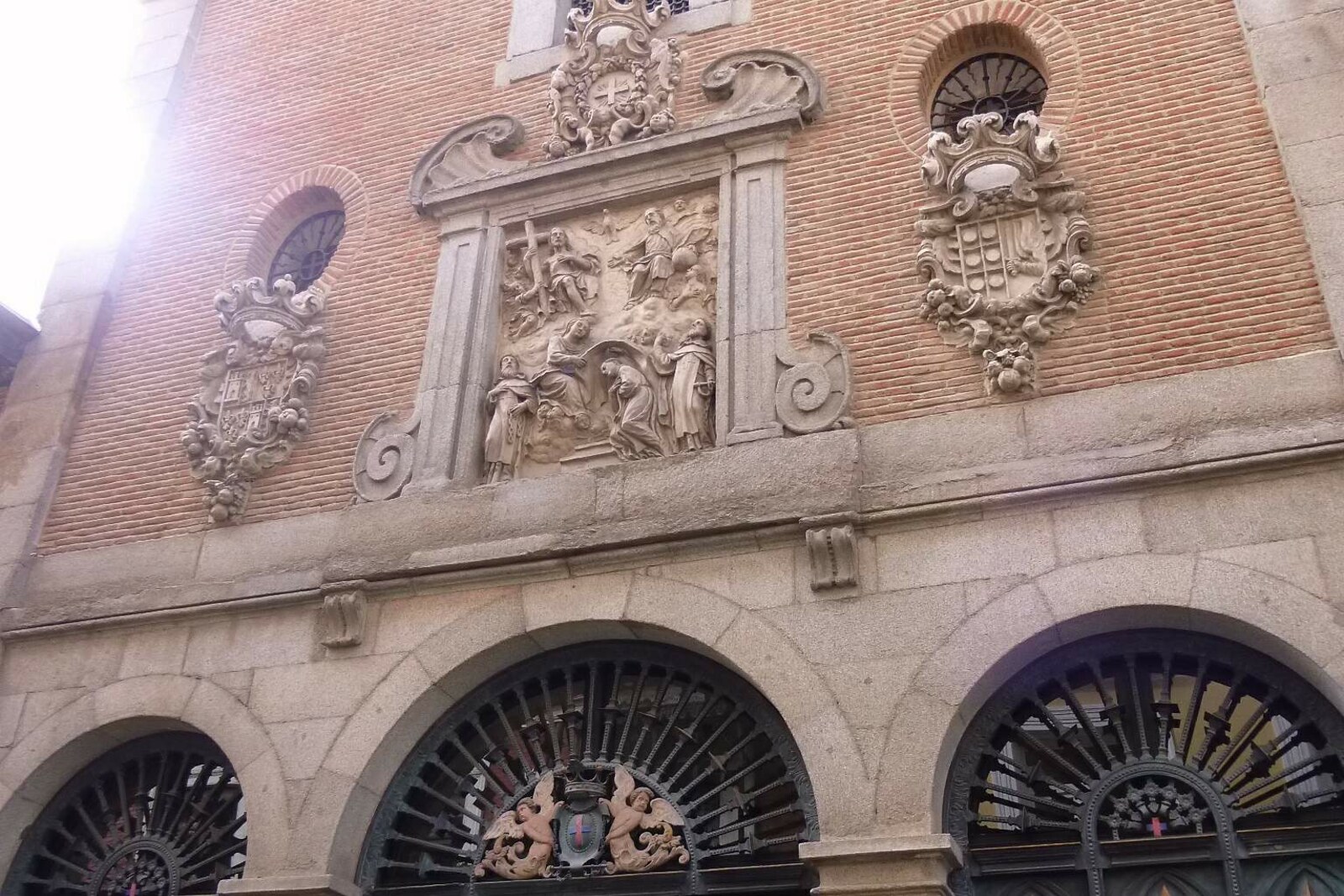
Look around first
What to notice
- Brick façade
- Marble plaque with Cervantes’s profile
- Entrance to the church
The story of the place
The word “discalced” means “barefoot”: it refers to the female branch of the Trinitarian Order, which lived by a strict rule and in enclosure. The first community settled here in sixteen twelve; behind the brick façade, the cells and cloister are still closed to visitors. The original small church has not survived: it was dismantled, the present one was built, and the old burials were moved to a common grave beneath the crypt. The marble plaque with the profile appeared on the façade much later, after the individual graves inside the convent had already disappeared.
This brick façade belongs to the Convent of the Discalced Trinitarians. In September fifteen seventy-five, twenty-eight-year-old soldier Miguel de Cervantes was returning from Italy to Spain. Corsairs captured his ship and took the prisoners to Algiers. Letters of recommendation from distinguished military commanders were found on Cervantes, and it was decided that a large ransom could be demanded for him. Hassan Pasha, the ruler of Algiers and the captive’s owner, set the price at five hundred gold escudos.
Cervantes spent five years in captivity and tried to escape several times. His family raised three hundred ducats—everything they could obtain—and gave the money to the Trinitarians. This Catholic order collected donations and ransomed Christian captives. In fifteen eighty, the monk Juan Gil arrived in Algiers specifically as a ransom agent. He did not have enough money for Cervantes, and Hassan Pasha was already preparing to sail to Constantinople and take the captive with him. Juan Gil obtained the missing sum from local merchants and, on September nineteenth, paid the required five hundred escudos. Cervantes returned to Spain.
The convent’s name is connected with the same order. “Discalced” literally means “barefoot” and refers to its reformed female branch, with a stricter rule and enclosure. In sixteen twelve, the first community of such nuns settled here. Their cells and cloister are still behind the brick façade; most of the convent is closed to visitors.
In April sixteen sixteen, Cervantes died in the neighboring quarter. A parish record reports that he instructed that he be buried with the Trinitarian nuns. His will has been lost, so the motive cannot be confirmed in his own words. The choice is traditionally explained as gratitude to the order that had once restored his freedom. The small original church of this convent was chosen for the burial. Ten years later, Catalina de Salazar, the writer’s widow, wished to lie beside her husband and was also buried here.
Cervantes’s individual grave disappeared because of decisions made within the convent itself. In sixteen thirty, the convent’s new patroness, María de Villena, Marchioness of la Laguna, secured for her family the right to burials in the main part of the church. Under the terms of the new patronage, the nuns moved the earlier burials but kept them within the convent walls. Later, the old church was dismantled and the present one was built beside it. Researchers believe that by seventeen thirty, the nuns had placed the moved bones in a common grave beneath the new crypt. There were no longer names on the individual remains.
In twenty fifteen, archaeologists and forensic anthropologists led by Francisco Etxeberria excavated the crypt’s southeastern corner. At a depth of one hundred thirty-five centimeters beneath the slabs lay the oldest ossuary: mixed remains of at least ten adults and five children, alongside fabric from priestly vestments and a seventeenth-century coin. Documents named seventeen people moved from the first church, including Cervantes and Catalina. The makeup of the group found matched that record closely enough, but it proved impossible to identify the writer’s own bones among the fragments. No traces of his known injuries survived either. The scientists’ conclusion was cautious: Cervantes’s remains are probably among the bones found.
In June of that same year, this entire mixed assemblage was placed in three urns and sealed into a monument inside the church. The marble plaque with Cervantes’s profile on the street façade had appeared as early as eighteen seventy. It states that the writer lies here of his own will, in the convent of the order to which he owed his ransom. Behind this wall, he has indeed remained—together with his wife and other people whose bones can no longer be separated from his own.
Useful on site
Open urban space; choose a viewpoint that does not obstruct pedestrian flow.
Checked: date not specified. Check the official source before visiting.Keep quiet and do not linger at the entrance during services; check separately whether it is possible to enter.