 Guide On Map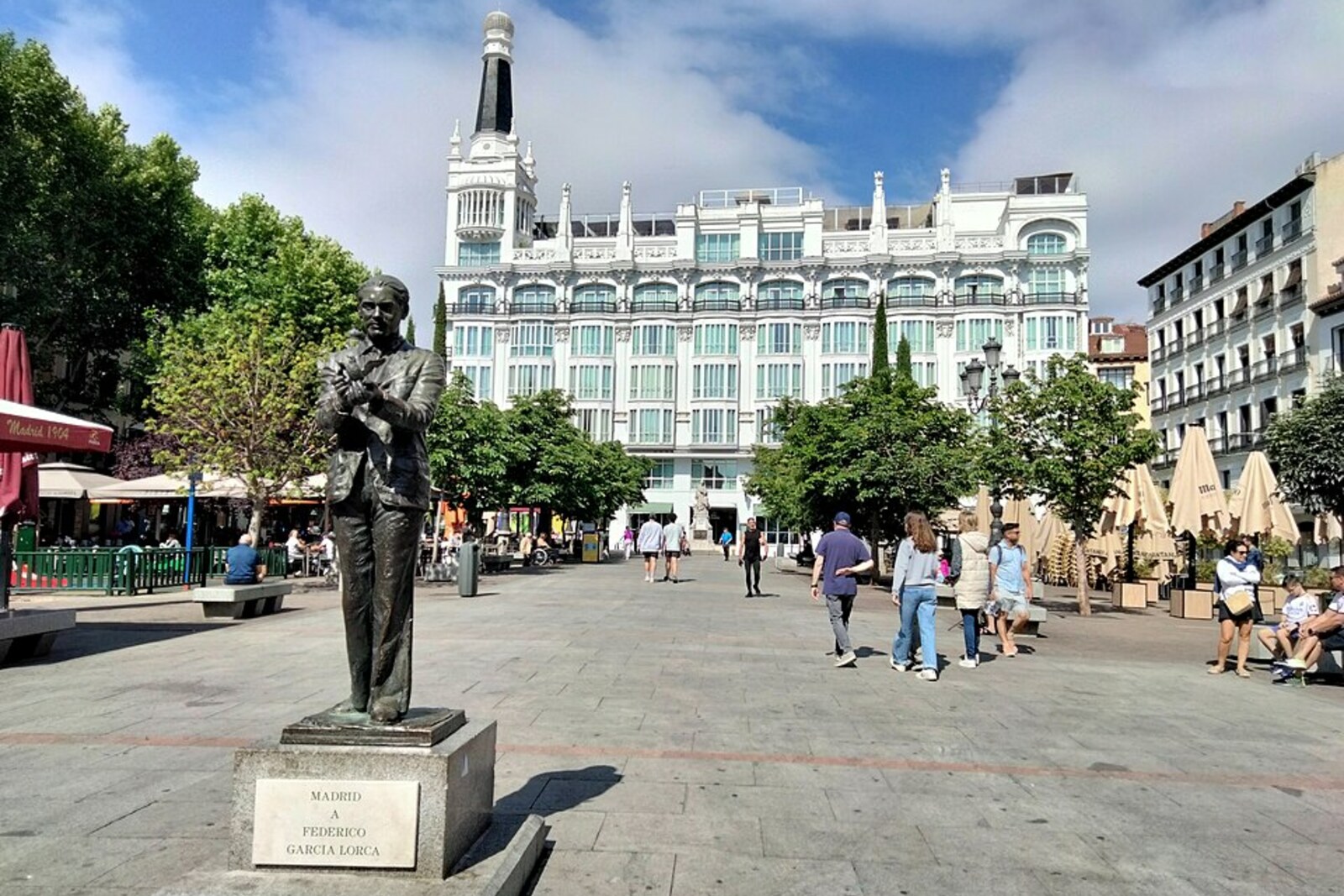
Look around first
What to notice
- Café terraces
- The façade of Teatro Español
- The plaque with the square's name
The story of the place
Beneath the café tables and stone paving, there is no old square. Until the beginning of the nineteenth century, almost all of this site was occupied by the church, cells, garden, and vegetable plot of the Convent of Santa Ana y San José.
Its founder was Ana de Jesús, a Carmelite who sought to carry out Teresa of Ávila's unrealized plan: to establish the first convent of Discalced Carmelite nuns in Madrid. Teresa died without ever receiving permission. Four years later, Ana obtained consent, and in fifteen eighty-six she brought six nuns to the capital. John of the Cross came with her, a priest and one of the founders of the reformed order.
At first, the community settled in another house. The nuns moved to this site in sixteen eleven, when Queen Margaret of Austria provided money to establish a permanent convent. The name “Santa Ana” was chosen in memory of Queen Anne of Austria, who had died shortly before the community was founded; Christians call the mother of the Virgin Mary Saint Anne. Thus the queen's name became the convent's name, and then outlived the building itself.
In eighteen ten, Spain was ruled by Joseph Bonaparte, Napoleon's brother, who had been placed on the throne after the French invasion. He wanted to clear Madrid's cramped center and create open public spaces. Here there was a thoroughly practical reason for such an intervention. The convent wall narrowed the former Calle de la Lechuga and the passage from Calle del Prado, while opposite stood the Coliseo del Príncipe—a theater whose audiences needed proper access and an entrance. It is now Teatro Español.
On June fourth, officials began assessing the convent and neighboring residential buildings: the king intended to clear the entire block. On August tenth, Joseph ordered the convent demolished. The nuns lost the church, cells, and land on which the community had lived for almost two centuries. On September third, another Carmelite convent in Madrid, the Convent of Santa Teresa, took them in. The two communities shared one house for five years. Only in eighteen fifteen were the nuns of Santa Ana able to turn houses they owned on Paseo del Prado into a new convent.
The neighboring residential buildings, marked for demolition along with the convent, were left standing at the time. The first square was therefore noticeably smaller than today's, and a row of buildings still blocked the theater for several decades. They were not demolished until the second half of the nineteenth century; then the open space extended to its present boundary.
Today, bar and restaurant terraces occupy most of the square. A parking garage lies underground, and a roadway has been left along the edge. Nothing of the church, cells, garden, or convent vegetable plot remains on the surface. Their exact site is occupied by the public square that Joseph Bonaparte ordered cleared for passage to the theater. The name of the displaced community remains on the city plaque: Santa Ana.
Useful on site
Open urban space; choose a viewing point that does not obstruct pedestrian flow.
Checked: date not specified. Check the official source before visiting.Listen to the story closer to the center of the square, without blocking the passage between the terraces; all the main landmarks can be seen from outside.