 Guide On Map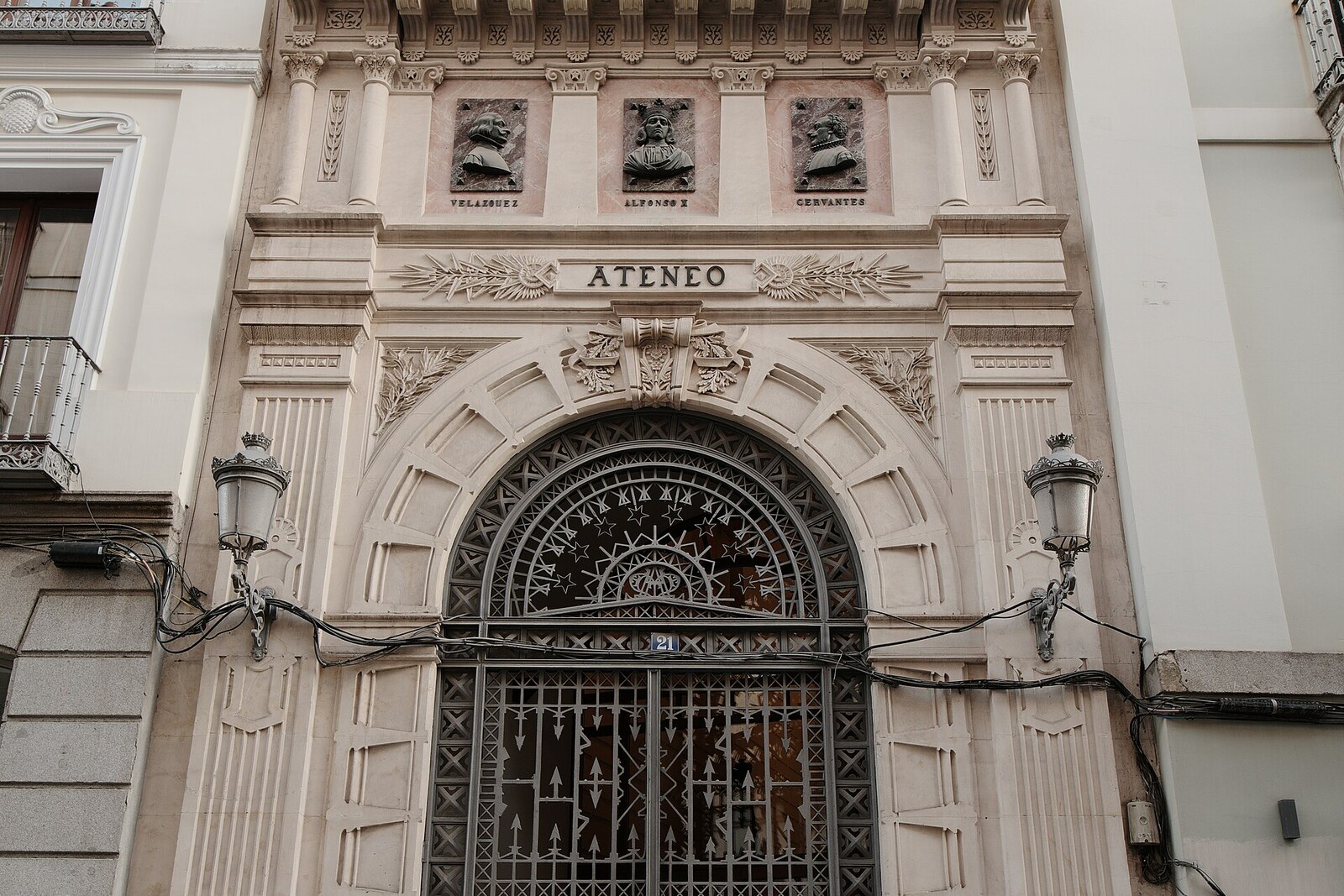
Look around first
What to notice
- Façade of Ateneo de Madrid
- Main entrance
- Portrait gallery
- Portrait of Emilia Pardo Bazán
The story of the place
The façade and main entrance of Ateneo de Madrid conceal a long-standing Madrid club for conversations about books, science, and art. It was founded in eighteen thirty-five for public discussions, and since eighteen eighty-four the society has occupied this building. Members built up a library, organized lectures, and divided into sections, where they themselves chose topics and leaders. Inside hangs a portrait gallery, left by many generations of such gatherings.
In this building, a woman could be paid to give lectures and at the same time not be recognized as a member of the society. In eighteen ninety-seven, Emilia Pardo Bazán, a professional writer and literary critic, gave a course here on modern literature. Eight hundred twenty-five people enrolled for eleven classes. Teachers were paid more than a peseta per minute; for Pardo Bazán, this was real work. Although she came from a wealthy family, the writer sought professional independence and by then maintained that her literary fees covered her personal expenses.
She was given a lectern, but not a membership card. Women were admitted to scientific and literary meetings only at the board's invitation and were assigned the upper gallery. They could listen to the discussion, but not propose a topic, vote, or be elected to the leadership of the sections.
That was how the private cultural society that had occupied this building since eighteen eighty-four was organized. The word “ateneo” derives from the name of a temple of Athena, the ancient Greek goddess of wisdom. Ateneo de Madrid was founded in eighteen thirty-five for open discussion of science and literature; art was added later. Members of the society built up a library, organized lectures, and divided into sections, where they themselves chose topics and leaders. That is why the question of admitting women was decided here—by the votes of those who were already members of the society.
At the beginning of nineteen oh five, fifty-three members demanded that it be determined whether women could join Ateneo de Madrid on equal terms. The board, led by its president Segismundo Moret, agreed. On February ninth, the general meeting approved Emilia Pardo Bazán as the first full female member; she was issued number seven thousand nine hundred twenty-five. She said that she had become the first woman officially to cross the threshold of Ateneo de Madrid. A month later, the writers Blanca de los Ríos and Carmen de Burgos were admitted as members.
Pardo Bazán sought the next right: to lead the literature section herself. She asked Blanca de los Ríos to gather votes for her and acknowledged in a letter that the position would take time away from paid literary work. But she considered the election a step that had to be taken for other women. On June fifteenth, nineteen oh six, the members of Ateneo de Madrid elected her chair of the literature section. Now the writer who had previously been admitted here as an invited lecturer led meetings and guided discussions. She was later elected to this position three more times.
Until two thousand twenty-one, Pardo Bazán's portrait remained the only female face among one hundred eighty-eight portraits in the Ateneo de Madrid gallery. Other women have now appeared beside it, and one of the library rooms bears Pardo Bazán's name.
Useful on site
Open urban space; choose a viewing point that does not obstruct pedestrian flow.
Checked: date not specified. Check the official source before visiting.You can listen to the story outside; the library, rooms, tours, and events have separate access arrangements.