 Guide On Map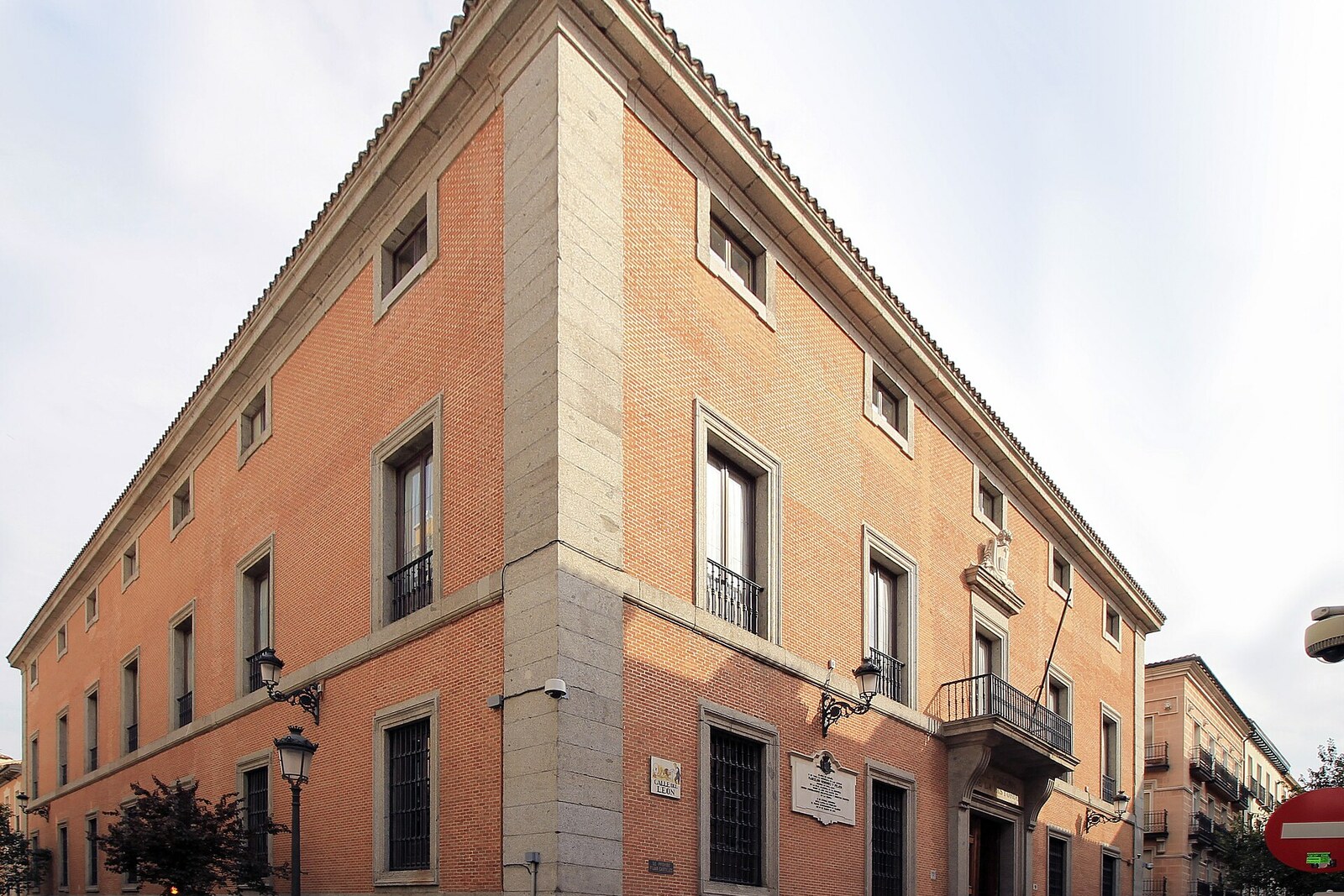
Look around first
What to notice
- Brick façade
- Granite portal
- Stone gridiron of Saint Lawrence
- Grilles on the windows
The story of the place
Above the balcony, the stone gridiron of Saint Lawrence remains, the emblem of the monastery of El Escorial: books for worship were once stored and sold behind these brick walls. The Crown charged the Hieronymites of El Escorial with printing and distributing the new service books throughout the kingdoms of Philip II; the income supported the needs of the monastery and its book collection. The books had previously been kept near San Jerónimo el Real, but that site was given over to the future Prado Museum, and the monks acquired an estate on Calle de León. The paper stock was protected from fire: wooden floors were replaced with brick vaults, and the windows were covered with grilles.
In eighteen sixty-nine, this heavy brick house was shared by people it served in entirely different ways. In the basement and on the mezzanine, members of the Royal Academy of History—scholars collecting documents, old books, coins, and archaeological finds—were crowded together. Part of the ground floor was still occupied by the office for church service books. Coal was sold from the side street, and apartments were rented out above. Even the academicians, along with the other tenants, paid the concierge thirty reals every month.
By then, the scholars had considered the house theirs for thirty-two years. In eighteen thirty-seven, the minister of the interior informed the Academy's director, Martín Fernández de Navarrete, that the government was transferring the building to it. Meetings were then held in the cramped Casa de la Panadería on Plaza Mayor, while the library and coin collection continued to grow. Seven years later, the order was revoked: royal property had laid claim to the house. The academicians received rooms, but not the entire building.
Such persistence was explained by its former purpose. After the Council of Trent, the Catholic clergy were moving to standardized service books—books used to read Mass and the daily prayers. They were called books of the New Prayer Rite. In fifteen seventy-three, King Philip II granted the Hieronymite monks of El Escorial the exclusive right to print, import, and sell these editions in his kingdoms. The income was intended for the monastery's sacristy and library.
At first, the monks kept their Madrid warehouse near San Jerónimo el Real. In the eighteenth century, King Charles III required that site for the Royal Cabinet of Natural History then under construction—the future Prado Museum. The Hieronymites sold the old premises to the Treasury, bought an estate here on Calle de León, and commissioned the court architect Juan de Villanueva to build a new center for selling and storing books.
Villanueva knew that a single fire could destroy all the stock and deprive the monastery of an important income. He dispensed with wooden floors: the stories rested on brick vaults, the windows were protected by grilles, and the granite jambs and lintel of the main entrance were hauled on carts drawn by twenty-eight pairs of oxen. Above the balcony, they placed a stone gridiron of Saint Lawrence—the emblem of El Escorial. From the words “New Prayer Rite,” the house received the name Nuevo Rezado.
In eighteen thirty-six, the government confiscated the property of the dissolved men's monasteries. The Hieronymites lost the warehouse, but the book repository they had designed turned out to be exactly what the Academy needed. Only in eighteen seventy-one did the ministry give the scholars the entire house, specifically stating the reason: the brick vaults left fire almost no way to pass between floors.
The remodeling was directed by Eduardo Saavedra, an Academy member and engineer. He had to cut through those very strong vaults to create a meeting hall. On June twenty-second, eighteen seventy-four, the academicians finally met here together. Now their meetings are held in the house, staff describe and publish manuscripts, maps, and antiquities, and researchers work with the archive. The gridiron of El Escorial remains on the façade, and books are still kept behind walls without wooden floors—only the service books have given way to records of the past.
Useful on site
Open urban space; choose a viewing spot that does not obstruct pedestrian traffic.
Checked: date not specified. Check the official source before visiting.The account is intended to be viewed from the street; access to the library collections should not be considered part of an ordinary walk.