 Guide On Map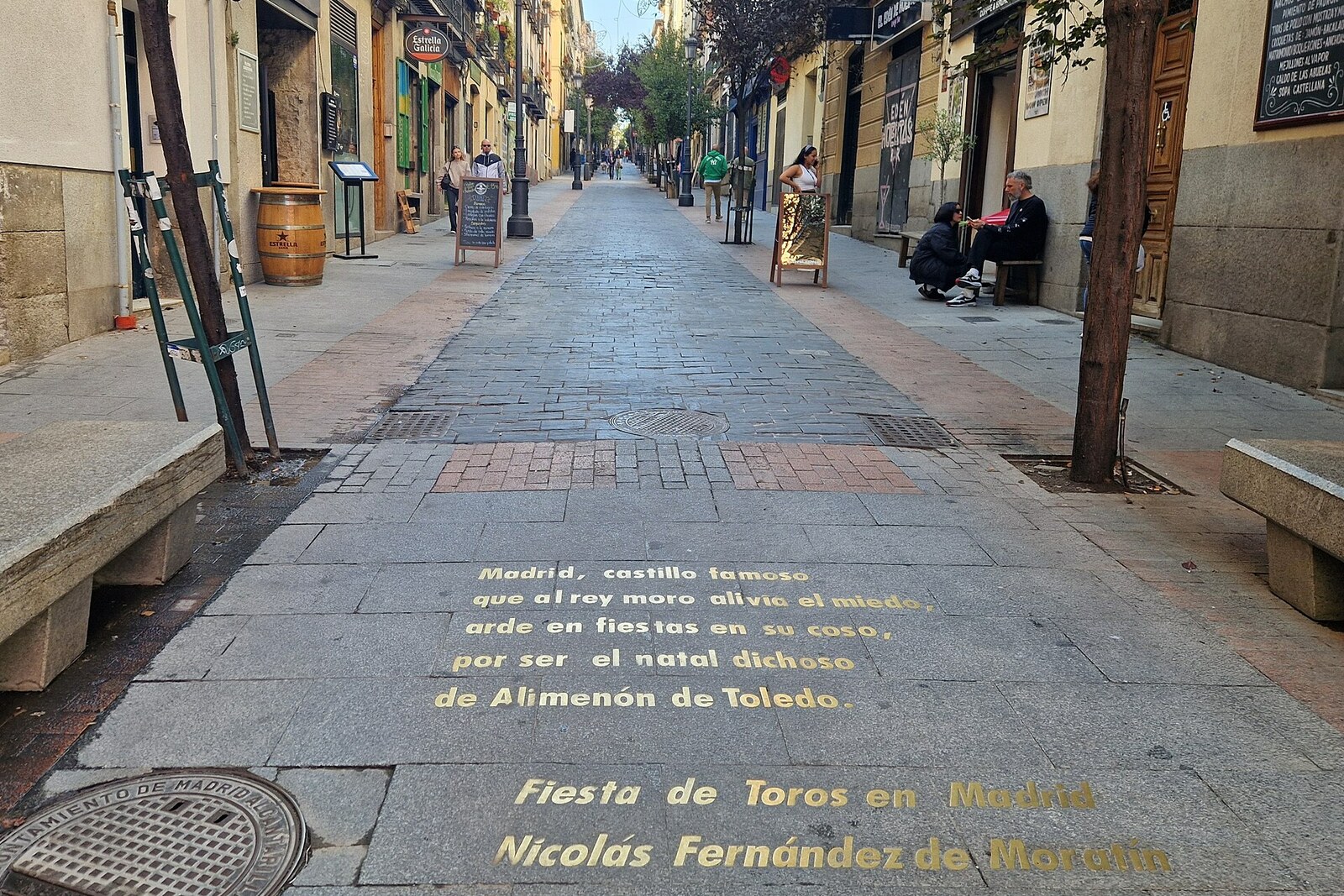
Look around first
What to notice
- The glass walls of the flower shop
- The garden behind the glass
- The sign reading “El Ángel del Jardín”
The story of the place
Calle de las Huertas was named after the vegetable gardens by the Prado. They first belonged to the Marquis of Castañeda, then passed to the monks of the Monastery of San Jerónimo. After the royal court moved to Madrid, houses began to be built along the road, the garden beds disappeared, but the name remained.
At the beginning of the street, by the Church of San Sebastián, a garden can be seen behind the glass walls of a flower shop. In seventeen seventy-one, this was the parish cemetery. San Sebastián served the theater district: its records listed actors’ marriages and deaths, and people of the stage were buried here as well.
On April twenty-second, María Ignacia Ibáñez, the leading actress of Teatro de la Cruz, was brought here. In three years, she had risen from a supporting performer to the leading lady of the company—an actress entrusted with the principal female roles. The stage was her profession and her livelihood.
Her lover José Cadalso served as an army captain and was trying to establish himself as a writer. He wanted to marry María Ignacia, although such a marriage could have cost him his officer’s position: according to biographical accounts, military authorities threatened to dismiss him from the army. Cadalso wrote the tragedy Don Sancho García for her and gave her the central role of Countess Ava. The play was first performed on January twenty-first, seventeen seventy-one. It was withdrawn after five performances. Three months later, María Ignacia died.
After the funeral, Cadalso wrote Lugubrious Nights. The book’s hero hires a gravedigger and comes to the cemetery to open the coffin of the woman he loves. Cadalso himself did not publish the work and did not live to see its success: the first parts were printed seven years after his death, from December seventeen eighty-nine to January seventeen ninety. The book was then reissued many times, and young Romantics read it as the confession of a man who had truly tried to bring back his dead beloved.
Cadalso and Ibáñez’s love, her death, her burial in this cemetery, and the connection between what he experienced and the book are documented. The nighttime visit with a gravedigger is a legend. A detailed account of it appeared in an eighteen twenty-two edition, in a letter by an unnamed friend. The letter’s author himself admitted that he had assembled the story from rumors, fragmentary memories, and other people’s words. That is where the version originated that Cadalso came here to dig up the body, and that the servants of the Count of Aranda stopped him.
The cemetery was later closed. By eighteen thirty, its site had already been turned into a walled garden, and around eighteen eighty-nine a flower shop opened here. It is now called El Ángel del Jardín and occupies house number two on Calle de las Huertas. María Ignacia’s grave has not survived; the glass greenhouse and garden stand where Cadalso buried the actress in life and tried to bring her back in literature.
Useful on site
Open urban space; choose a viewing spot that does not obstruct pedestrian flow.
Checked: date not specified. Check the official source before visiting.Read the inscriptions while standing at the edge of the flow; the street can be crowded, and the bronze figure stands right at the intersection.