 Guide On Map
Taipa and Cotai: From an Island to a Reclaimed City
From Taipa Grande hill through the old settlement to the Cotai Strip
Guide On Map on your phone
Open the walk like a regular app
It takes about 10 seconds to install. No app store needed.
The whole path
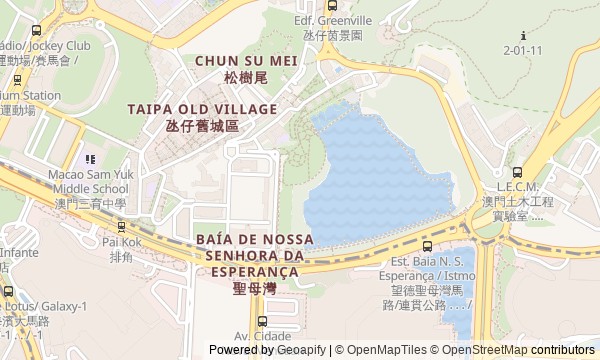
Route map
About the walk
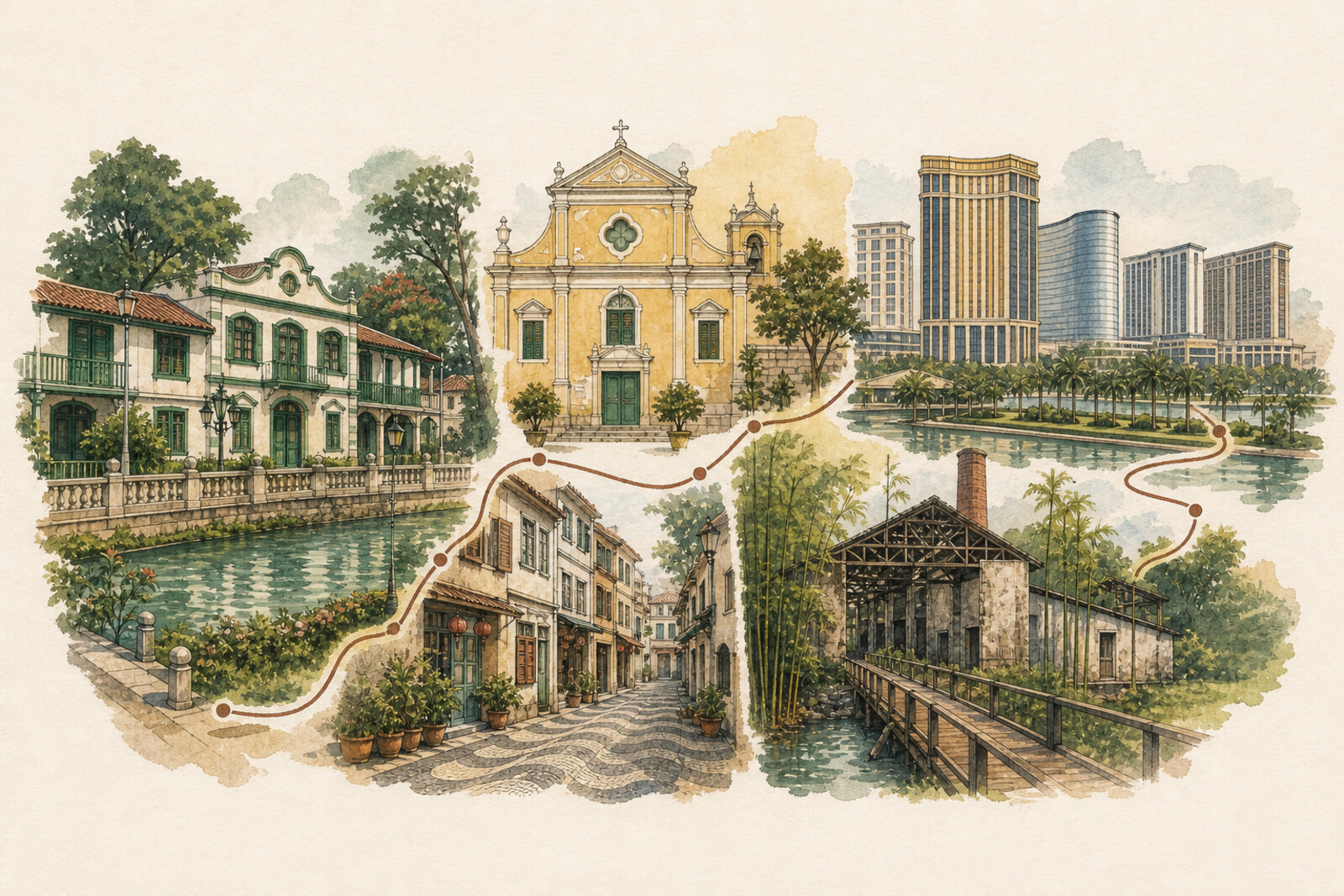
You will begin above Taipa, where the former stretch of sea between the hills can no longer be seen. The road will descend to factory yards, then climb into a garden and pass green official villas. Next come two neighboring worlds from the old settlement: a yellow Catholic church on the hill and a temple by the former bay. Beyond them, you will find an office, a shopping street, and finally Cotai—an immense district between Taipa and Coloane.
The story will stay with things people usually pass by: the closed eyes of a bronze figure, the distances between workshops, an old grille bearing the wrong name for today's shop. You will learn why all of this survived when you get there. No urban legends passed off as documents, and no ceremonial awe.
You will leave with a map of vanished water: where Taipa's shore once lay, where a bay ran between the islands, and where Cotai later rose.
Why this order
The route begins at a height, so you can immediately see Taipa's hills and Cotai between the former islands. The descent to the factory adds an industrial past to that panorama. From the scattered workshops, the road climbs into a garden—from collective production to the personal story behind a city monument. Below stand the homes of those who governed the islands, with the church tied to that same administration above them. The descent from there to Pak Tai Temple places the Catholic and fishing communities side by side. The former office then shows where Taipa and Coloane's affairs came together, while Rua do Cunha returns the story to family craft. A long walk south completes the transition physically: the old island settlement falls behind, and ahead rises a city on land between the islands.
Those who want to understand how Taipa stopped being a separate island Fans of industrial and everyday history Those drawn to the contrast between the old settlement and the Cotai Strip
Those looking only for casinos and shopping malls Those who find climbs, stairs, and the long walk to Cotai difficult Those who prefer a sightseeing overview without stories of production and urban infrastructure
Before you go
Choose comfortable shoes: the route begins with a climb and descent, the middle runs through old streets, and the final stretch feels noticeably more open. Bring water, sun protection, and headphones that let you hear the story without blocking out the sounds around you. In the church and temple, keep quiet, do not stand between worshippers and the altar, and check the photography rules on site. Museum interiors add to the route, but the walk will not fall apart if a building is closed: at most stops, the facade, square, garden, or position relative to the former shore also matters.
When to go
It is best to start in daylight, when distant landmarks can be made out from above and the details of old Taipa are clear without artificial light. For a particularly striking finish, set your pace to reach Cotai at dusk or after the facade lighting comes on.
Backup plan
In poor visibility, do not replace the panorama with guesses: listen to the introduction at the summit, note the nearest elevated landmarks, and save the distant view for another day. In rain, linger longer under available shelters and inside open museums, and keep the garden and panoramic sections shorter. If the church, temple, or factory interiors are inaccessible, stay in the public area and work with what is visible from outside. Heavy rain especially disrupts the final open crossings; in that case, you can finish the route in an accessible covered space in Cotai without seeking out a particular interior.
Route conditions
Elevation. Ascent — 24 m; descent — 44 m
OpenStreetMap extract of June 18, 2026: database data, not a check on the ground. Data © OpenStreetMap contributors, ODbL licence
Walk plan
Open in maps ↗- 1
Miradouro da Taipa Grande
From this height, the geography of the route becomes clear: Taipa's old hills, the built-up lowland, and Cotai. - 2
Iec Long Firecracker Factory
Taipa's industrial growth is evident here in a layout designed so that one accident would not destroy the entire production operation. - 3
Carmo Garden
This stop links a public garden with the fate of a student work that became a permanent monument. - 4
Taipa Houses Museum
Five houses show how officials’ staff housing was preserved as an intact row and turned into a museum. - 5
Our Lady of Carmo Church
The church explains why a small island community had to spend ten years seeking its own parish. - 6
Pak Tai Temple
Here you will see how fishermen, merchants, and artisans together enlarged the settlement’s main sanctuary. - 7
Museum of Taipa and Coloane History
A second administrative layer of Taipa will be revealed beneath the former office, discovered only during the museum’s creation. - 8
Rua do Cunha
The old grille lets you trace how a family tea house became a pastry shop without changing its address. - 9
Cotai Strip
The finale will show how a project on an underwater site set the scale for the entire Cotai Strip.
Route features
Everything you need stays in the browser
Progress, saves and your trip plan are stored on this device.
Add Guide On Map to your home screen so the walk opens outside the browser.
How we handle sources, maps and corrections: our editorial standards