 Guide On Map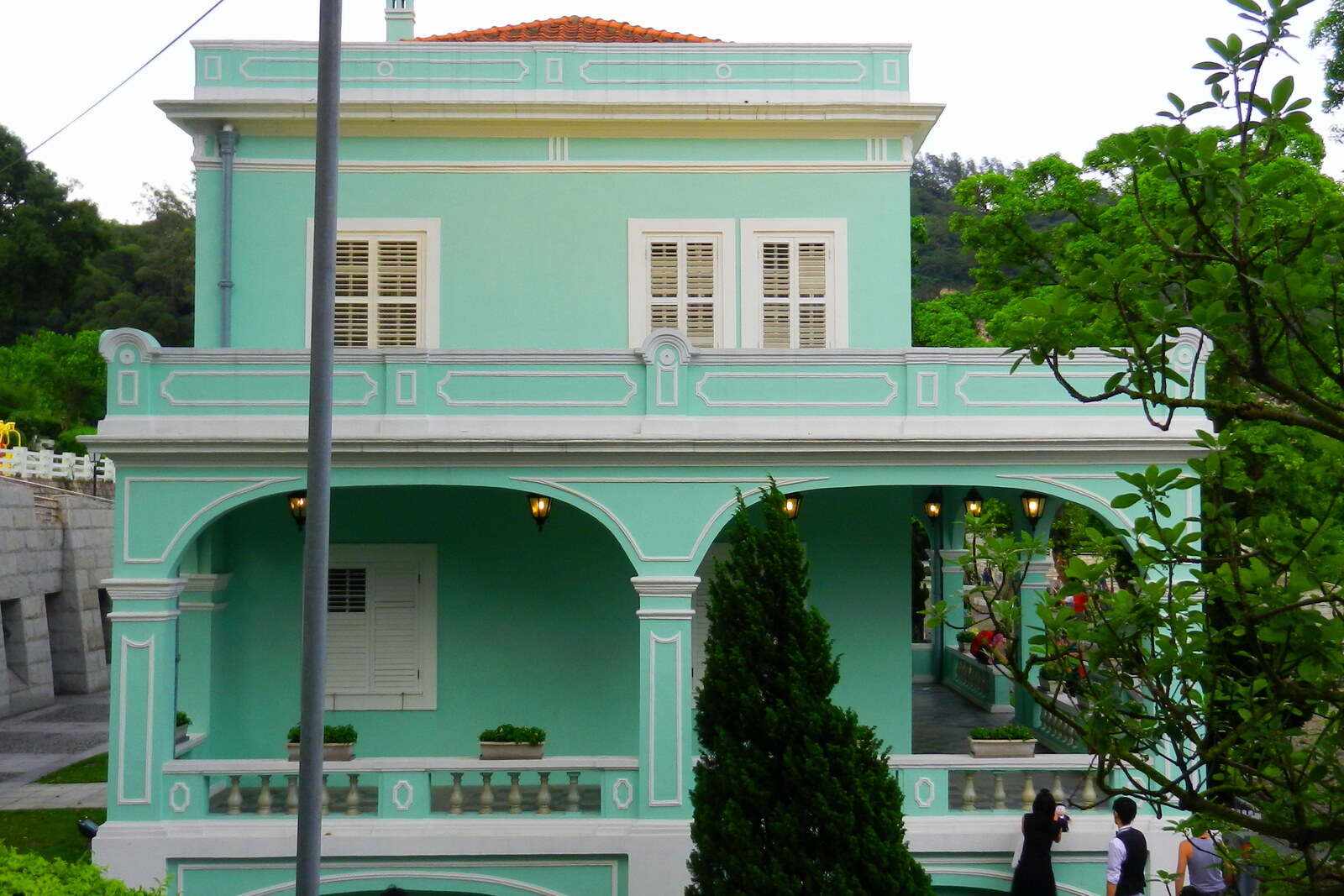
Look around first
What to notice
- Five green villas
- Verandas
- Recreated living rooms
- Former shoreline
The story of the place
Behind the verandas of the greenish row, ordinary family life once went on: five adult couples raised thirteen children here, had dinner together, and travelled to the peninsula. One house now recreates the life of a local family with Portuguese and Asian roots, so its furnishings were assembled by the museum rather than left by the former residents. Another house hosts temporary exhibitions, and the entire row has survived, although its residents moved away long ago.
The five green villas were built in nineteen twenty-one as staff housing. They accommodated officials who administered Taipa and Coloane, police officers, telegraph operators, and doctors. The address still recalls the former geography: Avenida da Praia means Beach Avenue. The shore began in front of the verandas, and Coloane lay across the water opposite.
In nineteen seventy-five, one of the villas was assigned to the doctor Alfredo Ritchie. He was sent to serve the island residents; Alfredo’s wife, the teacher Annabela Ritchie, returned from Portugal with him. The house was part of the assignment: the doctor’s family needed to live near his patients.
At the time, the five villas housed five married couples and thirteen children of roughly the same age. The children spent time together, the adults held shared dinners and travelled together to the Macau Peninsula. In Annabela’s recollections, the residents created a small community here. This explains the name of the complex more accurately than any furniture in the display cases: Taipa Houses Museum was five real homes, not decorative country mansions.
By the early nineteen nineties, the buildings had fallen into disrepair. João Manuel Costa Antunes, director of the tourism service, wanted to preserve the entire row, but families of government employees were still living inside. He reached an agreement with the finance department that no new residents would be housed here: officials replacing the former occupants were given more suitable apartments elsewhere. The houses therefore became vacant gradually, as assignments ended. The process took about four years.
When the last family moved out, the tourism service announced a competition for the redevelopment of the site. Of the three proposals, Costa Antunes’s team chose the project by the architect Maria José de Freitas. At the end of nineteen ninety-nine, the former staff villas opened as a museum complex.
One house now recreates the rooms of a Macanese family—a local community with Portuguese and Asian roots. This is a museum reconstruction, not an untouched apartment of the former residents. The villa where Annabela and Alfredo Ritchie lived became a gallery for temporary exhibitions. The five families and thirteen children are no longer here; all five houses where they lived have survived.
Useful on site
Free admission; open 10:00–19:00, last entry 18:30, closed Monday.
Checked: June 27, 2026. Check the official source before visiting.If the interiors are open, visit them as a separate addition; the history of the former shoreline can also be understood from outside.