 Guide On Map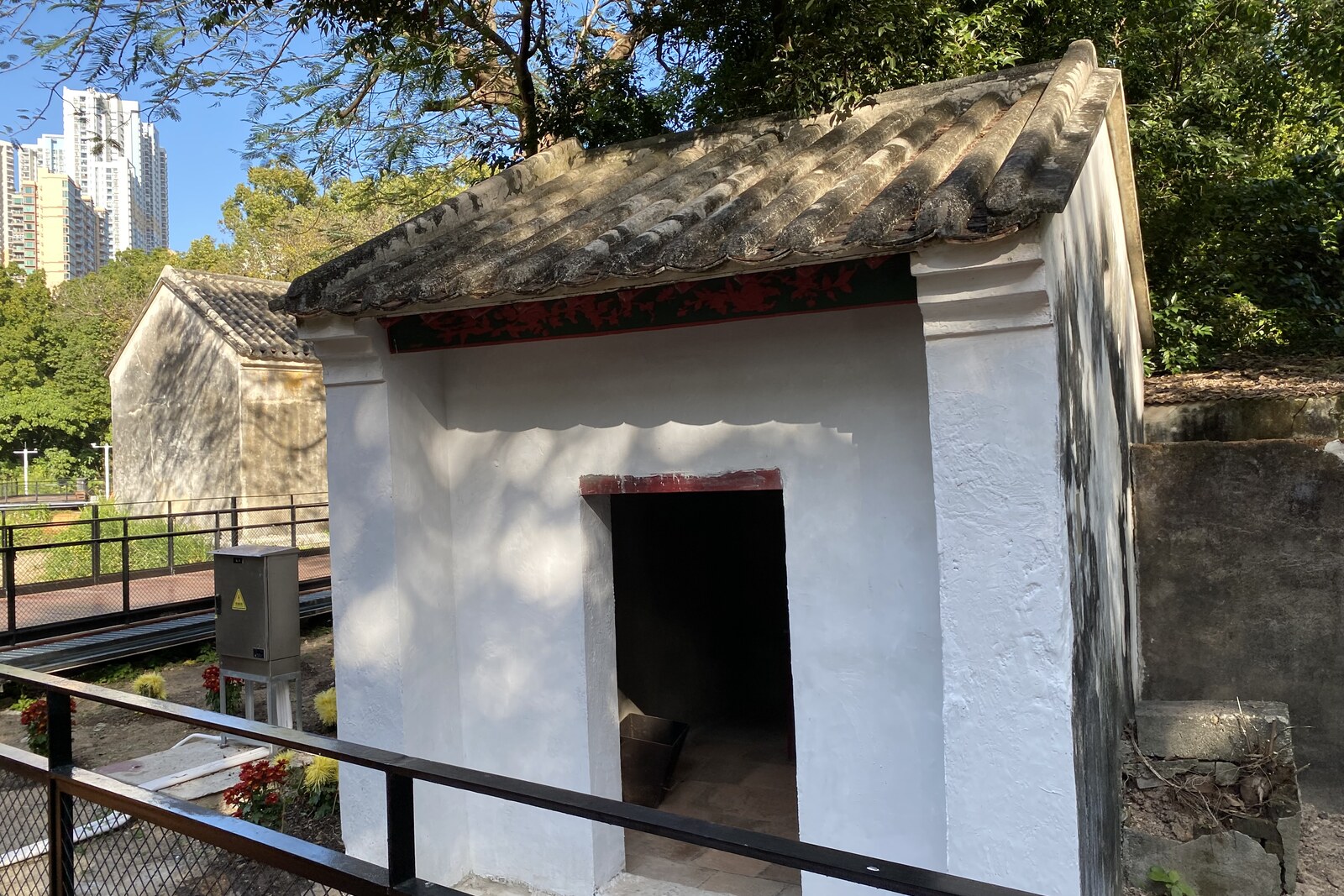
Look around first
What to notice
- Single-story workshops
- Pond
- Water channels
- Path between the buildings
The story of the place
On the grounds of the former firecracker factory, there is a pond and channels made as a reserve of water in case of fire. More than thirty former workshops and warehouses stand along today's approximately four-hundred-meter path. When the factory was operating, several hundred people made firecrackers here for Hong Kong, countries of Southeast Asia, Europe, and America. Production stopped in nineteen eighty-four, but the pond, channels, and buildings remain part of the walking route.
Single-story buildings scattered among the trees made up one factory. In one room, workers glued fuses; in another, they filled paper tubes with gunpowder, then crimped them, tied them into long strings, and packed them. Between neighboring operations, they had to carry semi-finished products across the yard. This inconvenient layout was created here for the sake of distance: an explosion in one workshop was not supposed to reach the others.
The factory was opened by pyrotechnics merchant Tang Bik Tong. He was already making money from firecracker production in Foshan and Nanhai, and in September nineteen twenty-five he received permission to move part of the business to Macau. Shortly before that, an explosion at a pyrotechnics factory on the Macau Peninsula had killed more than one hundred people. The Portuguese administration began pushing dangerous production out to less built-up Taipa. That is how Tang ended up here, on land by the water, where he could spread out the workshops and create a pond with channels for firefighting.
Tang called his first enterprise "Iec Long." At first, it occupied only a few rooms. On November twenty-sixth, nineteen twenty-eight, gunpowder exploded in one of the workshops. Six workers died and many were injured; the fire destroyed part of the buildings. For Tang, this meant the possible loss of his permit and of the entire Macau enterprise, based on one dangerous product.
He attended to the victims, rebuilt the factory, and secured the resumption of work. During the expansion, the most dangerous operations were placed in separate small buildings. The pond was kept as a water reserve, warehouses were separated from rooms where gunpowder was handled, and each successive stage of production was moved farther away from the preceding one. Workers had to walk more, but a single spark could no longer immediately destroy all the stock and everyone in the production chain.
The factory grew to several hundred workers and produced firecrackers for shipment to Hong Kong, Southeast Asia, Europe, and America. After demand fell, Tang's heirs stopped production in nineteen eighty-four. Today, a four-hundred-meter path passes more than thirty workshops, warehouses, water channels, and a pond. It follows the distances by which Tang Bik Tong separated production after the deaths of six workers.
Useful on site
Free admission. The wooden trail is open daily 06:00–19:00; the exhibition hall and souvenir shop 10:00–19:00, until 15:00 on Wednesdays.
Checked: June 27, 2026. Check the official source before visiting.Stay on the open visitor routes and behind the barriers: old production buildings may be inaccessible or unsafe without accompaniment.