 Guide On Map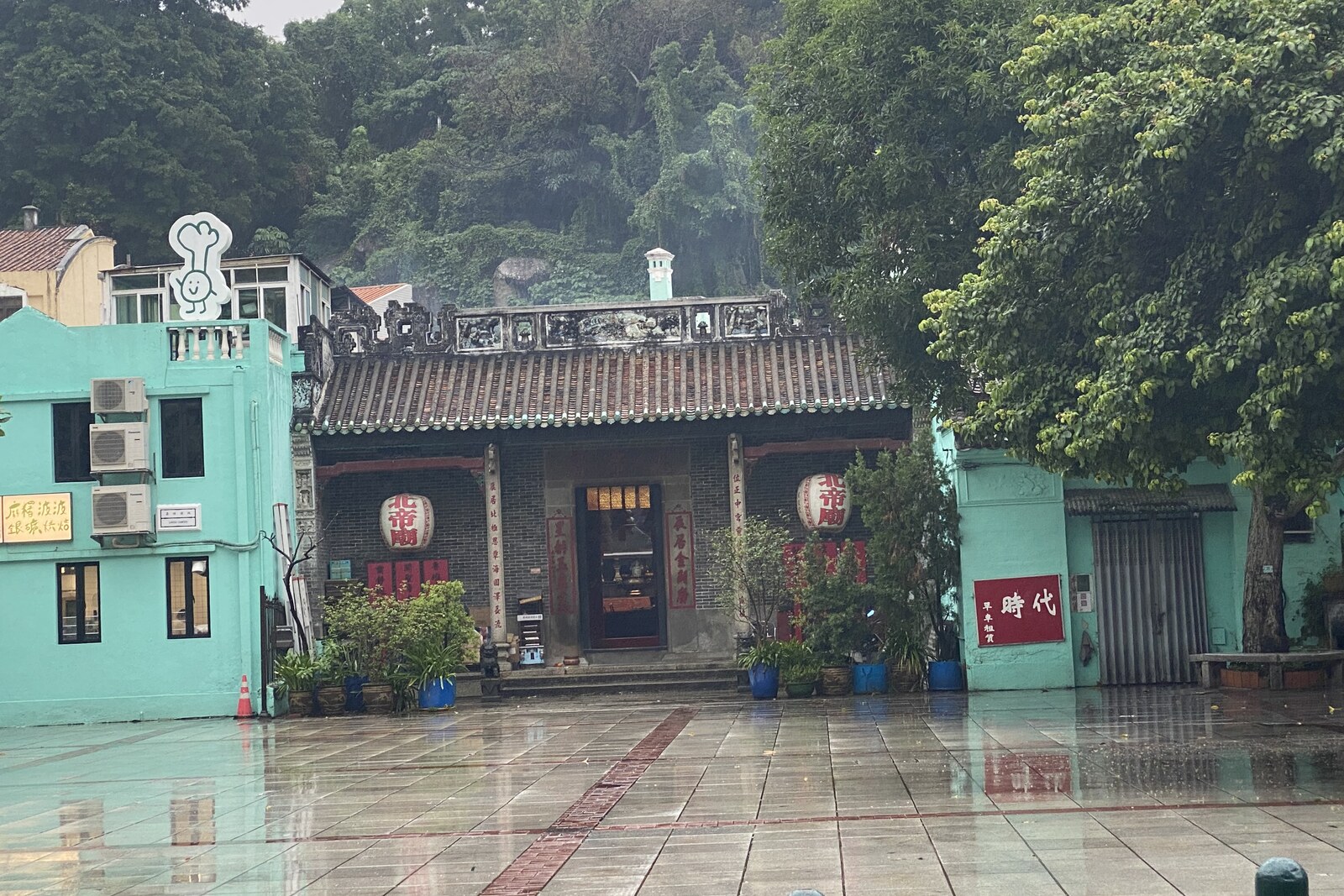
Look around first
What to notice
- Figure of Pak Tai
- Turtle and snake
- Stone tablet
- Altars
The story of the place
The temple stands on the former shore of a small bay: the sea has retreated behind reclaimed land and blocks of buildings, but the main entrance still faces the place where fishermen dried their nets and craftsmen repaired boats. Today’s square was once the settlement’s working edge, from which families went out to sea and where they waited for the catch to return. The stone tablet by the temple preserves an old record of donations, and the altars remain inside. During the temple festival, a temporary bamboo theater for Cantonese opera is erected in the square.
In the main hall, Pak Tai sits with his feet on a turtle and a snake. Pak Tai is the Cantonese name for the Northern Emperor, a Taoist deity credited with the power to subdue water and fire. The turtle and snake are his symbols, so the figure could be recognized even without an inscription.
Taipa’s residents chose this patron for very practical reasons. When they built the temple between eighteen forty-three and the beginning of eighteen forty-four, the shore of a small bay lay in front of it. Fishermen dried their nets where today’s square stands, while craftsmen repaired boats nearby. Families lived on the catch and waited for the boats to return intact. They asked Pak Tai for suitable weather, protection from floods and fires, and a safe return from the sea. The main entrance therefore faces the former water.
About forty years later, the temple needed help from its worshippers themselves. The walls still stood, but the roof structures had weathered, and the central hall was cramped and shallow. The temple stewards and the owners of forty-five local shops organized a fundraising drive. For a small settlement, this was a shared expense for fishermen, merchants, and artisans, whose earnings depended on one another: without boats there was no catch, and without a catch there were no customers in the shops.
The rebuilding was completed in the spring of eighteen eighty-two. Almost everything that had been collected was spent on it. The worshippers received a more spacious sanctuary, and the altars installed then remain in the temple. A stone tablet with a record of the fundraising was placed beside it. Researchers use its inscription to determine the temple’s founding date: no earlier document with an exact date has yet been found.
The shore has retreated behind reclaimed land and development, and boats are no longer repaired in front of the entrance. But the square is still needed by the temple. On the third day of the third lunar month, residents celebrate Pak Tai’s birthday: a temporary bamboo theater is erected before the facade, and Cantonese opera is performed for several evenings. The troupe performs in gratitude to the deity, and the human audience watches the same performance after the deity.
Useful on site
Open daily 08:30–17:00.
Checked: June 27, 2026. Check the official source before visiting.Enter only areas accessible to visitors, do not block the altar, and do not touch the offerings; during the festival, keep the passageways clear.