 Guide On Map
Alfama: from Portas do Sol to Castelo de São Jorge
From Portas do Sol through the cathedral and lower Alfama to the castle
Guide On Map on your phone
Open the walk like a regular app
It takes about 10 seconds to install. No app store needed.
The whole path
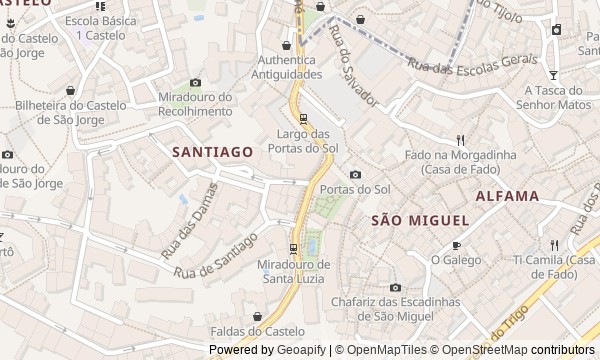
Route map
About the walk
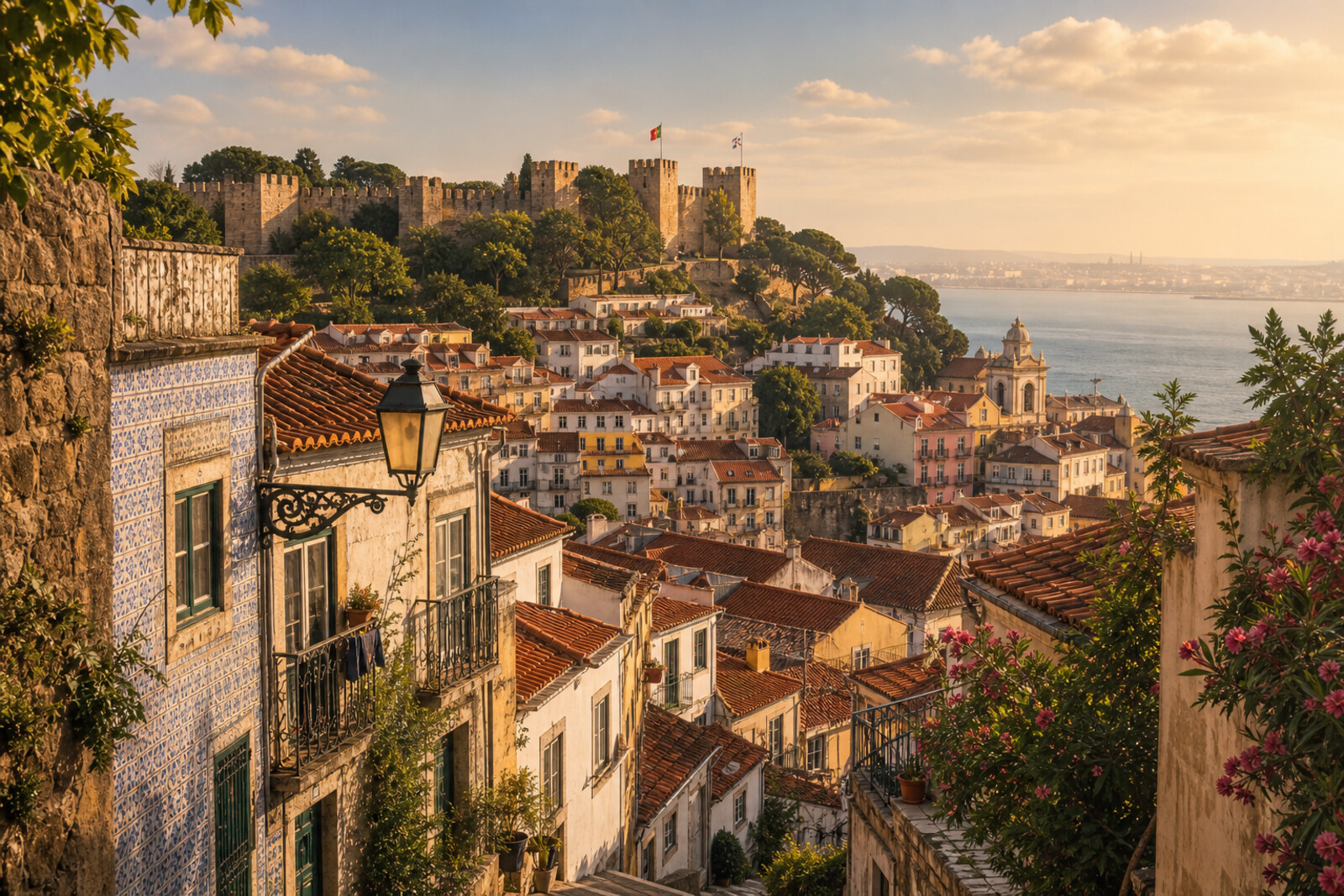
You will begin above Alfama’s rooftops, at the site of vanished eastern gates. Then you will follow the old line of the wall to a church garden and descend to 2 neighboring sanctuaries: Lisbon Cathedral and the Church of Saint Anthony. Lower down, the hill will lead to a former pumping station, where fado turns up among archives and classrooms. After that, the road rises again, through the parish of Church of São Miguel and on to Castelo de São Jorge.
This is not a walk through postcard “old Lisbon,” but through a city that had to be held, surrendered, reclaimed, and pieced back together with money, again and again. Why would silent bells prove more dangerous than weapons? Why would the head of a brotherhood be threatened with prison over an altar? And how could a fortress surrender before a siege engine reached its walls?
The story will separate documents from legend and trace major ruptures through small decisions. By the end, you will be able to read the slope of Alfama as a system of gates, parishes, and refuges—and explain why the castle above them once defended itself against Lisbon itself.
Why this order
Portas do Sol sets out the line of the vanished fortifications and reveals the eastern approach to the city. Nearby Miradouro de Santa Luzia continues along the same wall, but shifts the story from conquest to a place the Knights Hospitaller lost and won back. The descent to Lisbon Cathedral then moves from the city’s defenses to the power of bells and the bishop’s seat during another crisis. The neighboring Church of Saint Anthony replaces high politics with a household collection by the city to restore a church. From here the route heads lower, to the Fado Museum: after a church community comes a professional one, deciding whether its craft could be entrusted to researchers. The climb to Church of São Miguel returns to parish Alfama and reveals a conflict within the commission for an altar. The castle closes the route because it joins the eastern wall from the first stop to the December revolt at the cathedral: below, the city chooses a side, while above, the fortress is still waiting for permission to surrender.
Those interested in sieges, urban revolts, and the decisions of ordinary participants Those who want to cross Alfama from its viewing terraces to its lower parishes Those who enjoy telling documented events apart from later legend
Those expecting a level walk without stairs and climbs Those looking only for easy panoramas without weighty historical conflicts Those who want a detailed history of fado rather than a story about preserving a craft
Before you go
Choose shoes with a reliable grip on smooth stone paving, and bring water before the climb back up from lower Alfama. Lisbon Cathedral, the Fado Museum, the Church and Museum of Saint Anthony, Church of São Miguel, and the castle each require different amounts of time and may not be fully accessible, so check visiting conditions for your chosen day in advance. Do not build the walk around a promise to see every interior: the facades, squares, and city terrain are an important part of the story in their own right. At religious sites, allow for a quiet visit without disrupting services.
When to go
Start in the first half of the day if you want to combine the museum stops with the castle without rushing. The first 2 terraces need only short pauses, but Lisbon Cathedral and the Fado Museum can easily extend the overall duration. The most demanding stretch begins after lower Alfama: save some energy and time for Church of São Miguel, and do not reduce the finale in the fortress to a single look from the panoramic wall.
Backup plan
If Lisbon Cathedral or the churches are closed inside, keep the route’s order and work with what is visible from the street: the heavy facade of Lisbon Cathedral, the site of Saint Anthony’s house, the climb to Church of São Miguel, and the pattern of the neighborhood. If time is short, choose 1 detailed interior—the Fado Museum or the castle—instead of trying to rush through both. In rain, take particular care on descents and stairs; you can postpone the lower section by the museum while keeping the upper sequence of terraces, Lisbon Cathedral, and the approach to the fortress. If the castle is inaccessible, end the route by its gates and piece together the hill you have crossed from its outer walls and surrounding streets.
Route conditions
Surface. Paved — 1.9 km (data covers 82% of the route)
Stairs. Flights: 8, 154 m in total
Access. Wheelchair — no; stroller — limited (stairs)
Facilities. Toilets — 12; drinking water — 8
Elevation. Ascent — 80 m; descent — 52 m
OpenStreetMap extract of June 18, 2026: database data, not a check on the ground. Data © OpenStreetMap contributors, ODbL licence
Walk plan
Open in maps ↗- 1
Miradouro das Portas do Sol
This point establishes the route’s main theme: the vanished passage can explain the hill’s layout better than the better-preserved arch. - 2
Miradouro de Santa Luzia
Here the military frontier gives way to the story of how a church site can be lost for a century and regained. - 3
Lisbon Cathedral (Lisbon Cathedral)
This stop will show how city rumor and someone else's decision could turn the main church into a trap. - 4
Church of Saint Anthony
Here, a major urban catastrophe comes down to a domestic way of raising money for a shared shrine. - 5
Fado Museum
A former utility building will show how performers agreed to entrust their craft to an archive. - 6
Church of São Miguel
You will need the interior to hear not only the names of the craftsmen, but also the dispute over the price of work already completed. - 7
Castelo de São Jorge
The finale will bring the cathedral revolt and the fortress walls together in a single December denouement.
Route features
Everything you need stays in the browser
Progress, saves and your trip plan are stored on this device.
Add Guide On Map to your home screen so the walk opens outside the browser.
How we handle sources, maps and corrections: our editorial standards